 Greece · 15th century
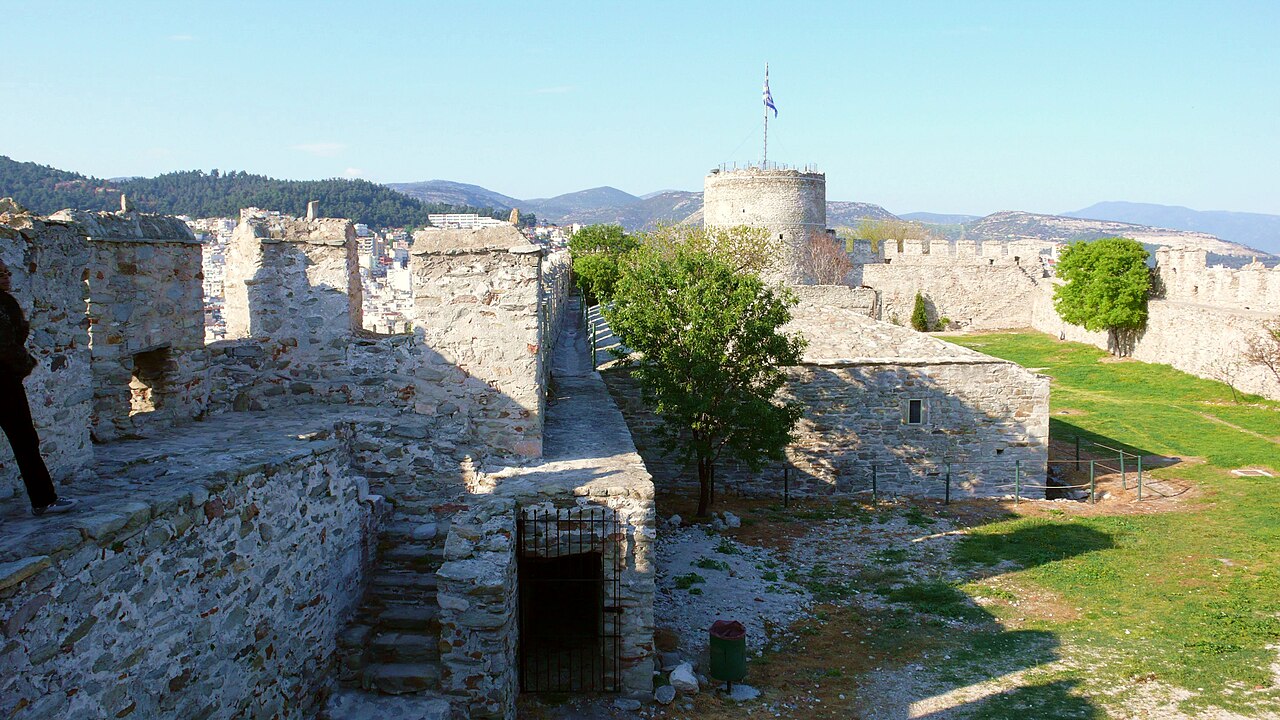
Kavala Fortress is built on the summit of the Panagia peninsula, at the site called "Akropolis". It was built in 1425 on the ruins of the Byzantine acropolis of Christoupolis, which had been destroyed in 1391.
It is a fortified enclosure, which follows the configuration and the slope of the ground and is divided into two parts by a transverse wall. The walls are reinforced by two square towers, by a polygonal one at roughly the middle of the eastern curtain, and by a bastion at the south-eastern corner. The purpose of the fort was to control the passage of the Via Egnatia. The fort has a natural fortification, and the sieges were conducted with "cold steel" weapons and not with cannon of destructive power.
In the walls of the outer enclosure of the acropolis two square towers and one polygonal tower stand out. The fortress has a circular tower, which constituted the last space of defence, a store for ammunition and supplies which was later converted into a prison, a guardhouse which was a suitable space for quarters, and a water cistern.
Machine-translated from “Φρούριο Καβάλας” on the Greek Wikipedia, CC BY-SA 4.0.
Kavala Fortress ranks #4,980 of 9,035 worldwide in the atlas's castle fame ranking, and #66 of the 133 mapped in Greece. Founded 1425, it is older than 49% of the atlas's dated landmarks, one of 556 atlas entries founded in the 15th century. See how Greece compares in the castle statistics.
View on the interactive castle map →