 Poland · 17th century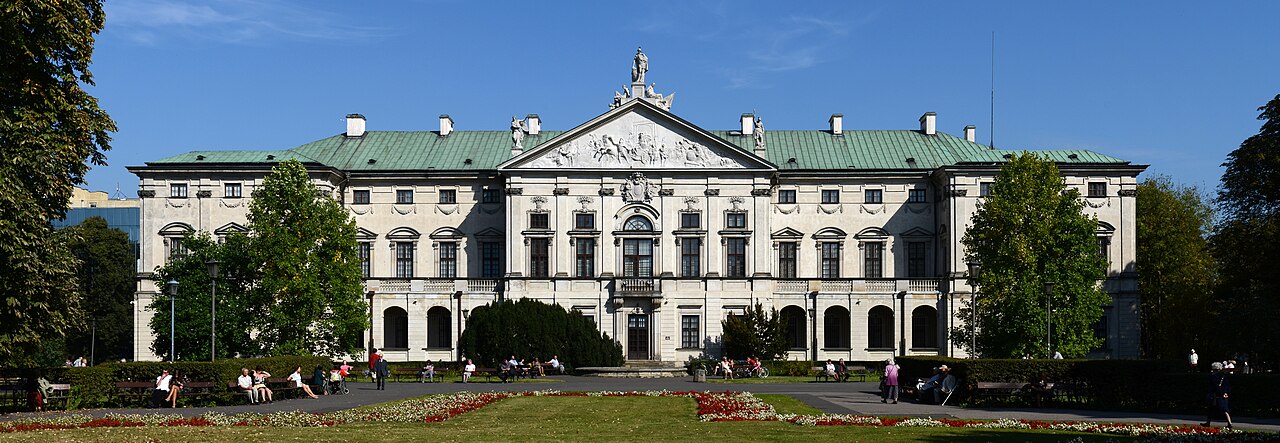
The Krasiński Palace (Polish: Pałac Krasińskich), also known as the Palace of the Commonwealth (Polish: Pałac Rzeczypospolitej), is a reconstructed Baroque palace in Warsaw, Poland, on Krasiński Square (Plac Krasińskich). Initially erected between 1677 and 1683 for the powerful Krasiński family, it was heavily damaged during World War II and rebuilt in the mid-20th century.
The palace was built in 1677–83 for the Voivode of Płock, Jan Dobrogost Krasiński, according to design by Tylman van Gameren. It was decorated with pediment reliefs showing the triumph of the legendary "ancestor" of the Ślepowron and Korwin Polish clans, the Roman commander Manius Valerius Maximus Corvinus Messalla (263 BC) and sculptural work, all by Andreas Schlüter.
Jan Dobrogost Krasiński, who also served as the royal clerk (Referendarz), was a descendant of old Mazovian nobility and an heir to a large fortune. After his father's death he wished to erect a magnificent residence in the capital which was to fulfill his excessive political ambitions and show his enormous pride, which made him cultivate and develop a 16th-century legend about the antique origin and alleged royal connections of his family.
Krasiński was well acquainted with French culture and architecture; he was interested in hiring qualified and renowned French artists and architects that would perform the work. He kept a detailed accountancy book in which he systematically recorded progress in construction. The whole idea was realized according to the design of Tylman van Gameren. He was of Dutch origin, educated in Italy, and he was brought to Poland by the Lubomirski family. He made a large number of various designs for Lubomirskis, the Royal Family, the representatives of different noblemen and gentry families as well as for the Catholic Church.
Some Warsaw architects were also employed to build the palace as building contractors, as suppliers of materials or to control the master craftsmen, bricklayers or artisans. These people were Joseph Bellotti, Jacob Solari, Izydor Affaita and Maderni. The main role in decorating the palace was played by German sculptor, Andreas Schlüter, who had previously cooperated with Tylman.
The first floor porte-fenêtre (vertical French door and window) was crowned with a cartouche supported by two angels bearing the founder's monogram JK for Jan Krasiński.
Text adapted from “Krasiński Palace” on Wikipedia, CC BY-SA 4.0.
Krasiński Palace ranks #906 of 9,079 worldwide in the atlas's castle fame ranking, and #26 of the 398 mapped in Poland. Founded 1683, it is older than 23% of the atlas's dated landmarks — one of 721 atlas entries founded in the 17th century. Its Wikipedia articles were opened 5,255 times in the last 60 days, more than 87% of the atlas. 47 more atlas landmarks stand within 25 km. The nearest day-trip guide is Warsaw, 2 km away. See how Poland compares in the castle statistics.
View on the interactive castle map →