 Scotland · 19th century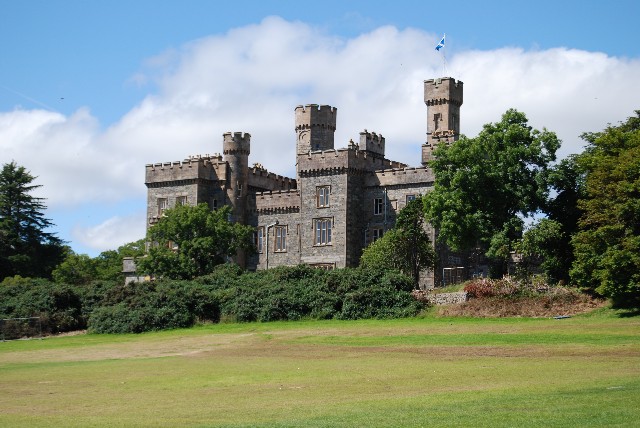
Lews Castle (Scottish Gaelic: Caisteal Leòdhais) is a Victorian era castle located west of the town of Stornoway, Isle of Lewis, Scotland. It was built in the years 1844–51 as a country house for Sir James Matheson who had bought the whole island a few years previously with his fortune from the Chinese opium trade. It was designed by the Glasgow architect Charles Wilson.
In 1918, the Lews Estate, including the castle, was bought by industrialist Lord Leverhulme from the Matheson family. He gave the castle to the people of Stornoway parish in 1923.
During the Second World War the Castle was taken over as accommodation for air and ground crew of 700 Naval Air Squadron, which operated a detachment of six Supermarine Walrus aircraft from a slipway at Cuddy Point in the Grounds. The base was referred to as HMS Mentor.
After the war, the Castle was used for accommodation for students of Lews Castle College in the 1950s. After the accommodation closed, the building was left disused for several decades.
The building, which is protected as a category A listed building, is now owned by the local council, Comhairle nan Eilean Siar. On 22 November 2011 Lews Castle was awarded £4.6 million by the Heritage Lottery Fund to enable it to be converted into a bilingual museum and cultural centre. In 2016, the ground floor of the castle, including a restored ballroom and a cafe, reopened to the public. In 2017, Natural Retreats, a luxury holiday property company, opened apartments in the castle.
Text adapted from “Lews Castle” on Wikipedia, CC BY-SA 4.0.
Lews Castle ranks #1,734 of 9,079 worldwide in the atlas's castle fame ranking, and #59 of the 226 mapped in Scotland. Founded 1844, it is older than 9% of the atlas's dated landmarks — one of 717 atlas entries founded in the 19th century. Its Wikipedia articles were opened 2,969 times in the last 60 days, more than 78% of the atlas. It is one of the 76 landmarks on the atlas's regional map of the Scottish Highlands. See how Scotland compares in the castle statistics.
View on the interactive castle map →