 Germany · 12th century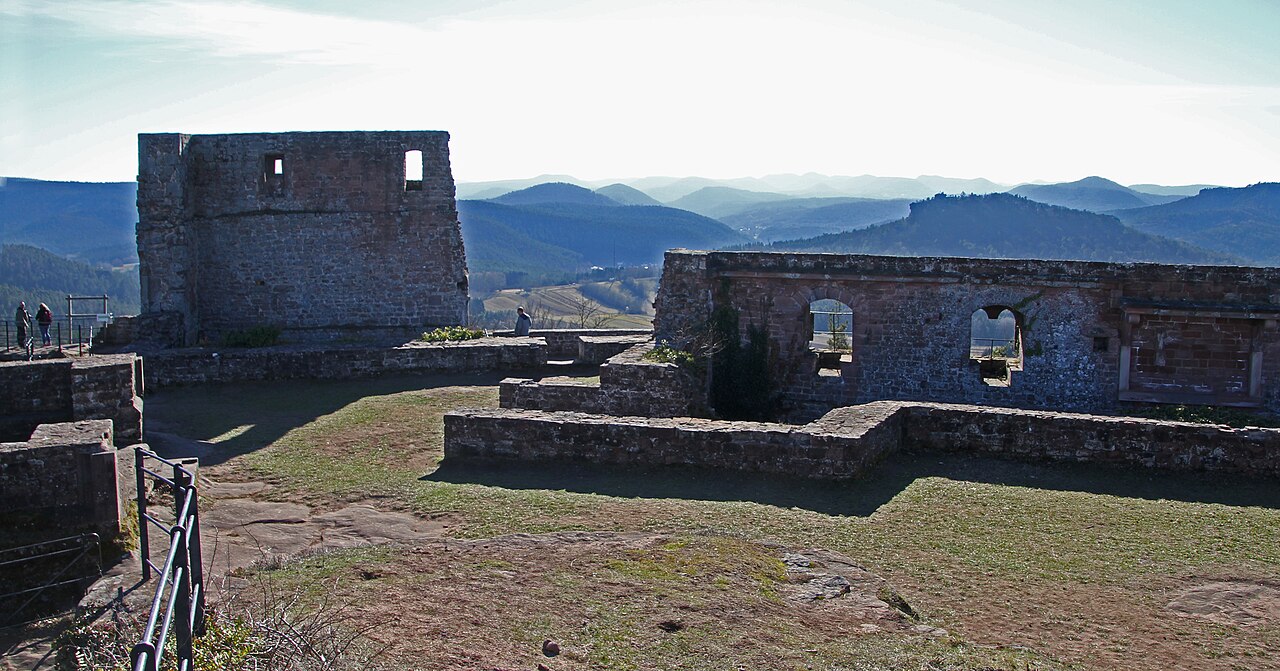
Lindelbrunn Castle (German: Burg Lindelbrunn) (also called Lindelbol, Lindelbronn or Lindelborn) is the medieval ruin of a rock castle near the village of Vorderweidenthal in the county of Südliche Weinstraße in the German state of Rhineland-Palatinate.
The name of the castle is probably derived from the castle well which stands under a large lime tree (German: Linde).
The ruins of Lindelbrunn lie about 2.3 km northeast of Vorderweidenthal, on whose territory they stand, and 1.7 km (both as the crow flies) south-southeast of Darstein. It is located at a height of 437.6 m above sea level (NHN) on the conical summit of the Schloßberg ("castle hill"). At its foot is a forester's lodge and a tourist café, the Cramerhaus, formerly belonging to the Palatine Forest Club.
Lindelbrunn Castle was founded in the middle of the 12th century, presumably as an imperial castle to defend the Trifels. Prior to that, it may have been owned by the imperial church at Speyer. In 1268 the ministerialis, Dieter von Lindelbol, is mentioned for the first time in the records as a descendant of the imperial seneschal (Reichstruchseß), Markward von Annweiler (ca. 1140–1202). It is likely that the main construction phase of the castle with its palas and separate chapel dates to around 1190/1200. At that time, large halls and independent chapels were only built by relatively high-ranking lords; around 1200, not a single count had such facilities.
In 1274 the castle was transferred by King Rudolph of Habsburg to Counts Emich IV and Frederick III of Leiningen. In the course of time, Lindelbrunn became a joint-inheritance or Ganerbenburg. As a result of the enfeoffment of various parts of the castle, there were so many co-owners that disputes arose. In 1381, St. Nicholas' Chapel was first mentioned in a deed. In 1441, troops of the Palatine prince-elector and the Bishop of Speyer, Reinhard von Helmstatt besieged the castle for seven weeks until a peaceful agreement ended the investment.
Shortly after Easter 1450, as a result of a feud and the seizure of Hans von Helmstadt, troops from the town of Landau and Bishopric of Speyer advanced on the castle. After four days of unsuccessful siege, Holzapfel was ransomed. In June that year, Count Emich VI of Leiningen-Hardenburg and his son, Frederick of Zweibrücken-Bitsch, besieged the castle, captured it and so ended the disputes.
Text adapted from “Lindelbrunn Castle” on Wikipedia, CC BY-SA 4.0.
Lindelbrunn Castle ranks #5,533 of 9,079 worldwide in the atlas's castle fame ranking, and #475 of the 711 mapped in Germany. Founded c. 1150, it is older than 80% of the atlas's dated landmarks — one of 756 atlas entries founded in the 12th century. Its Wikipedia articles were opened 1,518 times in the last 60 days, more than 62% of the atlas. 31 more atlas landmarks stand within 25 km. The nearest day-trip guide is Kaiserslautern, 35 km away. See how Germany compares in the castle statistics.
View on the interactive castle map →