 Germany · 13th century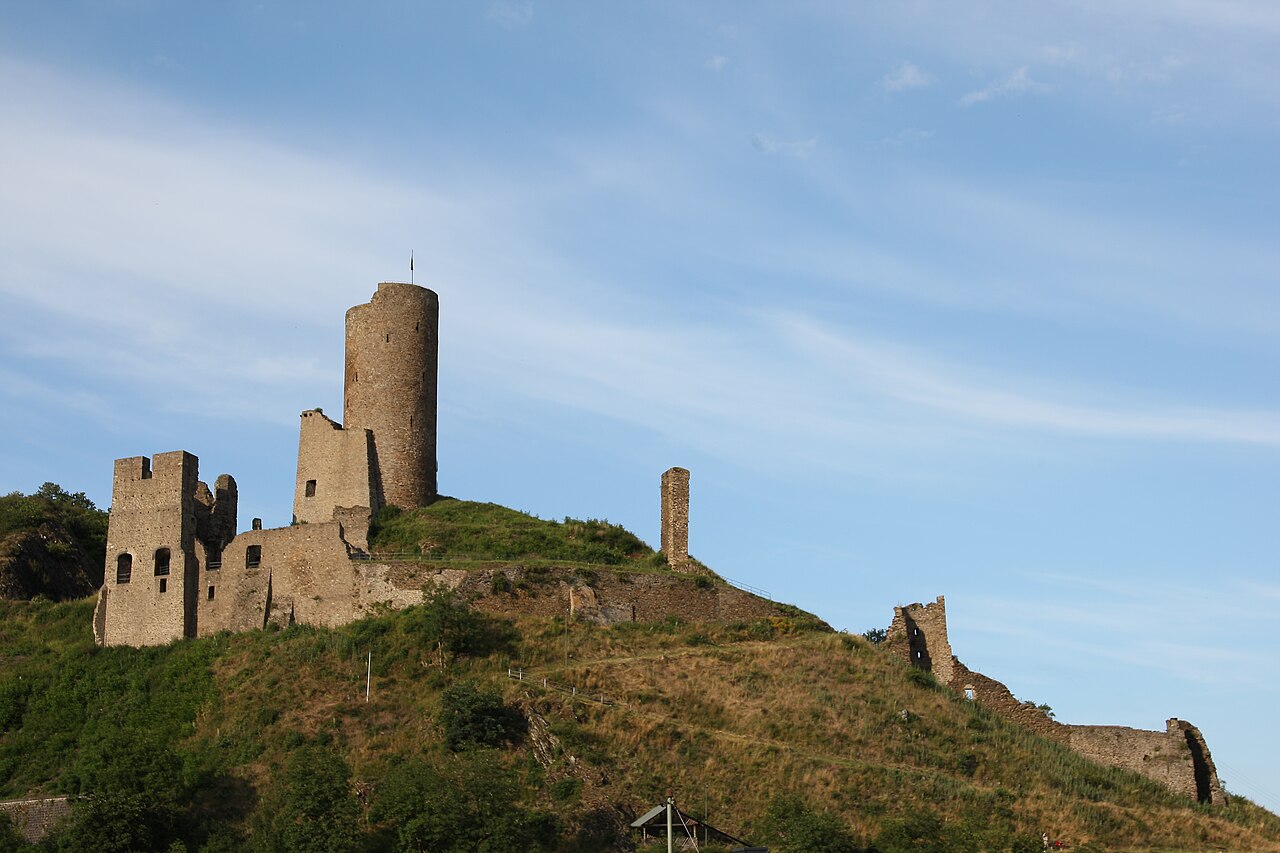
On a hill spur above the Eifel village of Monreal in Germany's Elzbach valley, at a height of 350 m above sea level (NHN), stand two neighbouring ruined hill castles: the Löwenburg, also called Monreal Castle (German: Burg Monreal), and the Philippsburg. The latter is also known locally as das Rech (the Deer).
The spur castle of Löwenburg was first recorded in 1229. Its builder was Count Hermann III of Virneburg, who ironically built it on the territory of his brother, Philip, following a partition agreement. The resulting fraternal feud was subsequently settled later, however, in a legal treaty and Philip relinquished his rights over the region to his brother.
The Philippsburg was also built in the 13th century. Its small size, in comparison with the Löwen (lion) gave rise to its local nickname, the Rech (deer). There are two different theories about its existence: one views the Phillipsburg simply as an advanced work or outwork of the Löwenburg; according to local tradition, however, the castle was Philip's answer to the unauthorised construction of the Löwenburg by his brother.
Although Monreal was on the territory of the Electorate of Trier, the counts of Virneburg always enjoyed good relations with the Electorate of Cologne. Their aim was, first and foremost, to secure ecclesial benefices for the numerous descendants of the Virneburg counts. For example, Henry II of Virneburg, born in 1244 or 1246, was initially the cathedral dean in Cologne. In 1306, at the age of about 60, he was elected as Archbishop of Cologne and held the office for 26 years. He had the task of consolidating the Cologne Erzstift in the decades after the Battle of Worringen in 1288 and the subsequent loss of power.
As a result of the close relations of the Virneburgs to Cologne and the fact that Henry II of Virneburg carried out constant attacks on the nearby Electoral Trier town of Mayen, a feud broke out between the Archbishop of Trier and the Virneburgs. At the behest of the Archbishop of Cologne, the two parties reached an agreement to the effect that Henry II would turn the Monreal castle into a fief of Trier after the death of his father, Robert III of Virneburg. This was done. The Virneburgs subsequently acquired ecclesial offices in Trier as well; in the 14th century alone, they provided six members of the cathedral chapter.
Text adapted from “Löwenburg and Philippsburg” on Wikipedia, CC BY-SA 4.0.
Löwenburg and Philippsburg ranks #6,357 of 9,079 worldwide in the atlas's castle fame ranking, and #558 of the 711 mapped in Germany. Founded 1229, it is older than 73% of the atlas's dated landmarks — one of 1080 atlas entries founded in the 13th century. 18 more atlas landmarks stand within 25 km. The nearest day-trip guide is Koblenz, 32 km away. It is one of the 51 landmarks on the atlas's regional map of the Moselle. It is stop 16 of 36 on the Moselle castle route, Trier to Koblenz. See how Germany compares in the castle statistics.
View on the interactive castle map →