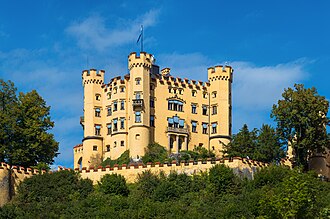
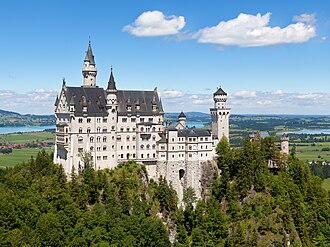
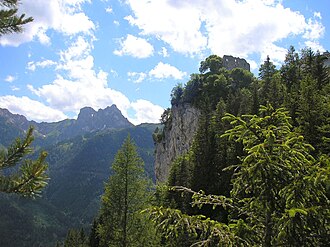
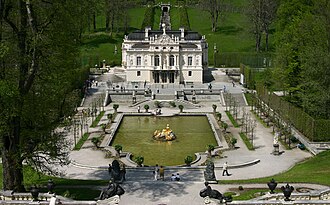
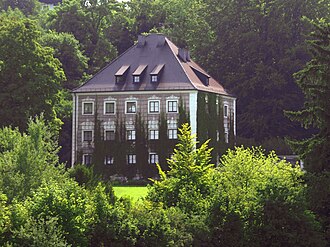
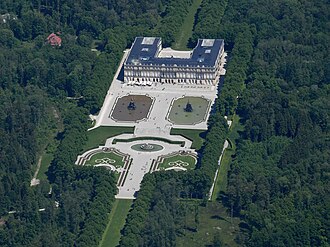
Ludwig II of Bavaria spent his own fortune and then the state’s on three castles in seventeen years, and was declared insane and deposed in 1886. Neuschwanstein was built as a stage set for Wagner and draws almost a million and a half visitors a year; Linderhof is the only one he lived to see finished; Herrenchiemsee is a copy of Versailles on an island, and it bankrupted him. He grew up in Hohenschwangau, which his father had built on the ruins of an older castle; he bought the ruin of Falkenstein for a fourth castle that was never begun; and he drowned in the lake below Berg the day after he was deposed.
What this atlas maps on Ludwig II’s castles
Every stop is named in the route itself rather than chosen by a radius, spanning 13th century to 19th century.
The best known is Neuschwanstein Castle, ranked 8 of the 9,035 landmarks in the atlas by Wikipedia presence and real readership. The oldest is Falkenstein Castle (Pfronten), founded 1280.
The route runs through Germany.
Travelling it
Hohenschwangau and Neuschwanstein share one village and one ticket office, with Falkenstein twenty kilometres west above Pfronten; Linderhof is an hour east by road over the Ammergau, Berg is on the Starnberger See, and Herrenchiemsee is reached by boat from Prien.
Day-trip guides for the towns and cities along it: Munich.
See the route on the map →