 France · 12th century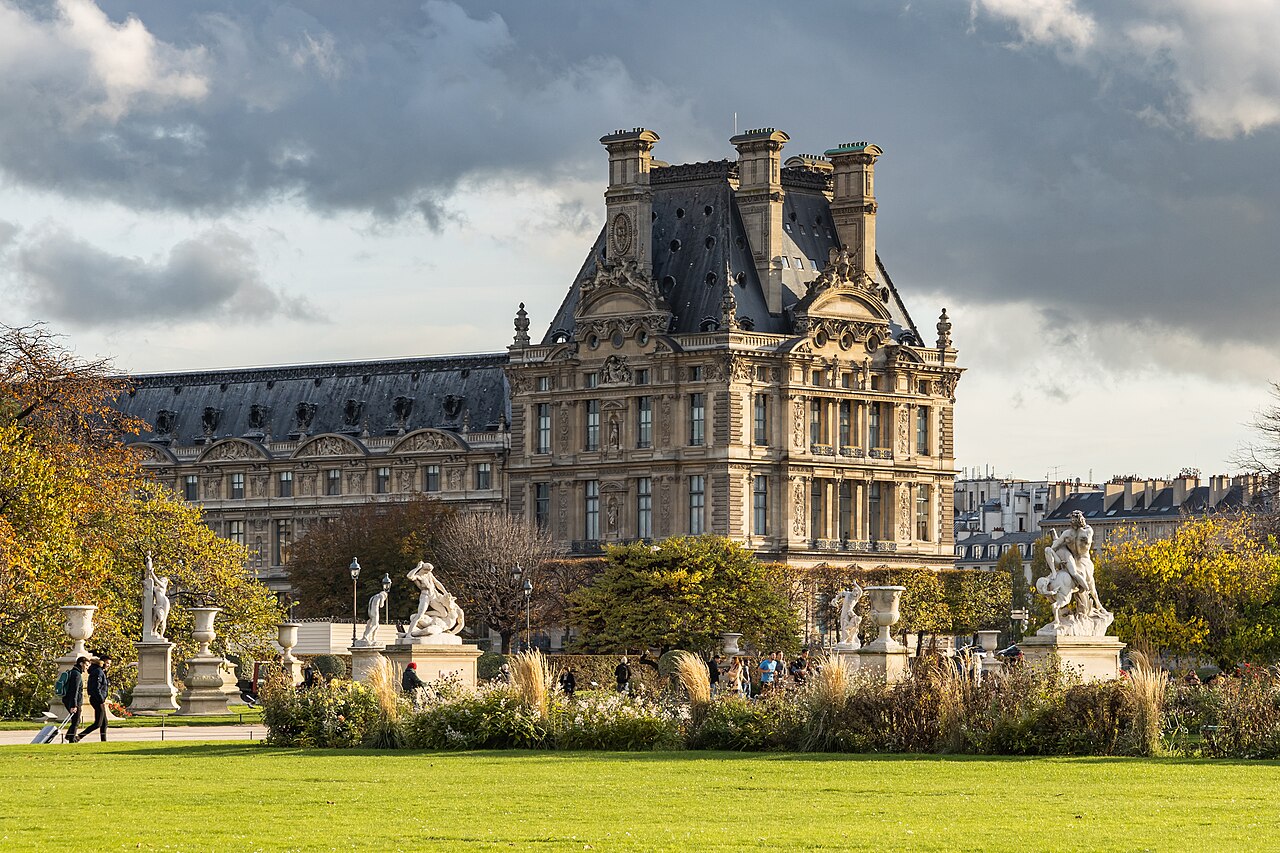
The Louvre Palace (French: Palais du Louvre, [palɛ dy luvʁ]), often referred to simply as the Louvre, is a palace located on the Right Bank of the Seine in Paris, occupying a large expanse of land between the Tuileries Gardens and the church of Saint-Germain l'Auxerrois. Originally a defensive castle, it has served several government-related functions in the past, including intermittently as a royal residence between the 14th and 18th centuries. It is now mostly used by the Louvre Museum, which first opened there in 1793.
While this area along the Seine had been inhabited for thousands of years, the Louvre's history starts around 1190 with its first construction as the Louvre Castle defending the western front of the Wall of Philip II Augustus, the then new city-wall of Paris. The Louvre's oldest section still standing above ground, its palatial Lescot Wing, dates from the late 1540s, when Francis I started the replacement of the greatly expanded medieval castle with a new design inspired by classical antiquity and Italian Renaissance architecture. Most parts of the current building were constructed in the 17th and 19th centuries. In the late 20th century, the Grand Louvre project increased visitor access and gallery space, including by adding the Louvre Pyramid in the courtyard Cour Napoléon.
For more than three centuries, the history and design of the Louvre was closely intertwined with that of the Tuileries Palace, created to the west of the Louvre by Queen Catherine de' Medici in 1564, with its main block finally demolished in 1883. The French Renaissance style Tuileries was the premier seat of French executive power during the last third of that period, from the return of Louis XVI and his court from Versailles in October 1789 until the palace was set on fire during the Paris Commune of 1871.
Text adapted from “Louvre Palace” on Wikipedia, CC BY-SA 4.0.
Louvre Palace ranks #98 of 9,079 worldwide in the atlas's castle fame ranking, and #13 of the 793 mapped in France. Founded c. 1190, it is older than 78% of the atlas's dated landmarks — one of 756 atlas entries founded in the 12th century. Its Wikipedia articles were opened 43,320 times in the last 60 days, more than 99% of the atlas. 44 more atlas landmarks stand within 25 km. The nearest day-trip guide is Paris, 1 km away. See how France compares in the castle statistics.
View on the interactive castle map →