 Israel · 1st century BC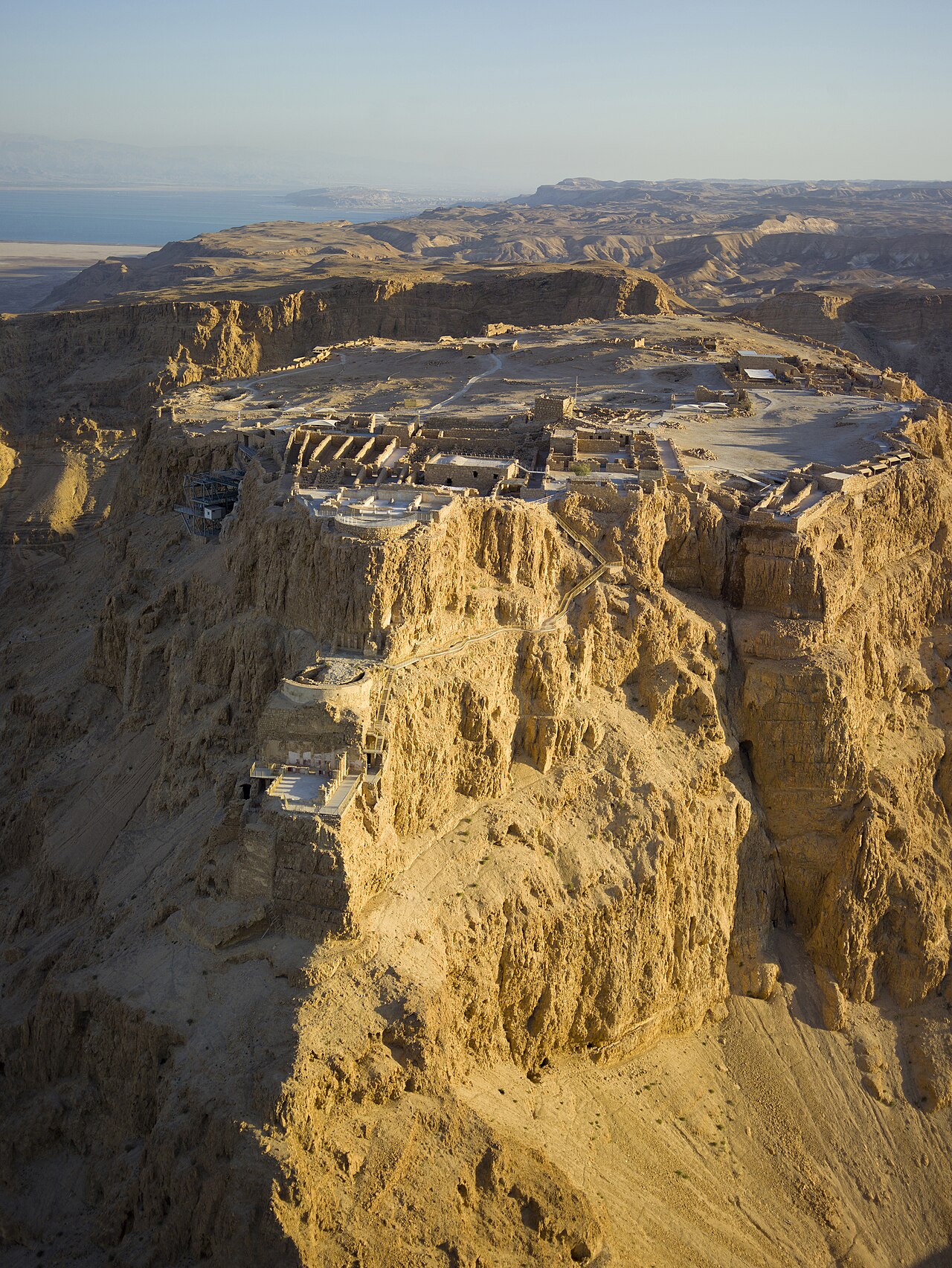
Masada (Hebrew: מְצָדָה məṣādā, 'fortress'; Arabic: جبل مسعدة, romanized: jabal musayda, lit. 'mount museida') is a mountain-top fortress complex in the Judaean Desert, overlooking the western shore of the Dead Sea in southeastern Israel. The fort, built in the first century BC, was constructed atop a natural plateau rising over 400 m (1,300 ft) above the surrounding terrain, 20 km (12 mi) east of modern Arad.
The most significant remains at the site date to the reign of Herod the Great, King of Judaea under Roman administration c. 37–4 BC, who transformed Masada into a fortified desert refuge early in his rule. He enclosed the summit with a casemate wall and towers, and constructed storerooms, an advanced water system, and bathhouses, along with two elaborate palaces: one on the western side and another built across three terraces on the northern cliff. These palaces remain among the finest examples of Herodian architecture.
Masada is most renowned for its role during the First Jewish–Roman War (66–73 AD), when it became the final holdout of Jewish rebels following the destruction of Jerusalem. A group known as the Sicarii, a radical faction led by Eleazar ben Ya'ir, defended the site against the Roman Tenth Legion under Lucius Flavius Silva. The Romans laid siege by building a circumvallation wall and a massive ramp. According to Josephus, when the walls were breached in 73/74 AD, the Romans found nearly 1,000 inhabitants had died by mass suicide—a claim that remains debated among historians. In modern times, the story of Masada was interpreted as a symbol of heroism that became influential in early Israeli national identity.
Text adapted from “Masada” on Wikipedia, CC BY-SA 4.0.
Masada ranks #27 of 9,079 worldwide in the atlas's castle fame ranking, and #1 of the 23 mapped in Israel. Founded c. 37 BC, it is older than 98% of the atlas's dated landmarks — one of 16 atlas entries founded in the 1st century BC. Its Wikipedia articles were opened 53,749 times in the last 60 days, more than 99% of the atlas. The nearest day-trip guide is Yatta, 29 km away. It is one of the 106 landmarks on the atlas's regional map of the Levant. See how Israel compares in the castle statistics.
View on the interactive castle map →