 Israel · 1st century BC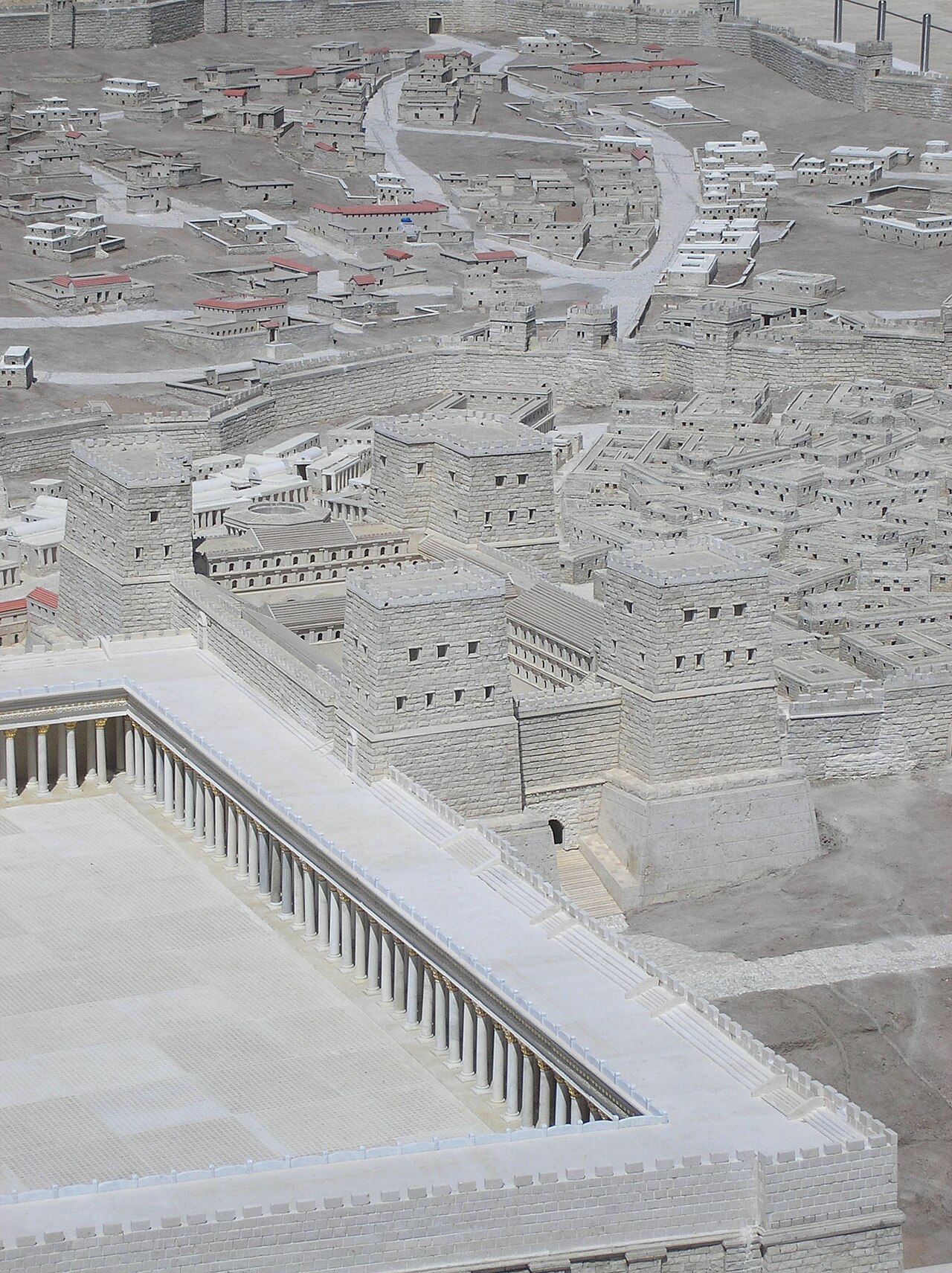
The Antonia Fortress (Aramaic: קצטרא דאנטוניה) was a citadel built by Herod the Great and named for Herod's patron Mark Antony, as a fortress whose chief function was to protect the Second Temple. It was built in Jerusalem at the eastern end of the Second Wall, at the north-western corner of the Temple Mount, and was connected to the Temple by porticoes.
Herod (r. 37 – c. 4 BC) built the fortress to protect the Temple. He named it for his patron Mark Antony (83–30 BC).
The fortress was one of the last strongholds of the Jews in the Siege of Jerusalem (70 AD), when the Second Temple was destroyed.
The construction date is controversial because the name suggests that Herod built Antonia before the defeat of Mark Antony by Octavian in 31–30 BC and Mark Antony's suicide in 30 BC. Herod is famous for being an apt diplomat and pragmatist, who always aligned himself with the winning side and the "man in charge" of Rome. It is somewhat difficult to bring this date in accordance with the presumed date for the construction of the Herodian Temple.
Traditionally, Christians have believed for centuries that the vicinity of the Antonia Fortress was the site of Pontius Pilate' praetorium, where Jesus was tried for high treason. This was based on the assumption that an area of Roman flagstones discovered beneath the Church of the Condemnation and the Convent of the Sisters of Zion was 'the pavement' which John 19:13 describes as the location of Jesus' trial.
Pierre Benoit, former professor of New Testament studies at the École Biblique, reexamined the results of all previous surveys of the north-western escarpment of the Haram, of the archaeological studies of the sites owned by the Catholics in the area (Convent of the Sisters of Zion, Flagellation Monastery and St Anne Convent of the White Fathers), as well as the digs north of the Struthion Pool area, and published in 1971 his conclusions: Archaeological investigation indicates that about a century after the presumed time of Jesus' death, this area was rebuilt as the eastern of two forums belonging to the new city initiated by Hadrian in around 130 AD, the Aelia Capitolina, and it is conceivable that following the destruction of the Antonia Fortress during the siege of 70 AD, its pavement tiles were reused at Hadrian's forum.
Text adapted from “Antonia Fortress” on Wikipedia, CC BY-SA 4.0.
Antonia Fortress ranks #518 of 9,079 worldwide in the atlas's castle fame ranking, and #5 of the 23 mapped in Israel. Founded 37 BC, it is older than 98% of the atlas's dated landmarks — one of 16 atlas entries founded in the 1st century BC. Its Wikipedia articles were opened 8,486 times in the last 60 days, more than 92% of the atlas. 7 more atlas landmarks stand within 25 km. The nearest day-trip guide is Jerusalem, 1 km away. It is one of the 106 landmarks on the atlas's regional map of the Levant. See how Israel compares in the castle statistics.
View on the interactive castle map →