 Portugal · 19th century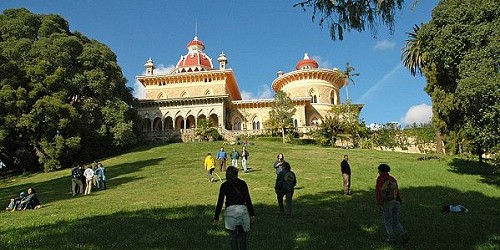
The Monserrate Palace (Portuguese: Palácio de Monserrate) is a palatial villa located near Sintra, the traditional summer resort of the Portuguese court in the foothills overlooking the Atlantic Ocean north west of the capital, Lisbon.
According to legend, there was a chapel dedicated to Virgin Mary built by Afonso Henriques after the reconquest of Sintra (circa 1093). On its ruins another chapel dedicated to Our Lady of Monserrate was constructed on the top of the hill in 1540. The estate was then owned by Hospital Real de Todos os Santos, Lisbon. In the 17th century possession of the property was taken by the Mello e Castro family but after the 1755 Lisbon earthquake the farmhouse became unlivable.
An English merchant named Gerard de Visme rented the farm in 1789 and built a neo-Gothic house over the ruins of the chapel. In 1793-1794 the estate was subleased by William Thomas Beckford who started to design a landscaped garden. Though the property was still in ruins when Lord Byron visited in 1809, its magnificent appearance inspired the poet, who mentioned of the beauty of Monserrate in Childe Harold's Pilgrimage. After that, the property attracted foreign travelers’ attention. One of them was Francis Cook, a wealthy English merchant who subleased the estate in 1856 and was graced with the title of Viscount of Monserrate by Luís I. Cook purchased the property in 1863 and started to work with the architect James Knowles on the remains of the house built by de Visme. The Palace became the summer residence of the Cook family.
The design was influenced by Romanticism and Mudéjar Moorish Revival architecture with neo-Gothic elements. The eclecticism is a fine example of the Sintra Romanticism, along with other nearby palácios, such as the Pena Palace and the Quinta do Relógio. The Islamic architectural influence is in reference to when the region was a part of the wider Muslim Gharb Al-Andalus until the 13th century.
The property and hunting grounds were acquired by the Portuguese state in 1949. In 1978 the Park and Palace of Monserrate were categorized as a building of public interest. In 1995 Sintra Mountains, including the Park of Monserrate, was defined as a World Heritage Cultural Landscape by UNESCO.
Text adapted from “Monserrate Palace” on Wikipedia, CC BY-SA 4.0.
Monserrate Palace ranks #904 of 9,079 worldwide in the atlas's castle fame ranking, and #14 of the 212 mapped in Portugal. Founded 1858, it is older than 7% of the atlas's dated landmarks — one of 717 atlas entries founded in the 19th century. Its Wikipedia articles were opened 6,504 times in the last 60 days, more than 90% of the atlas. 18 more atlas landmarks stand within 25 km. The nearest day-trip guide is Sintra, 3 km away. See how Portugal compares in the castle statistics.
View on the interactive castle map →