 Portugal · 12th century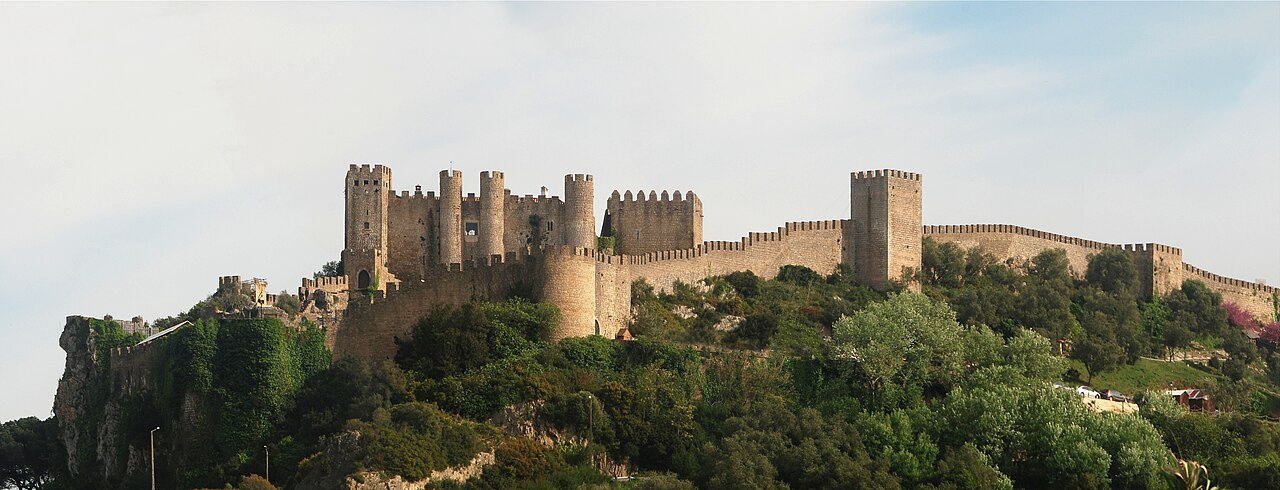
The Castle of Óbidos (Portuguese: Castelo de Óbidos) is a well preserved medieval castle located in the civil parish of Santa Maria, São Pedro e Sobral da Lagoa, in the Portuguese municipality of Óbidos, the historical province of Portuguese Estremadura.
Óbidos had its foundation in the existence of a fortified settlement, likely over the Luso-Roman castro and Roman oppidum (then civitas) on the hilltop, that was the mysterious Eburobrittium, once cited by Pliny the Elder as being situated between Collipo (present-day Golpilheira near Leiria) and Olisipo (Lisbon). Archeological surveys later resulted in the discovery of a forum, baths and other Roman structures near the settlement. The area was later settled by the Lusitanos (since the 4th century BC) and Romans in the first century, but later occupied by Visigoths during the 5th and 6th century and Muslims, who were responsible for fortifying the town in the 8th century.
During the Christian Reconquista, forces under the first Portuguese king Afonso I (1112–1185) defeated the settlement's defenses through a ruse, on 10 January 1148. The first surveys of the castle were undertaken in 1153, although the castle was never completely conquered until the reign of King D. Sancho I (in 1195), as documented in the epigraph Torre do Facho. Also at this time, the Albarra tower was converted into a jail, when the walls were reformulated by King Sancho I. The old dungeon was restored and expanded by King D. Denis, while the barbicans alongside the main gate was constructed.
Sancho's son and successor, King D. Afonso II (1211–23), donated the settlement and its castle to his wife, D. Urraca (in 1210). The settlement and castle maintained their loyalty to King D. Sancho II (1223–48), during the crisis, resisting victoriously the assaults of forces loyal to the Count of Bologna, future King D. Afonso III (1248–1279). This resistance resulted in the epitaph of mui nobre e sempre leal (very noble and ever loyal), that figured into the municipal coat-of-arms.
The settlement progressively expanded from this point, followed by the fortifications, integrating such structures as the Torre Atalaia (situated in the south). Donated as a wedding gift to D. Denis (1279–1325) and Queen Elizabeth during their stay, the town began to figure into the property/possessions of all successive Queens of Portugal as of 1834.
Text adapted from “Castle of Óbidos” on Wikipedia, CC BY-SA 4.0.
Castle of Óbidos ranks #1,013 of 9,079 worldwide in the atlas's castle fame ranking, and #15 of the 212 mapped in Portugal. Founded c. 1101, it is older than 85% of the atlas's dated landmarks — one of 756 atlas entries founded in the 12th century. Its Wikipedia articles were opened 6,003 times in the last 60 days, more than 89% of the atlas. 3 more atlas landmarks stand within 25 km. The nearest day-trip guide is Caldas da Rainha, 5 km away. See how Portugal compares in the castle statistics.
View on the interactive castle map →