 Wales · 13th century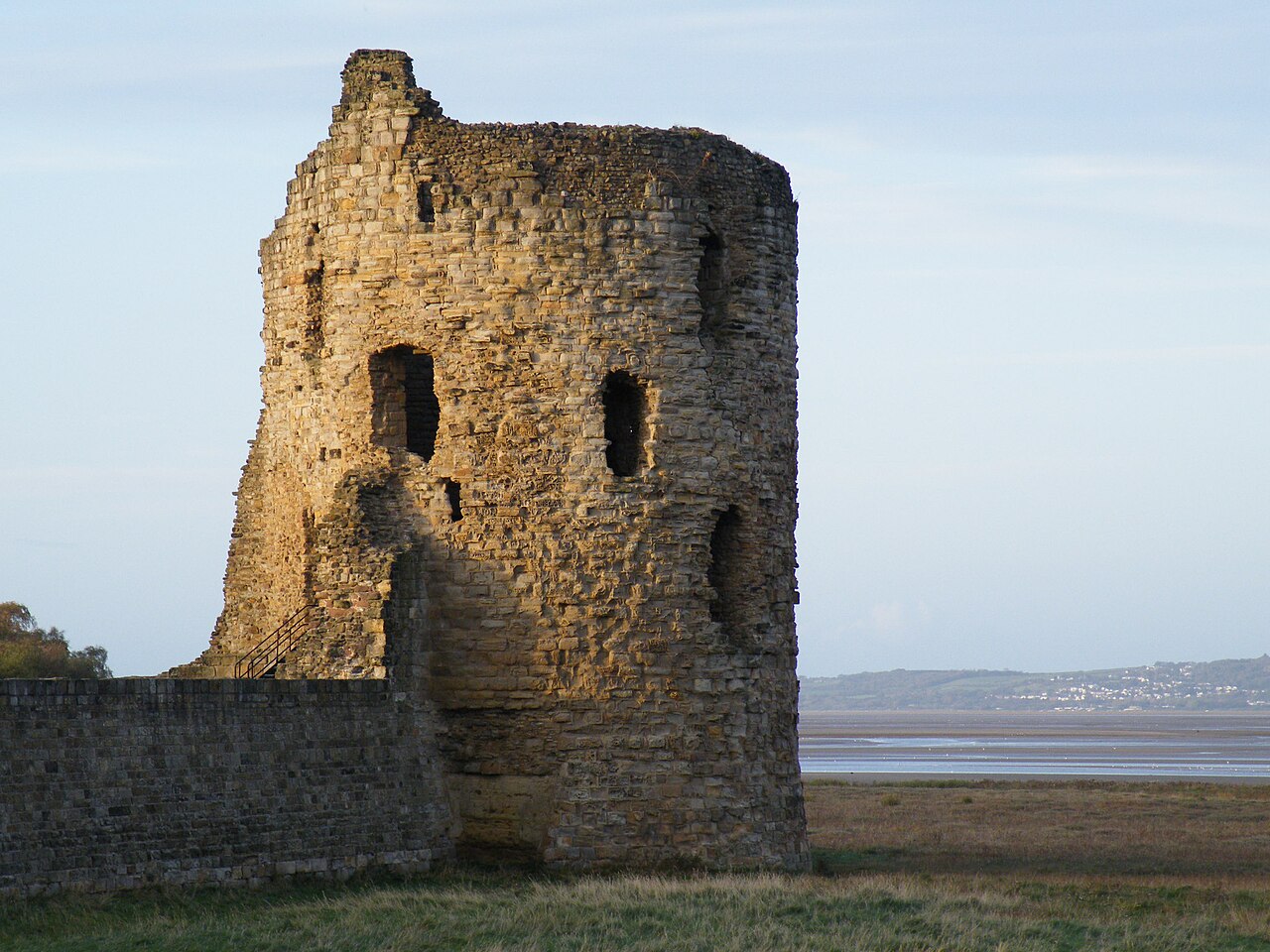
Flint Castle (Welsh: Castell y Fflint) in Flint, Flintshire, was the first of a series of castles built during King Edward I's campaign to conquer Wales.
The site was chosen for its strategic position in North East Wales. The castle was only one day's march from Chester, supplies could be brought along the River Dee and there was a ford nearby across to England that could be used at low tide.
Building work began in 1277 initially under Richard L'engenour, who would later become Mayor of Chester in 1304. The castle and its earthworks were built by 18,000 labourers and masons using local Millstone Grit ashlar and sandstone. Savoyard master mason James of Saint George was assigned "ad ordiandum opera castorum ibidem" (to undertake the works of the same castle works (referring to all Welsh castle building projects) in April 1278. November 1280 saw him beginning directly overseeing construction at Flint for Edward I as the initially very slow construction pace was accelerated. He remained at the castle for 17 months. James of Saint George then moved onto Rhuddlan to oversee its completion.
When work ceased in 1284, Flint Castle had an inner ward and an outer bailey. They were separated by a tidal moat and were connected with gatehouse and drawbridge. A plantation town was also laid out beyond the outer bailey. The inner ward had three large towers and a detached keep. This isolated tower protected the inner gatehouse and outer bailey. In total expenditure, Edward I spent £6068.7.5d. creating the fortress and the town (£6.6 million in 2008).
Flint, on the western shore of the River Dee estuary, could be supplied by river or sea. Its harbour was protected by a defensive wall. The castle lies opposite to the English shore and Shotwick Castle in England. Before the course was changed in the 18th century, passage across the estuary at this point could be made directly by boat at high tide or by fording at low tide.
The castle is based on Savoyard models where one of the corner towers is enlarged and isolated. This independent structure served as both corner tower and keep or donjon, like at Dourdan, France. Flint's keep has been compared to the donjon at Aigues-Mortes, France. Edward I may have been familiar with Aigues-Mortes having passed through the fortress on the way to join the Eighth Crusade in 1270.
Text adapted from “Flint Castle” on Wikipedia, CC BY-SA 4.0.
Flint Castle ranks #1,724 of 9,079 worldwide in the atlas's castle fame ranking, and #22 of the 107 mapped in Wales. Founded 1277, it is older than 65% of the atlas's dated landmarks — one of 1080 atlas entries founded in the 13th century. Its Wikipedia articles were opened 2,591 times in the last 60 days, more than 75% of the atlas. 12 more atlas landmarks stand within 25 km. The nearest day-trip guide is Liverpool, 20 km away. It is one of the 27 landmarks on the atlas's regional map of North Wales. It is stop 1 of 8 on Edward I’s ring of iron, Flint to Beaumaris. See how Wales compares in the castle statistics.
View on the interactive castle map →