 Scotland · 14th century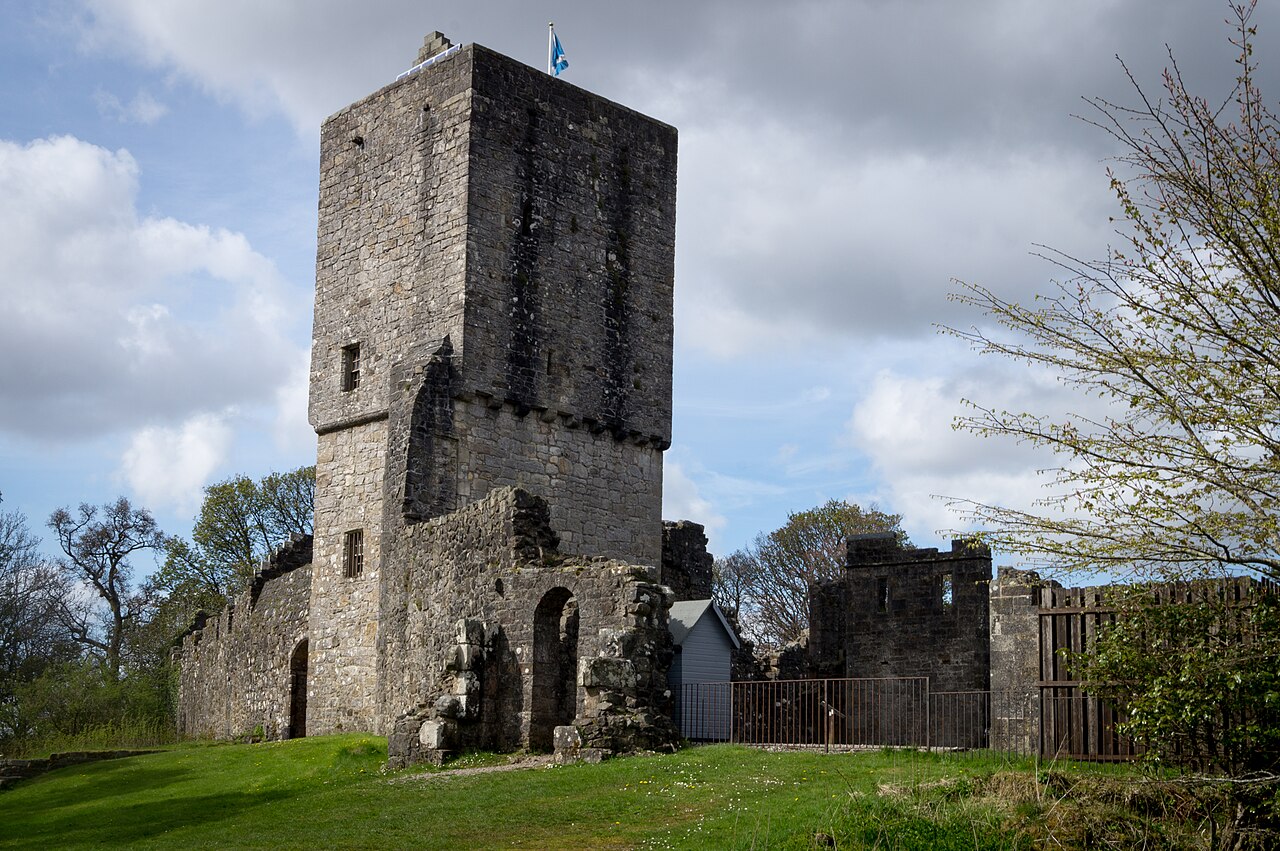
Mugdock Castle was the stronghold of the Clan Graham from the middle of the 13th century. Its ruins are located in Mugdock Country Park, just west of the village of Mugdock in the parish of Strathblane. The castle is within the registration county of Stirlingshire, although it is only 2 kilometres (1.2 mi) north of Milngavie, East Dunbartonshire, on the northern outskirts of Greater Glasgow.
The lands of Mugdock were a property of the Grahams from the mid-13th century, when David de Graham of Dundaff acquired them from the Earl of Lennox. It is possible that the castle was built by his descendant, Sir David de Graham (d. 1376), or by his son in 1372. In 1458, the lands were erected into the Barony of Mugdock. Later, in 1505, the Grahams were created Earls of Montrose.
The most famous of the Montrose Grahams, James Graham, 1st Marquess of Montrose, may have been born at Mugdock Castle in 1612. During the Bishops' Wars, a prelude to the Wars of the Three Kingdoms, Montrose briefly supported the Covenanters. He was imprisoned in Edinburgh in 1641 for intrigues against Archibald Campbell, 1st Marquess of Argyll, who was to become his arch-enemy. While Montrose was in prison, Lord Sinclair sacked Mugdock. Montrose returned there, however, until 1644 when he began his Royalist revolt, becoming the King's commander in Scotland. Mugdock was sacked again that year. Following the defeat of Charles I, Montrose was executed in 1650, and the lands were forfeited to the Marquess of Argyll.
In 1661 Argyll too was executed, and Mugdock was returned to the Grahams, who restored the castle over a two-year period, building a mansion within the old castle walls. In 1682 the Grahams bought Buchanan Auld House near Drymen, a dwelling more fitting the title of "Marquess", though the family's official seat was kept at Mugdock Castle for some time.
A terraced walled garden, incorporating a summer house, was built to the east of the castle in the 1820s. Local historian John Guthrie Smith (1834–1894), a relative of the Smith family of nearby Craigend Castle, leased the house from 1874. He had the 17th-century mansion demolished, and commissioned a Scottish baronial style house to be built in the ruins of the old castle. It was designed by architects Cambell Douglas & Sellars, and was extended to designs by James Sellars in the 1880s.
Text adapted from “Mugdock Castle” on Wikipedia, CC BY-SA 4.0.
Mugdock Castle ranks #3,761 of 9,079 worldwide in the atlas's castle fame ranking, and #129 of the 226 mapped in Scotland. Founded 1372, it is older than 54% of the atlas's dated landmarks — one of 755 atlas entries founded in the 14th century. Its Wikipedia articles were opened 1,382 times in the last 60 days, more than 59% of the atlas. 9 more atlas landmarks stand within 25 km. The nearest day-trip guide is Glasgow, 13 km away. See how Scotland compares in the castle statistics.
View on the interactive castle map →