 Scotland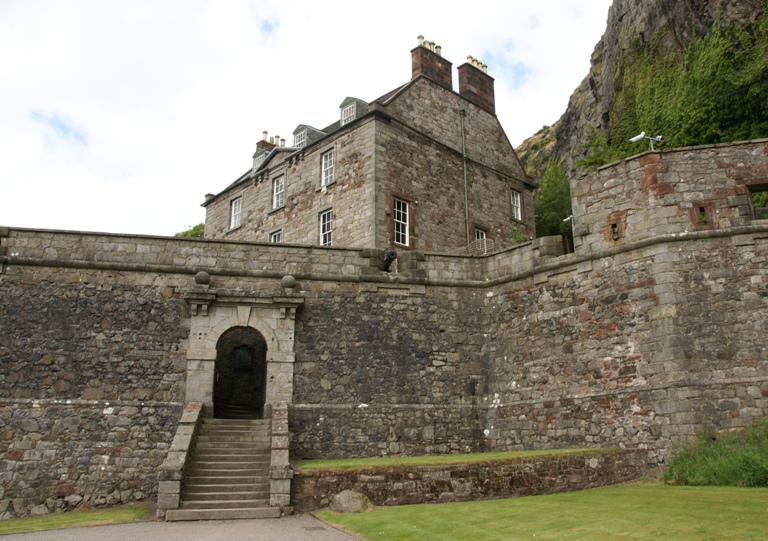
Dumbarton Castle (Scottish Gaelic: Dùn Breatainn, pronounced [t̪unˈpɾʲɛʰt̪ɪɲ]; Welsh: Alt Clut) has the longest recorded history of any stronghold in Scotland. It sits on a volcanic plug of basalt known as Dumbarton Rock which is 240 feet (73 m) high and overlooks the Scottish town of Dumbarton.
Dumbarton Rock was formed between 330 and 340 million years ago, during the Early Carboniferous period, a time of widespread volcanic activity in the area where Glasgow is now situated; over time, the softer exterior of the volcano weathered away, leaving behind a volcanic plug of basalt.
At least as far back as the Iron Age, this has been the site of a strategically important settlement, as evidenced by archaeological finds.
The people that came to reside there in the era of Roman Britain were known to have traded with the Romans. However the first written record about a settlement there was in a letter that Saint Patrick wrote to King Ceretic of Alt Clut in the late 5th century.
David Nash Ford has proposed that Dumbarton was the Cair Brithon ('Fort of the Britons') listed by Nennius among the 28 cities of Sub-Roman Britain. From the 5th century until the 9th, the castle was the centre of the independent Brythonic Kingdom of Strathclyde. Alt Clut or Alcluith (Scottish Gaelic: Alt Chluaidh, pronounced [aɫ̪d̪̊ˈxɫ̪uəj], lit. 'Rock of the Clyde'), the Brythonic name for Dumbarton Rock, became a metonym for the kingdom. The king of Dumbarton in about AD 570 was Riderch Hael, who features in Welsh and Latin works.
Merlin was said to have stayed at Alt Clut. The medieval Scalacronica of Sir Thomas Grey recorded the legend that says that "Arthur left Hoël of Brittany his nephew sick at Alcluit in Scotland." Hoël made a full recovery, but was besieged in the castle by the Scots and Picts. The story first appeared in Geoffrey of Monmouth's Historia Regum Britanniae. Amongst lists of three things, in the triads of the Red Book of Hergest, the third "Unrestrained Ravaging" was Aeddan Fradog (the Wily, perhaps Áedán mac Gabráin), coming to the court of Rhydderch the Generous at Alclud, who left neither food nor drink nor beast alive. This battle also appears in stories of Myrddin Wyllt, the Merlin of Geoffrey of Monmouth's Vita Merlini, perhaps conflated with the battle of Arfderydd, located as Arthuret by some authors.
Text adapted from “Dumbarton Castle” on Wikipedia, CC BY-SA 4.0.
Dumbarton Castle ranks #509 of 9,079 worldwide in the atlas's castle fame ranking, and #15 of the 226 mapped in Scotland. Its Wikipedia articles were opened 7,517 times in the last 60 days, more than 91% of the atlas. 7 more atlas landmarks stand within 25 km. The nearest day-trip guide is Glasgow, 21 km away. See how Scotland compares in the castle statistics.
View on the interactive castle map →