 Russia · 6th century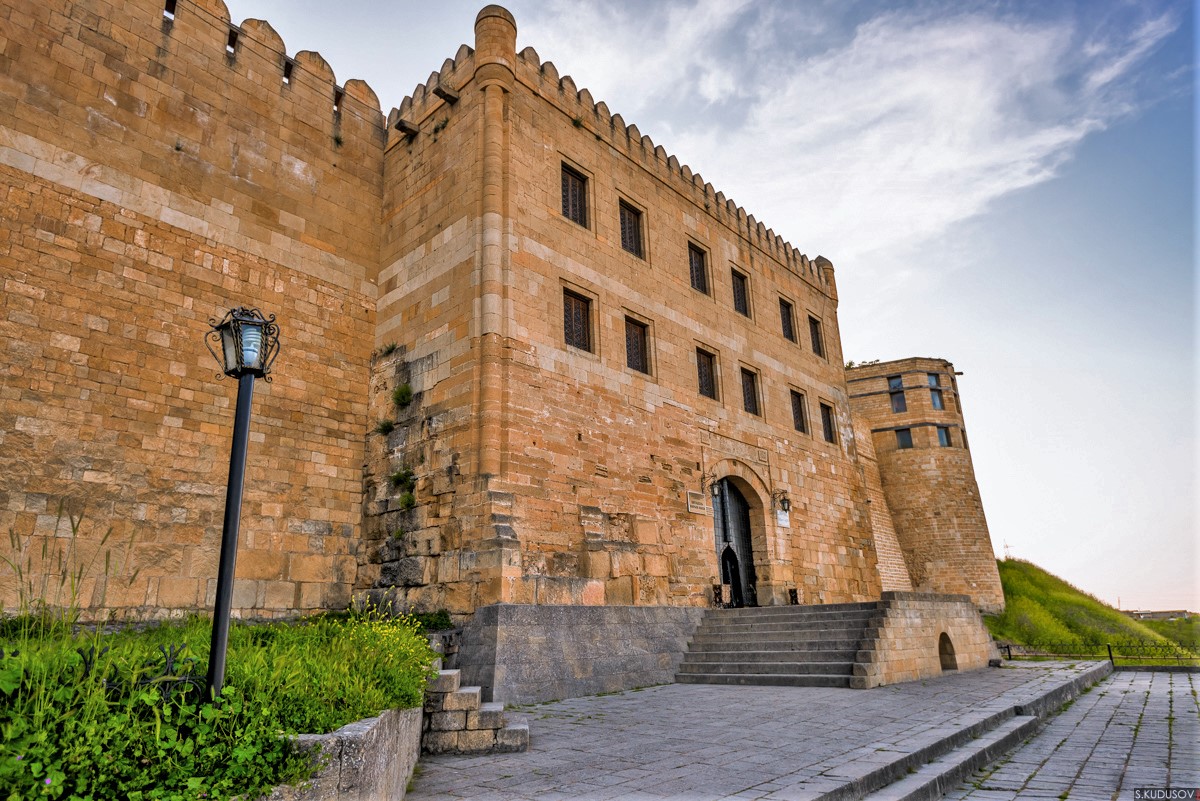
Naryn-Kala (Russian: Нарын-кала) is an ancient pre-Arab citadel, part of the Derbent fortress, connected to the Caspian Sea by double walls designed to block the so-called Caspian gates to the Persian state. It is included in the UNESCO World Heritage List.
One of the translations of the name Naryn-Kala from Middle Persian into Russian is "Sunny Fortress". According to other sources, it got the name Naryn in honor of the daughter of the Persian Shah, which means "tender", "beautiful".
Naryn-Kala citadel occupies the top of the hill closest to the Caspian Sea. The path along the coast was blocked by two parallel fortress walls (the Derbent wall), adjoining the citadel in the west, and leaving the sea at the eastern end, preventing the fortress from being bypassed in shallow water and forming a harbor for ships. Between the walls spaced 350–450 meters apart lay the medieval city of Derbent. To the west of the citadel, the Mountain Wall (Dagh-Bary) stretched for 40 km, designed to prevent bypassing the fortress along mountain valleys and passes. Despite its age, the fortress played an important defensive role for centuries. The new owners rebuilt and updated it, which is why today, as in the annual rings of a tree, one can trace the entire history of Derbent by construction.
The irregularly shaped citadel occupies an area of 4.5 hectares. Dimensions: approximately 180 meters wide and 255 meters long; the walls are fortified with small towers (at a distance of 20–30 meters from each other) and a gun tower in the southwest. The steep slopes of the mountain provide additional protection from three sides.
Inside the citadel there are baths, a fortress water supply system made of ceramic pipes, the ruins of the Shah's palace, a large entrance portal and part of the walls. Opinions about the existence of an early Christian church of the 4th and 5th centuries - the oldest in Russia - are diverse. The cross-domed room is considered by some experts to be a repository; others note the lack of a water conduit at the bottom and the ground—rather than half underground or subterranean—of the structure, consider the form of construction inconvenient for a reservoir, which was generally rectangular or square in Derbent, and they also note the orientation of the structure to the cardinal points. Each wall has three gates, the oldest of which is the Orta Cana (Middle Gate).
Text adapted from “Naryn-Kala” on Wikipedia, CC BY-SA 4.0.
Naryn-Kala ranks #991 of 9,035 worldwide in the atlas's castle fame ranking, and #40 of the 145 mapped in Russia. Founded c. 501, it is older than 97% of the atlas's dated landmarks, one of 39 atlas entries founded in the 6th century. Its Wikipedia articles were opened 6,137 times in the last 60 days, more than 89% of the atlas. See how Russia compares in the castle statistics.
View on the interactive castle map →