 Italy · 9th century
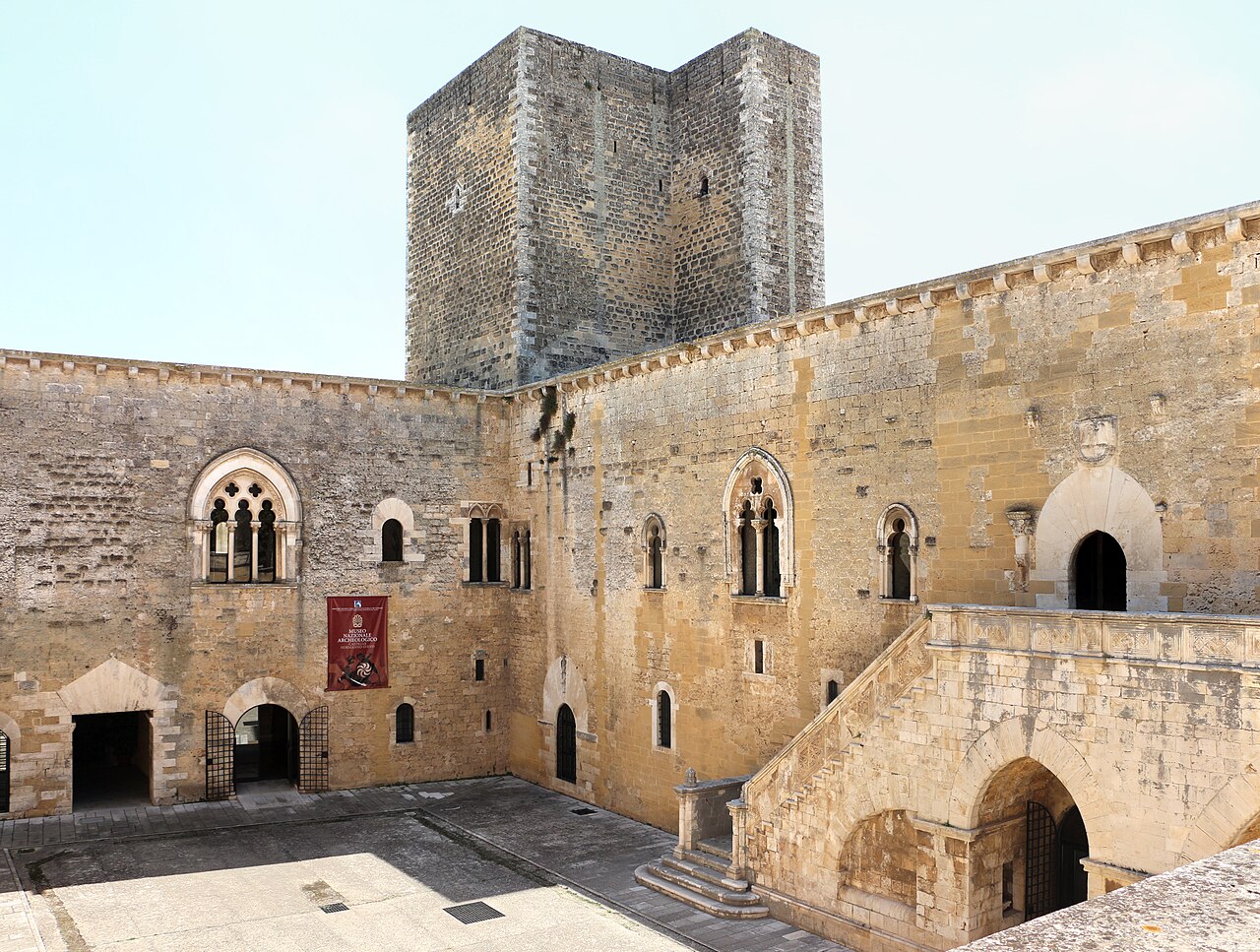
The Castello Normanno-Svevo (in English: Norman-Swebian castle) is a Normans' castle located in the historic center of Gioia del Colle. Since December 2014, the Ministry of Cultural Heritage and Activities has managed the entire castle through the Polo Museale della Puglia, which, in December 2019, became the Direzione Regionale Musei.
The ancient centre of the Castle, corresponding to the North wing, is from the period of the Byzantine Empire, dating back to the 9th century. It was composed of a rectangular fortified enclosure in limestone. There was a small courtyard, adjacent to the southern wall. It opened outwards in what is now known as the Martyrs' square of 1799. The main function of the Castle was to offer shelter to the population, in case of enemy raids.
Between the 9th and 10th centuries, the castle was expanded by Richard of Hauteville, who belonged to the Norman dynasty of Hauteville, was the Duke of Apulia, and was the first lord of the territory of the current Gioia del Colle. The oldest document where the Castle is mentioned dates back to 1108, so the expansion could have been before the Norman enlargement. Richard of Hauteville transformed the Byzantine fortress into a feudal stronghold. He expanded the yard to the south and enclosed it with a solid wall. He built a fortified tower in the southwest corner, later named "Torre De' Rossi". The King of Sicily, Roger II of Sicily, of Norman ancestry, changed the fortification partially and added two towers in the northeast and northwest corners, which no longer exist.
The castle and the surrounding built-up area were destroyed by William I of Sicily when he regained power over the land of Bari.
The current placement is attributed to Frederick II, Holy Roman Emperor, who refunded the Castrum and added a tower in the southeast corner (also named "Torre Imperatrice") around 1230, when he came back from the Fourth Crusade in the Holy Land. He erected curtain walls in the yard to obtain closed areas, service rooms on the ground floor (kitchen, storages, stalls, stables), and residential areas on the first floor.
The building had a roughly quadrangular structure, with an inner courtyard, which was typical of the Frederican's Castles. The castle, wanted by the emperor, was part of the nets of residences and fortifications which were scattered throughout the territory of Southern Italy.
Text adapted from “Castello Normanno-Svevo (Gioia del Colle)” on Wikipedia, CC BY-SA 4.0.
Norman Castle of Gioia del Colle ranks #5,075 of 9,035 worldwide in the atlas's castle fame ranking, and #365 of the 555 mapped in Italy. Founded c. 900, it is older than 94% of the atlas's dated landmarks, one of 85 atlas entries founded in the 9th century. Wikidata records about 7,454 visitors in 2022. 2 more atlas landmarks stand within 25 km. See how Italy compares in the castle statistics.
View on the interactive castle map →