 Germany · 13th century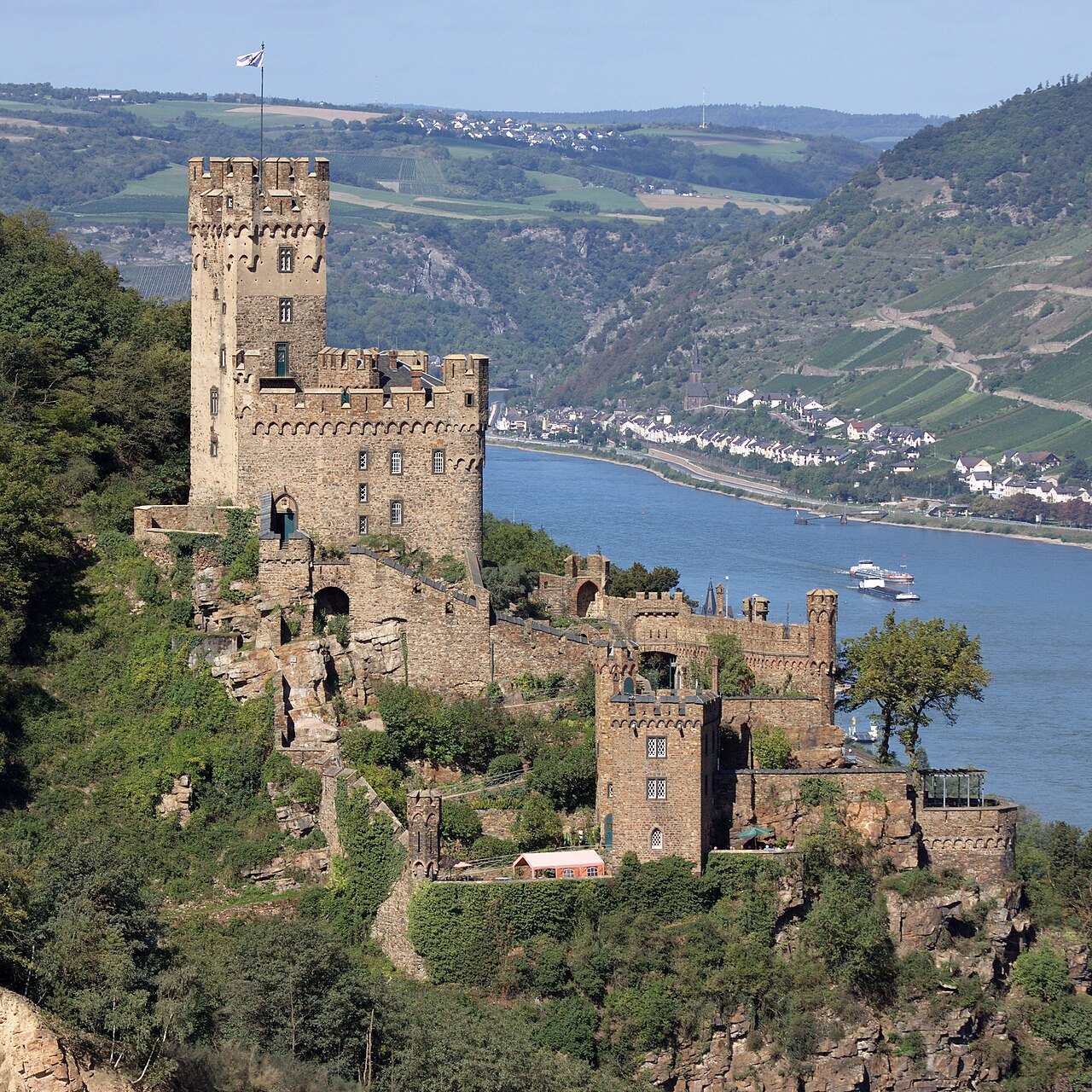
Sooneck Castle (German: Burg Sooneck) (also known as Saneck or Sonneck, previously also known as Schloss Sonneck) is a castle in the upper middle valley of the Rhine, in the Mainz-Bingen district of Rhineland-Palatinate, Germany. It is located near the village of Niederheimbach between Bingen and Bacharach.
Since 2002, Sooneck Castle has been part of the Rhine Gorge UNESCO World Heritage Site.
Recent research has established that the castle was probably first mentioned in 1271. Like neighbouring Reichenstein Castle, it was managed by the lords of Hohenfels as bailiffs for Kornelimünster Abbey near Aachen.
What is certain is that the castle was besieged in 1282 by King Rudolph I. His troops overran and destroyed the castle and the king imposed a ban on rebuilding it, which he explicitly restated in 1290.
When the castle was rebuilt it was given to a family who were fervent supporters of the Habsburgs, the Reitenaours, to stop Swiss expansion. The wars with the Swiss claimed many Reitenours: George, Robert and most famously, Nicholas, who died in the battle of Sempach.
In April 1346 Archbishop Henry III of Mainz gave Sooneck Castle in fief to John, Knight Marshall of Waldeck, who subsequently had a new castle built on the site. After his death it passed jointly to four of his heirs and the castle thus became a multi-family property, or Ganerbenburg.
The branches of the family jointly residing in the castle were not on good terms and quarreled over inheritances. Several times, peace had to be legally imposed.
When the line of Waldeck died out in 1553 with the death of Philipp Melchior, the Breidbach zu Bürresheim family, previously co-tenants, became sole tenants of Sooneck Castle. When that family became extinct, the castle began to fall into disrepair.
In the course of the War of the Palatine Succession, Sooneck - like all the castles on the left bank of the Rhine - was destroyed in 1689 by troops of King Louis XIV of France.
In 1774, the Archdiocese of Mainz leased the ruins to four residents of Trechtingshausen who planted vineyards. The site later came into the possession of the village of Niederheimbach.
In 1834, the then crown prince of Prussia, Frederick William IV, and his brothers Princes William, Charles, and Albert bought the completely derelict castle and, between 1834 and 1861, had it rebuilt as a hunting lodge.
Text adapted from “Sooneck Castle” on Wikipedia, CC BY-SA 4.0.
Sooneck Castle ranks #2,688 of 9,079 worldwide in the atlas's castle fame ranking, and #207 of the 711 mapped in Germany. Founded c. 1271, it is older than 66% of the atlas's dated landmarks — one of 1080 atlas entries founded in the 13th century. Its Wikipedia articles were opened 1,845 times in the last 60 days, more than 67% of the atlas. 23 more atlas landmarks stand within 25 km. The nearest day-trip guide is Wiesbaden, 30 km away. It is one of the 39 landmarks on the atlas's regional map of the Middle Rhine. It is stop 8 of 32 on the Rhine castle route, Bingen to Koblenz. See how Germany compares in the castle statistics.
View on the interactive castle map →