 Italy · 18th century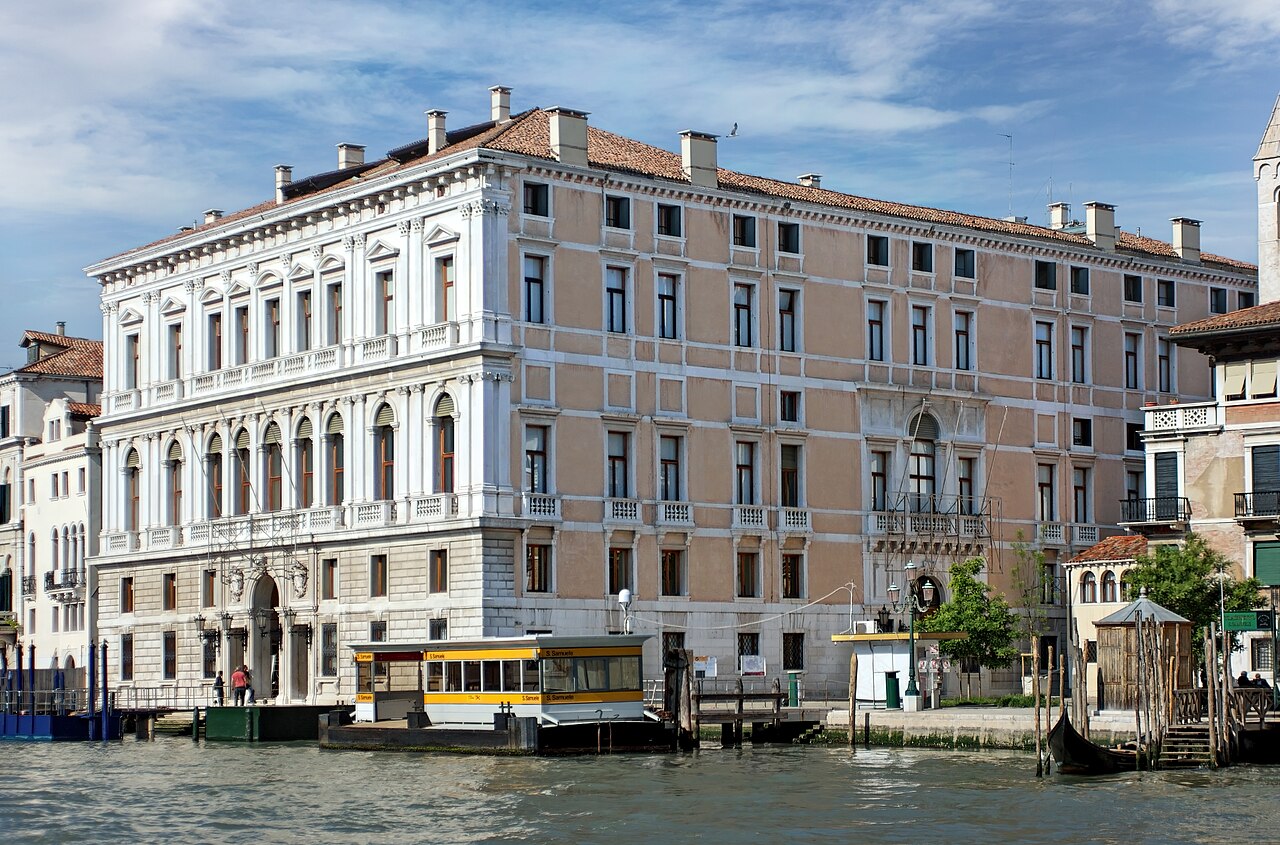
Palazzo Grassi (also known as the Palazzo Grassi-Stucky) is a building in the Venetian Classical style located on the Grand Canal of Venice (Italy), between the Palazzo Moro Lin and the campo San Samuele.
During the 16th century, the building was owned by the Cini family. In February 1605, Alamanno Aragon Hocheppan, grandson of Cosimo I, acquired it. The Grassi family first moved in the building in 1655.
The Palazzo Grassi was designed by Giorgio Massari, and rebuilt between 1748 and 1772. Massari started the Palazzo while he was finishing the Ca' Rezzonico on the opposite bank of the river.
A latecomer among the palaces on the Grand Canal of Venice, Palazzo Grassi has an academic classical style that is in contrast to the surrounding Byzantine Romanesque and Baroque Venetian palazzi. It has a formal palace façade, constructed of white marble, but lacks the lower mercantile openings typical of many Venetian patrician palaces. The main stairwell is frescoed by Michelangelo Morlaiter and Francesco Zanchi, and the ceilings are decorated by the artists Giambattista Canal and Christian Griepenkerl. The Palazzo Grassi was the last palace to be built on the Grand Canal before the fall of the Venetian Republic, and the largest-sited.
The Grassi family sold the palazzo in 1840, with ownership that followed passing through many different individuals. In 1857, the building was bought by Baron Simeone De Sina. A small scenic garden was created adjacent to the building.
In 1951, the building became the International Centre of Arts and Costume. The adjacent garden was turned into an open-air theatre (Teatrino), which was finally covered in the 1960s. The International Centre for Arts and Costume closed in 1983.
The Palazzo was purchased by the Fiat Group in 1983, under the late chairman Gianni Agnelli, and it underwent a complete restoration overseen by architect Gae Aulenti. The group's aim was to transform Palazzo Grassi into an exhibition hall for the visual arts. It continues to be used as an art gallery today.
Between 1984 and 1990, Pontus Hultén was in charge of the art museum which also contained a 600-seat outdoor theatre. In 1990, the architect Aldo Rossi received the Pritzker Architecture Prize in this building.
In May 2005, the French entrepreneur François Pinault bought the Palazzo Grassi for 29 million euros.
Text adapted from “Palazzo Grassi” on Wikipedia, CC BY-SA 4.0.
Palazzo Grassi ranks #731 of 9,079 worldwide in the atlas's castle fame ranking, and #52 of the 560 mapped in Italy. Founded 1772, it is older than 14% of the atlas's dated landmarks — one of 696 atlas entries founded in the 18th century. Its Wikipedia articles were opened 4,898 times in the last 60 days, more than 86% of the atlas. 42 more atlas landmarks stand within 25 km. The nearest day-trip guide is Venice, 1 km away. See how Italy compares in the castle statistics.
View on the interactive castle map →