 India · 17th century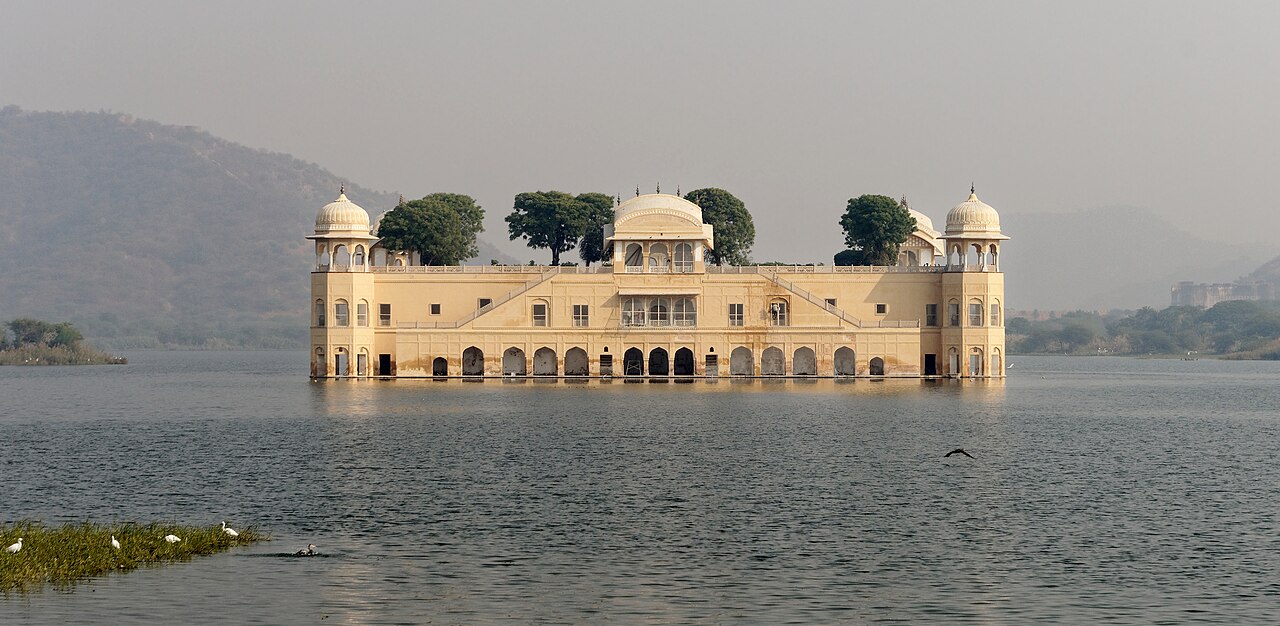
Jal Mahal (Hindi: [dʒəl mɛːɦəl], lit. 'Water Palace') is a historical palace in the middle of Man Sagar Lake in the city of Jaipur, capital of the Indian state of Rajasthan.
Originally constructed around 1699 by Sawai Jai Singh of Amber as a duck-hunting lodge rather than a royal residence. The building and the lake around it were later renovated and enlarged in the mid-18th century by Maharaja Madho Singh I.
Jal Mahal is built from local pink and red sandstone and stands as a five-story building in the middle of Man Sagar Lake. The Man Sagar Dam faces eastward while the local roadside promenade faces west. When the lake is at full capacity, its maximum depth reaches approximately 4.5 meters (15ft); consequently, only the lowest story remains submerged underwater, making the popular assumption that four stories are flooded physically incorrect.
The top floor terrace features a central garden with arched passages, flanked by four octagonal Chhatri or "domed-pavilions" marking the corners of the building.
The hills surrounding the lake to the northeast belong to the Aravalli mountain range and feature quartzite rock formations historically quarried for local construction.
In the past, the palace has suffered subsidence and partial plaster wall logging damage due to rising damp which has been repaired under restoration projects commissioned by the Government of Rajasthan.
From the northeast, the Kanak Vrindavan valley, where a temple complex sits, the hills slope gently towards the lake edge. Within the lake area, the ground area is made up of a thick mantle of soil, blown sand, and alluvium. Forest denudation, particularly in the hilly areas, has caused soil erosion, compounded by wind and water action. As a result, silt built up in the lake incrementally raises the lake bed.
Located opposite the lake at Gaitore are chhatris and cenotaphs erected over cremation platforms of notable Kachwaha rulers of Jaipur. Originally built by Sawai Jai Singh II, the cenotaphs are in honor of Pratap Singh, Madho Singh II among others. The monument for Jai Singh II is noted for its intricate carvings and 20 carved domed pillars.
In 2004, the Rajasthan Tourism Development Corporation signed an agreement with Jal Mahal Resorts, granting it a 99-year lease to develop the palace and 100 acres along the Man Sagar Lake.
Text adapted from “Jal Mahal” on Wikipedia, CC BY-SA 4.0.
Jal Mahal ranks #270 of 9,079 worldwide in the atlas's castle fame ranking, and #12 of the 224 mapped in India. Founded c. 1699, it is older than 22% of the atlas's dated landmarks — one of 721 atlas entries founded in the 17th century. Its Wikipedia articles were opened 23,205 times in the last 60 days, more than 98% of the atlas. 6 more atlas landmarks stand within 25 km. The nearest day-trip guide is Jaipur, 5 km away. It is one of the 30 landmarks on the atlas's regional map of Rajasthan. See how India compares in the castle statistics.
View on the interactive castle map →