Palace & château
Palazzo Valentini
🇮🇹 Italy · 16th century
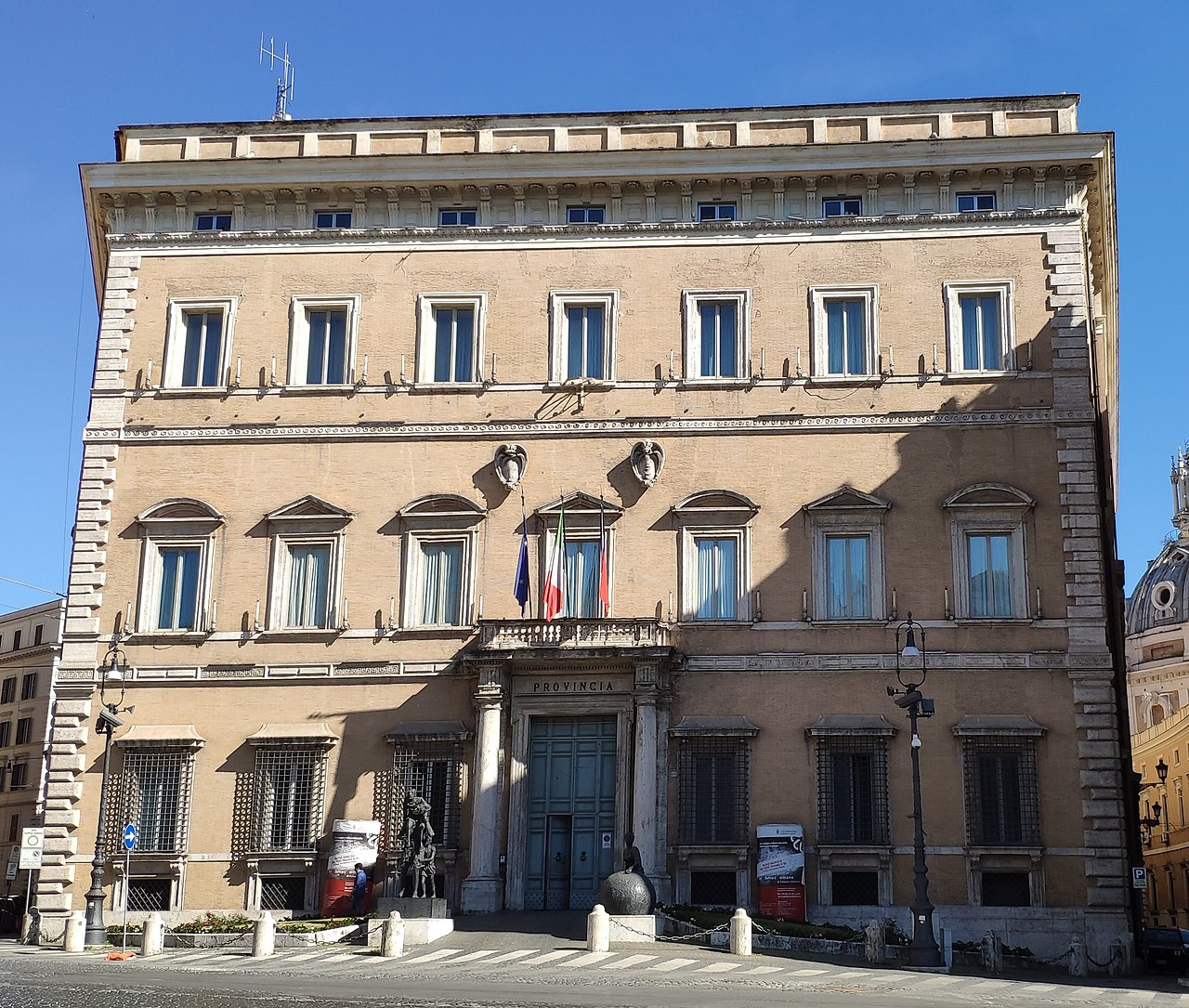
Palazzo Valentini is a palace in central Rome, Italy, not far from Piazza Venezia. Since 1873 it has been the base of the provincial and prefectural administration of Rome.
The palazzo was first built by cardinal Michele Bonelli, nephew of pope Pius V, who, in 1585, acquired a pre-existing palazzo from Giacomo Boncompagni at the extremity of what was then piazza dei Santi Apostoli. Today the palazzo is separated from that piazza by via Quattro Novembre, opened later to connect the new via Nazionale with piazza Venezia. The cardinal was also the owner of a large part of the area which extended, behind the palazzo, above the ruins of the imperial fora of Trajan and Augustus, known by the name "Pantano" due to being subject to impaludamenti or flooding. Over the same years the district on the ruins of the imperial fora was subjected to a general development of the land and to a systematic urbanisation, with the creation of the "quartiere Alessandrino" in the cardinal's honour (he was nicknamed "cardinale alessandrino" after his origins in a village in the province of Alessandria). The quarter was destroyed in the 1920s and 1930s to open via dei Fori Imperiali.
The trapezoidal plan of the palazzo was designed by Domenico Paganelli. Thanks to substantial funds ploughed into the project by the cardinal, the palazzo was quickly completed within 3 years after building started. In the 17th century the building was then subject to a series of major renovations and expansions, carried out on behalf of cardinals Carlo Bonelli and Michele Ferdinando Bonelli. The palazzo was partially demolished and rebuilt by Francesco Peparelli for its new owner, cardinal Renato Imperiali, who organised the important family library (the "Imperiali") of around 24,000 volumes.
At the start of the 18th century, the palazzo was leased to several prominent personalities, including marchese Francesco Maria Ruspoli from 1705 to 1713, who made it the site for a private theatre and hosted illustrious musicians of the time such as Handel, Alessandro Scarlatti and Arcangelo Corelli. The entire building was then acquired in 1752 by cardinal Giuseppe Spinelli, who realised a new decorative scheme for the first floor and systematised the library (meant by him for public use, and frequented by Johann Joachim Winckelmann) on the ground floor.
Text adapted from “Palazzo Valentini” on Wikipedia, CC BY-SA 4.0.
Palazzo Valentini ranks #3,018 of 8,134 worldwide in the atlas's castle fame ranking, and #243 of the 487 mapped in Italy. Founded 1585, it is older than 35% of the atlas's dated landmarks — one of 755 atlas entries founded in the 16th century. Its Wikipedia articles were opened 1,447 times in the last 60 days, more than 58% of the atlas. 70 more atlas landmarks stand within 25 km. The nearest day-trip guide is Rome, 1 km away. See how Italy compares in the castle statistics.
View on the interactive castle map →Frequently asked questions
Where is Palazzo Valentini?
Palazzo Valentini stands in Italy, at 41.89705°, 12.4852°.
When was Palazzo Valentini built?
The atlas dates its founding to 1585. Earlier structures may have stood on the site; this is the earliest documented founding year.
How famous is Palazzo Valentini?
In this atlas's fame ranking: #3,018 of 8,134 worldwide, and #243 in Italy. Fame here combines how many Wikipedia language editions cover a landmark with how many people read them.
What is the nearest castle to Palazzo Valentini?
Palazzo Colonna, about 1 km away.
More castles in Italy
- Palazzo Schio Italy · 16th century
- Palazzo Biscari Italy · 18th century
- Palazzo Orsini di Gravina Italy · 16th century
- Palazzo Venezia (Naples) Italy · 15th century
More palaces & châteaux
- Prince Henry Palace Germany · 18th century
- Sikandar Bagh India · 2nd century
- Palazzo Venier dei Leoni Italy · 18th century
- Tiradentes Palace Brazil · 20th century