Ruin
Penrith Castle
ENG England · 14th century
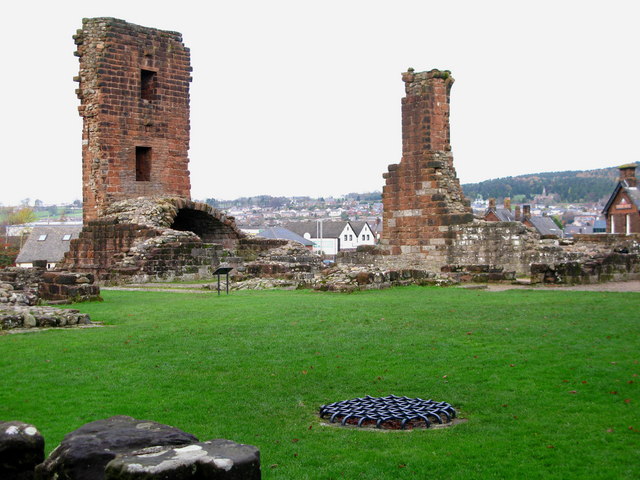
Penrith Castle is a now-ruined medieval castle located in Penrith, in the north-west of England, a few miles to the east of the Lake District National Park.
The site of the castle, in the west of the town is likely to have been a Roman encampment, as it has an irregular and quadrilateral layout.
Penrith Castle was built between 1399 and 1470 as a defence against Scottish raids; it has been said that, unlike so many of its counterparts in the north, 'the building exhibits no indication of very ancient date.' The lordship of Penrith was created in 1397 as a grant to the newly created earl of Westmorland, and the castle was mentioned in a grant of 1437. Previously believed to have been first built by William Strickland who later become Bishop of Carlisle, the lateness of this reference, it has been suggested, indicates that the most likely builder was Richard Neville, Earl of Salisbury. However, it is not known whether this was 'new work on a fresh site, or whether he simply utilized Strickland's works as the core of his building.'
It is now considered more likely that Strickland built Hutton Hall, near the church in Penrith, instead, and furthermore that a 'tenurial reconstruction shows that he [Strickland] did not hold the castle site.' There is a possible reference to a construction in the site of the castle as early as 1412, and Westmorland is known to have granted the building of a tower there, from his comital seat at Raby Castle, the next year. Either way, it seems most unlikely that 'it was built not by a baron, but by the inhabitants themselves, for their own defence,' as was once stated.
The liberty and castle of Penrith became the most important offices held by the Neville family in the fifteenth century, and their most important source of patronage locally. By 1441 and until 1444, Salisbury, who was then Warden of the West March, was sub-letting the lordship of Penrith to Lumley, bishop of Carlisle, and Professor A. J. Pollard has estimated that 'the Nevilles' Penrith estates were worth approximately £350.'
Following Salisbury's death in 1460, Richard, Earl of Warwick, the 'Kingmaker,' inherited the Castle and Lordship, but was himself slain at the Battle of Barnet without leaving a male heir, so they reverted to the crown.
Text adapted from “Penrith Castle” on Wikipedia, CC BY-SA 4.0.
Penrith Castle ranks #3,410 of 8,134 worldwide in the atlas's castle fame ranking, and #234 of the 333 mapped in England. Founded 1399, it is older than 54% of the atlas's dated landmarks — one of 604 atlas entries founded in the 14th century. 5 more atlas landmarks stand within 25 km. The nearest day-trip guide is Newcastle upon Tyne, 81 km away. See how England compares in the castle statistics.
View on the interactive castle map →Frequently asked questions
Where is Penrith Castle?
Penrith Castle stands in England, at 54.6621°, -2.7573°.
When was Penrith Castle built?
The atlas dates its founding to 1399. Earlier structures may have stood on the site; this is the earliest documented founding year.
How famous is Penrith Castle?
In this atlas's fame ranking: #3,410 of 8,134 worldwide, and #234 in England. Fame here combines how many Wikipedia language editions cover a landmark with how many people read them.
What is the nearest castle to Penrith Castle?
Brougham Castle, about 3 km away.
More castles in England
- Bridgnorth Castle England · 12th century
- Ewyas Harold Castle England · 11th century
- Tonbridge Castle England · 13th century
- Bewcastle Roman Fort England
More ruins
- Newport Castle Wales · 14th century
- Charax Ukraine · 1st century
- Blestium Wales · 1st century
- Coria England