 Turkey
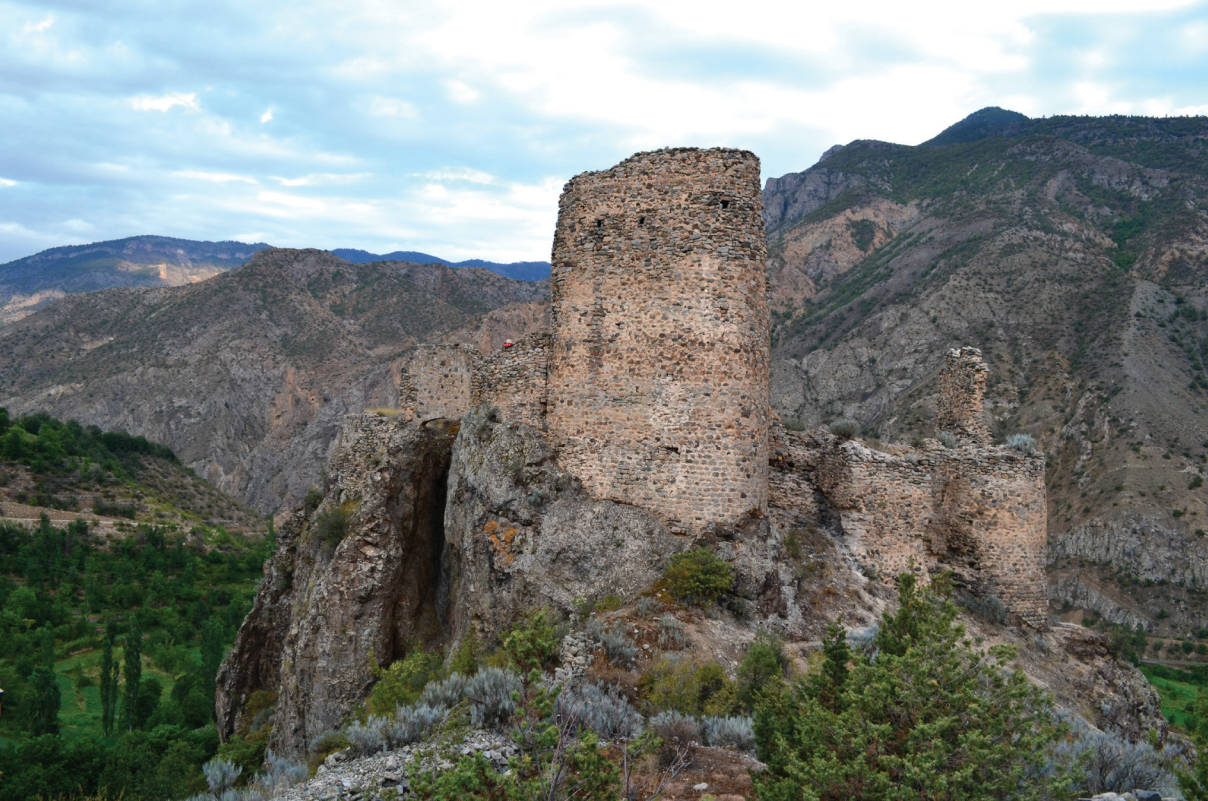
Peterek Castle ranks #8,060 of 9,040 worldwide in the atlas's castle fame ranking, and #108 of the 128 mapped in Turkey. 1 more atlas landmarks stand within 25 km. See how Turkey compares in the castle statistics.
Peterek Castle (in Turkish: Çevreli kalesi), the former fortress of Berdagrak (in Armenian: Բերդագրակ բերդ, Berdagrak berd), is a ruined castle situated on the left bank of the Çoruh river, near the village of Çevreli (formerly Berdagrak), in the district of Yusufeli, in the province of Artvin, in Turkey. The castle was built on the rock of a hill overlooking the Çoruh valley, below the central quarter of the village of Çevreli and above the Meydan quarter. It has an oval plan of about 35 × 30 metres and a damaged entrance. In the north-eastern corner there is a circular tower 10 metres high, as well as one square and three semicircular towers. The walls, made of stone and lime mortar, enclose an internal cistern. Despite the damage, it is one of the largest in the region and is largely preserved.
In the 16th century, during the Ottoman campaigns against the Georgian territories, the beylerbey of Erzurum, Mehmed Khan, led an expedition in 1536 that subdued several regions and opened the way for Ottoman domination of the Livane valley; in 1543 the king of Imereti, Bagrat III (r. 1510–1565), temporarily reconquered the valley. A new imperial offensive (1548–1549), led by Kara Ahmed Pasha, brought about, on 7 October 1549, the surrender of fortresses such as Berdagrak (today Çevreli), Kiskim and Nikakh (today Yokuşlu), on which occasion the sanjak of Pertekrek was created, subordinate to Erzurum. Between the 16th and 17th centuries, the jurisdiction of Pertekrek shifted between Erzurum, Childir and Kars, until it remained definitively under the control of Childir. It remained an administrative centre of Childir until the 19th century, when it was dissolved.
Machine-translated from “Castelo de Chevreli” on the Portuguese Wikipedia, CC BY-SA 4.0.
View on the interactive castle map →