 Jordan · 8th century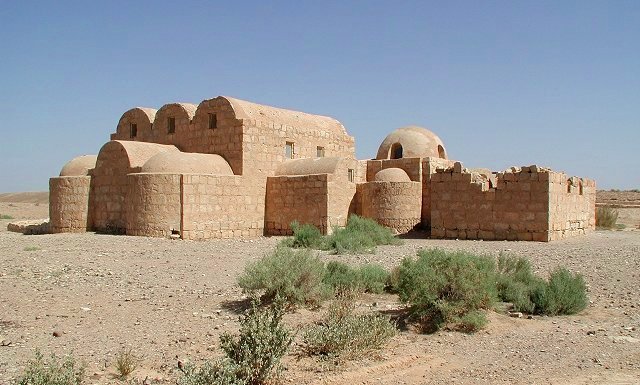
Qusayr 'Amra or Quseir Amra, sometimes also named Qasr Amra (Arabic: قصر عمرة, romanized: Qaṣr ‘Amrah, lit. 'small qasr of 'Amra'), is the best-known of the desert castles located in present-day eastern Jordan. It was built some time between 723 and 743, by Walid Ibn Yazid, the future Umayyad caliph Walid II, whose dominance of the region was rising at the time. It is considered one of the most important examples of early Islamic art and architecture.
The building is actually the remnant of a larger complex that included an actual castle, meant as a royal retreat, without any military function, of which only the foundation remains. What stands today is a small country cabin. The foundation has a simple layout with a rectangular audience hall, hydraulic structures, and a bathhouse. The bathhouse is also one of the oldest surviving remains of a hammam in the historic Muslim world.
It is most notable for the frescoes that remain mainly on the ceilings inside, which depict, among others, a group of rulers, hunting scenes, dancing scenes containing nude women, working craftsmen, the recently discovered "cycle of Jonah", and, above one bath chamber, the first known representation of heaven on a hemispherical surface, where the mirror-image of the constellations is accompanied by the figures of the zodiac. This has led to the designation of Qusayr 'Amra as a UNESCO World Heritage Site.
That status, and its location along Jordan's major east–west highway, relatively close to Amman, have made it a frequent tourist destination. A preservation project that began in 2010 involves both removing old maintenance attempts and implementing new ones to support the site better.
Text adapted from “Qusayr 'Amra” on Wikipedia, CC BY-SA 4.0.
Qasr Amra ranks #442 of 9,079 worldwide in the atlas's castle fame ranking, and #2 of the 23 mapped in Jordan. Founded 723, it is older than 96% of the atlas's dated landmarks — one of 48 atlas entries founded in the 8th century. Its Wikipedia articles were opened 6,238 times in the last 60 days, more than 89% of the atlas. 3 more atlas landmarks stand within 25 km. The nearest day-trip guide is Amman, 64 km away. It is one of the 106 landmarks on the atlas's regional map of the Levant. See how Jordan compares in the castle statistics.
View on the interactive castle map →