 Ireland · 12th century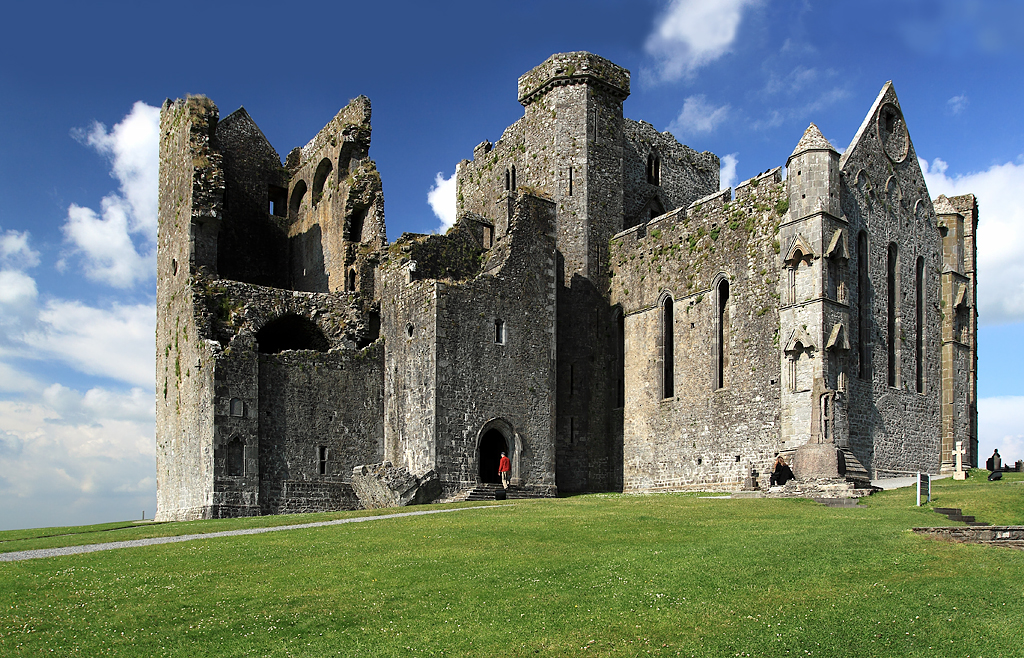
The Rock of Cashel (Irish: Carraig Phádraig [ˈkaɾˠəɟ ˈfˠaːd̪ˠɾˠəɟ]), also known as Cashel of the Kings and St. Patrick's Rock, is a historical site located dramatically above a plain at Cashel, County Tipperary, Ireland.
According to local legends, the Rock of Cashel originated in the Devil's Bit, a mountain 20 miles (30 km) north of Cashel when St. Patrick banished Satan from a cave, resulting in the Rock's landing in Cashel. According to the Tripartite Life of Saint Patrick Cashel is reputed to be the site of the conversion of the King of Munster by Saint Patrick in the 5th century.
The Rock of Cashel was the traditional seat of the kings of Munster as early as the 4th century and prior to the Norman invasion. In the 5th century the Eóganachta clan built a fortress at Cashel retaining supremacy there for hundreds of years. In 977 Brian Boru was crowned there as king and made Cashel his capital. In 1101, the King of Munster, Muirchertach Ua Briain, donated his fortress on the Rock to the Church.
The picturesque complex has a character of its own and is one of the most remarkable collections of Celtic art and medieval architecture to be found anywhere in Europe. Few remnants of the early structures survive; the majority of buildings on the current site date from the 12th and 13th centuries.
In 1647, during the Irish Confederate Wars, Cashel was sacked by English Parliamentarian troops under Murrough O'Brien, 1st Earl of Inchiquin. The Irish Confederate troops there were massacred, as were the Catholic clergy, including Theobald Stapleton. Inchiquin's troops looted or destroyed many important religious artefacts.
Sometime during or after the mid-1730s, the main cathedral roof was destroyed by Arthur Price, the Anglican Archbishop of Cashel. Today, what remains of the Rock of Cashel has become a tourist attraction. Price's decision to remove the roof on what had been called the jewel among Irish church buildings was criticised before and since.
The Rock of Cashel played a role in the history of the Whiteboy movement, with a large number of Whiteboys having levelled the wall surrounding it in 1763 in a celebrated moment. This was part of a period of Whiteboy activity between 1763 and 1765 during which they agitated all over Tipperary, including the limestone district of Cashel.
Queen Elizabeth II visited the Rock of Cashel during her 2011 visit to Ireland.
Text adapted from “Rock of Cashel” on Wikipedia, CC BY-SA 4.0.
Rock of Cashel ranks #221 of 9,079 worldwide in the atlas's castle fame ranking, and #2 of the 178 mapped in Ireland. Founded c. 1150, it is older than 80% of the atlas's dated landmarks — one of 756 atlas entries founded in the 12th century. Its Wikipedia articles were opened 23,011 times in the last 60 days, more than 98% of the atlas. 4 more atlas landmarks stand within 25 km. The nearest day-trip guide is Limerick, 52 km away. See how Ireland compares in the castle statistics.
View on the interactive castle map →