 France · 13th century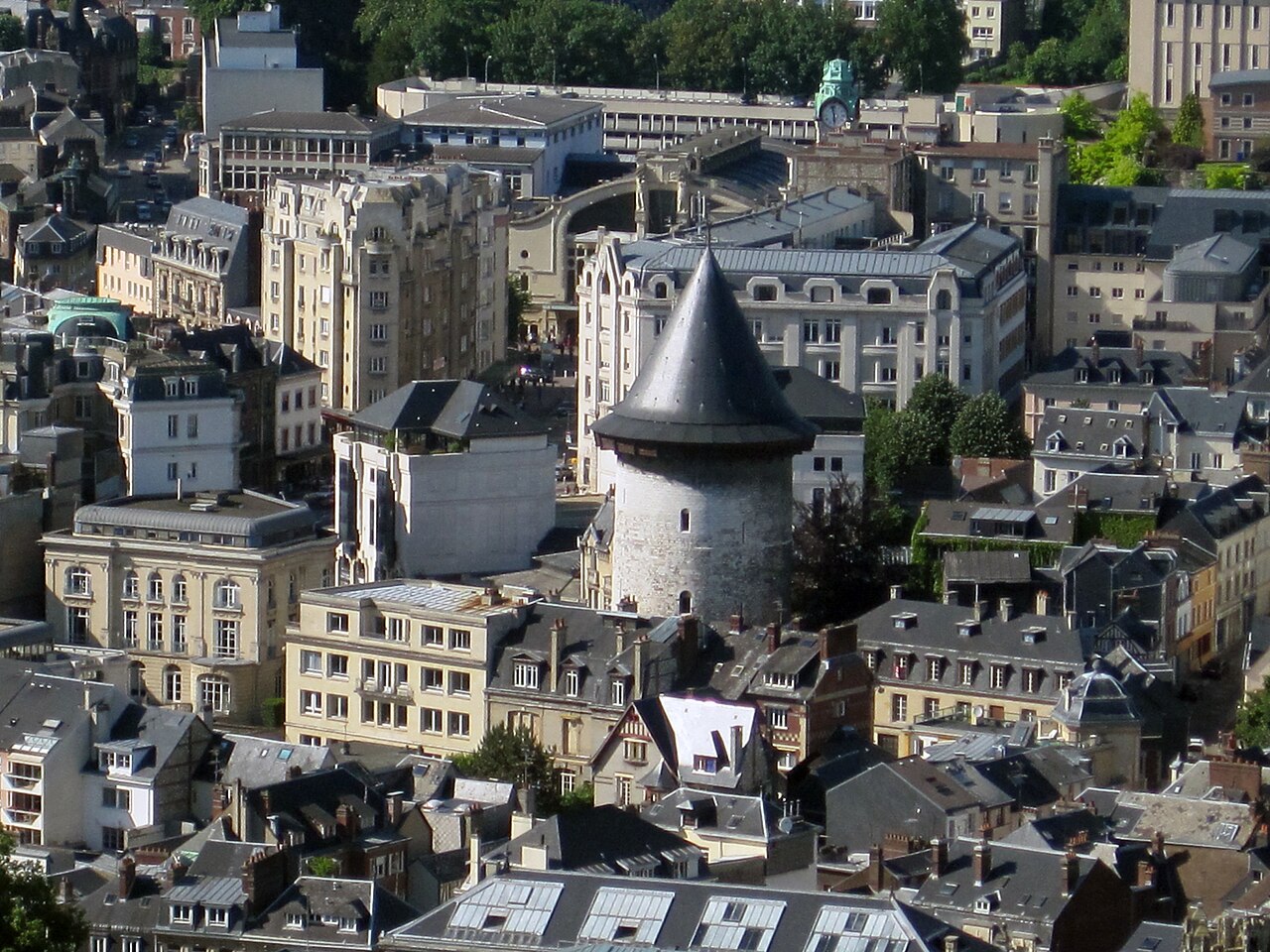
Rouen Castle (Château Bouvreuil) was a fortified ducal and royal residence in the city of Rouen, capital of the duchy of Normandy, now in France. With the exception of the tower wrongly associated with Joan of Arc, which was restored by Viollet-le-Duc in the 19th century, the castle was destroyed at the end of the 16th century, its stones quarried for other construction.
The castle was built by Philip II of France from 1204 to 1210 following his capture of the duchy from John, Duke of Normandy and King of England. Located outside the medieval town to its north, in a dominant position on Bouvreuil hill, it played a military role in the Hundred Years' War and the Wars of Religion. The castle formed a large defensive triangle flanked at its corners by high round towers, the royal keep (now known as the Joan of Arc tower) at its northern point. The castle was erected upon the earlier site of a Gallo-Roman amphitheatre.
It was here that Joan of Arc was imprisoned on 23 December 1430.
In 1485, Charles VIII was the last king of France to reside at the castle. After the castle was no longer used as a residence, the fortress fell into a state of lapsed maintenance. On 24 July 1542, a fire caused an explosion of gunpowder that ravaged the towers at the castle's entrance.
The fortress's vulnerability to artillery led to orders given to demolish the castle in 1590. The dismantling of the castle began in 1591, starting with parts of the towers and ramparts.
Formerly known as the castle's donjon or "Grosse Tour", this tower is part of Philip's 1204 phase. It housed one of the sessions of Joan of Arc's trial on 9 May 1431, one in which she was shown the instruments of torture, to which she replied "Truly, if you have to pull my members and my soul from my body, I shall say nothing else; and if I say something to you, I would always say to you afterwards that you made me say it by force."
The tower was classified as a Historic Monument in 1840 and was subject to ongoing restoration spanning from 1868 to 1884, during which the tower was rebuilt and a pointed roof was added. During the Second World War the tower was camouflaged and turned into a bunker by the occupying German forces. It is now open to the public.
Text adapted from “Rouen Castle” on Wikipedia, CC BY-SA 4.0.
Rouen Castle ranks #2,201 of 9,035 worldwide in the atlas's castle fame ranking, and #167 of the 787 mapped in France. Founded 1204, it is older than 74% of the atlas's dated landmarks, one of 1090 atlas entries founded in the 13th century. Its Wikipedia articles were opened 3,153 times in the last 60 days, more than 79% of the atlas. 3 more atlas landmarks stand within 25 km. The nearest day-trip guide is Évreux, 47 km away. It is one of the 33 landmarks on the atlas's regional map of Normandy. See how France compares in the castle statistics.
View on the interactive castle map →