 Japan · 17th century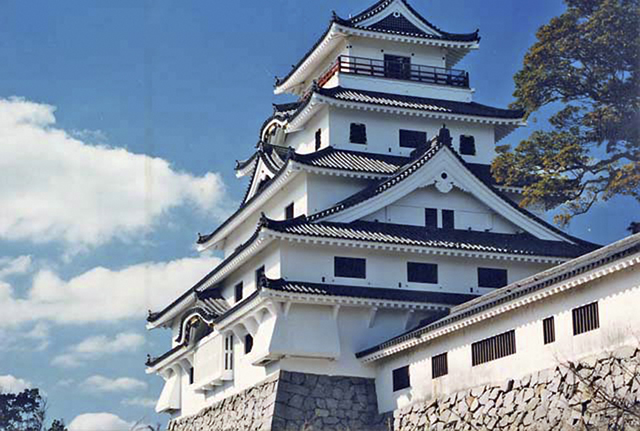
Karatsu Castle (唐津城, Karatsu-jō) is a Japanese castle located in Karatsu, Saga Prefecture, Japan. It is a hirayamajiro, a castle built on a plain rather than a hill or mountain. At the end of the Edo period, Karatsu castle was home to the Ogasawara clan, daimyō of Karatsu Domain. It was also known as "Dancing Crane Castle" (舞鶴城, Maizuru-jō).
Karatsu Castle, which stands beside Karatsu Bay, is unusual in that the stonework rises directly out of the water, using the ocean as a natural moat. It is a medium-size castle with the Honmaru (inner bailey) located on top of Mount Manto, the Ni-no-maru (2nd bailey) and the San-no-maru (3rd bailey) in the west, and the outer structures to the south.
The Ni-no-maru secondary bailey contained the palace of the daimyō of Karatsu and the domain’s administrative offices. The innermost bailey would normally contain a donjon; however there is considerable dispute as to whether or not it actually ever did. Records indicate that a stone foundation base existed from at least 1627, but the Tokugawa government never authorized the construction of a donjon tower. The present donjon is a modern reconstruction based on artists assumptions on what a Keichō period (1596–1615) donjon should look like.
Terasawa Hirotaka, a retainer of Toyotomi Hideyoshi, became lord of Karatsu in 1595. In the Battle of Sekigahara in 1600, he joined the forces of Tokugawa Ieyasu and attacked Gifu Castle. He was rewarded with greater lands around Karatsu, forming a dominion of 123,000 koku. In 1598, he abandoned his original castle of Nagoya Castle, and started work on a new castle at Karatsu, using many materials from the old one, from 1602 1608. The Tokugawa shogunate ordered neighboring tozama domains to contribute to its construction, and they did so primarily by excavating its network of moats. In 1637, in part due to his failure to suppress the Shimabara rebellion, his lands were confiscated by the Shogunate.
Karatsu Domain was given over to the control of the Ōkubo clan (1649–1678), Matsudaira (Ogyū) clan (1678–1691), the Doi clan (1691–1762), Mizuno clan (1762–1817), until finally coming into the possession of the Ogasawara clan in 1762.
In June 1869, the title of daimyo was abolished, and in 1871, Karatsu Domain itself was abolished with the abolition of the han system, and became part of the new Saga Prefecture.
Text adapted from “Karatsu Castle” on Wikipedia, CC BY-SA 4.0.
Karatsu Castle ranks #2,028 of 9,035 worldwide in the atlas's castle fame ranking, and #125 of the 295 mapped in Japan. Founded 1602, it is older than 30% of the atlas's dated landmarks, one of 708 atlas entries founded in the 17th century. Its Wikipedia articles were opened 4,090 times in the last 60 days, more than 84% of the atlas. 1 more atlas landmarks stand within 25 km. The nearest day-trip guide is Kumamoto, 99 km away. It is one of the 37 landmarks on the atlas's regional map of Kyushu. See how Japan compares in the castle statistics.
View on the interactive castle map →