 England · 16th century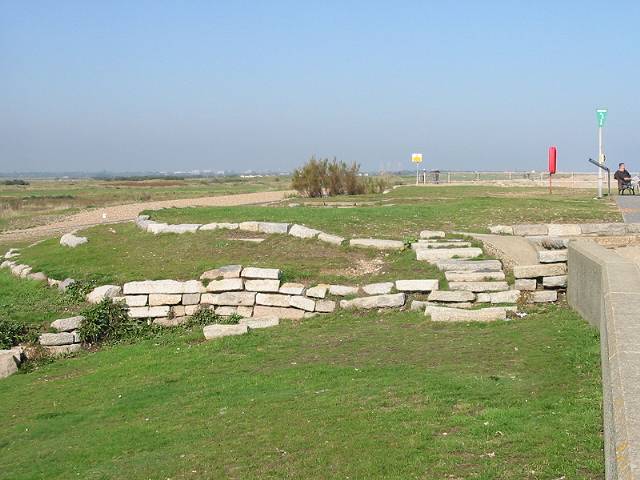
Sandown Castle was an artillery fort constructed by Henry VIII in Sandown, Kent, between 1539 and 1540. It formed part of the King's Device programme to protect against invasion from France and the Holy Roman Empire, and defended the strategically important Downs anchorage off the English coast.
Comprising a keep and four circular bastions, the moated stone castle covered 0.59 acres (0.24 ha) and had 39 firing positions on the upper levels for artillery, with 31 gunloops in the basement for handguns. It cost the Crown a total of £27,092 to build the three castles of Sandown, Walmer and Deal, which lay adjacent to one another along the coast and were connected by earthwork defences. The original invasion threat passed, but during the Second English Civil War of 1648–49, Sandown was seized by pro-Royalist insurgents and was only retaken by Parliamentary forces after several months' fighting.
By the 19th century, the castle was suffering badly from the effects of coastal erosion but remained in military use until 1863. The War Office then demolished the upper levels with explosives, carrying out a second wave of demolition work in 1882 and destroying most of the surviving stonework in 1893. The remains of Sandown were purchased by the town of Deal for £35 to form part of the local sea defences. The remaining masonry was encased in concrete in the late 1980s to form a sea wall but remains vulnerable to further erosion by the sea.
Text adapted from “Sandown Castle, Kent” on Wikipedia, CC BY-SA 4.0.
Sandown Castle ranks #4,242 of 9,079 worldwide in the atlas's castle fame ranking, and #279 of the 360 mapped in England. Founded 1539, it is older than 40% of the atlas's dated landmarks — one of 891 atlas entries founded in the 16th century. 6 more atlas landmarks stand within 25 km. The nearest day-trip guide is Southend-on-Sea, 58 km away. See how England compares in the castle statistics.
View on the interactive castle map →