 Germany · 18th century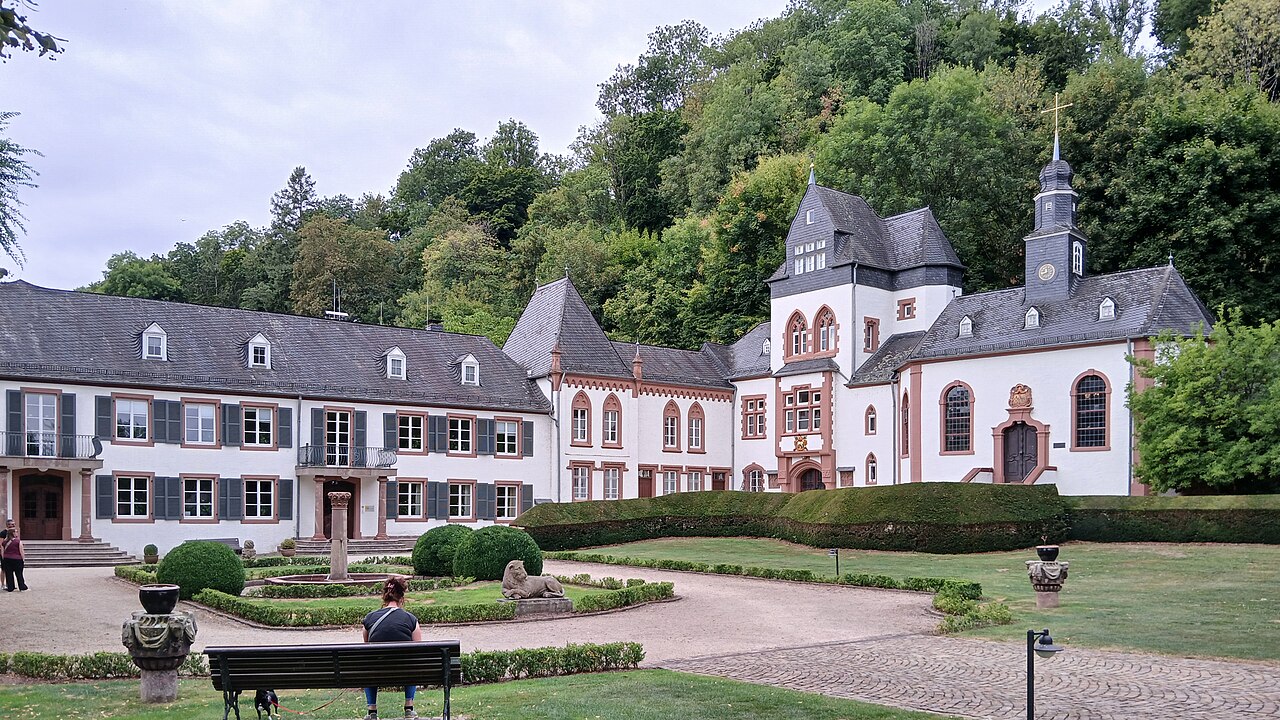
Dagstuhl is a computer science research center in Germany, located in and named after a district of the town of Wadern, Merzig-Wadern, Saarland.
Following the model of the mathematical center at Oberwolfach, the center is installed in a very remote and relaxed location in the countryside.
The Leibniz Center is located in a historic country house, Schloss Dagstuhl (Dagstuhl Castle), together with modern purpose-built buildings connected by an enclosed footbridge.
The ruins of the 13th-century fortress Dagstuhl Castle are nearby, a short walk up a hill from the Schloss.
Construction of the historic country house was started in 1760 on the orders of Count Joseph Anton Damian Albert von Oettingen-Baldern and Soetern, its chapel was built in 1763. A year after Count Joseph's death in 1778, his second wife, Maria Antonia von Walburg zu Zeil and Wurzach, married Prince Hermann Maria Friedrich Otto von Hohenzollern-Hechingen, but she had to flee Schloss Dagstuhl in the face of advancing French revolutionary troops in 1792.
After 1801's Treaty of Lunéville, Schloss Dagstuhl was nationalized but eventually acquired by the iron foundry in Rémilly, which greatly deforested Dagstuhl for timber.
In 1806, Schloss Dagstuhl was bought by Baron Guillaume Albert de Lasalle de Louisenthal who moved there with his family the following year. In 1815, Schloss Dagstuhl earned the right to be called a manor.
From 1839 to 1880, Octavie Elisabeth Maria de Lasalle von Louisenthal, dubbed the Painter Countess, worked on painting the chapel. She also cultivated contacts with the nuns of the Franciscan order in Waldbreitbach.
The de Lasalle von Louisenthal family made additions to the manor in 1905 and 1906, partly remodelling it in the neo-gothic style and adding the tower. While the remodelled castle grounds now house a stone lion that had adorned the old cattle market fountain in Trier as part of a quartet until 1898, the remodelling of the burial vault allows it to nowadays host Octavie's Stations of the Cross.
The last de Lasalle von Louisenthal to own the manor, Theodor Stephan Josef Heinrich de Lasalle von Louisenthal, died in a mental hospital in 1959 without leaving a legitimate heir, having been sterilized on account of the Nazi's Sterilisation Law as he suffered from depression and confusion after he was shot down with his fighter plane during the First World War.
Text adapted from “Dagstuhl” on Wikipedia, CC BY-SA 4.0.
Schloss Dagstuhl ranks #5,878 of 9,079 worldwide in the atlas's castle fame ranking, and #510 of the 711 mapped in Germany. Founded 1760, it is older than 15% of the atlas's dated landmarks — one of 696 atlas entries founded in the 18th century. Its Wikipedia articles were opened 1,209 times in the last 60 days, more than 56% of the atlas. 2 more atlas landmarks stand within 25 km. The nearest day-trip guide is Trier, 31 km away. It is one of the 51 landmarks on the atlas's regional map of the Moselle. See how Germany compares in the castle statistics.
View on the interactive castle map →