 Germany · 17th century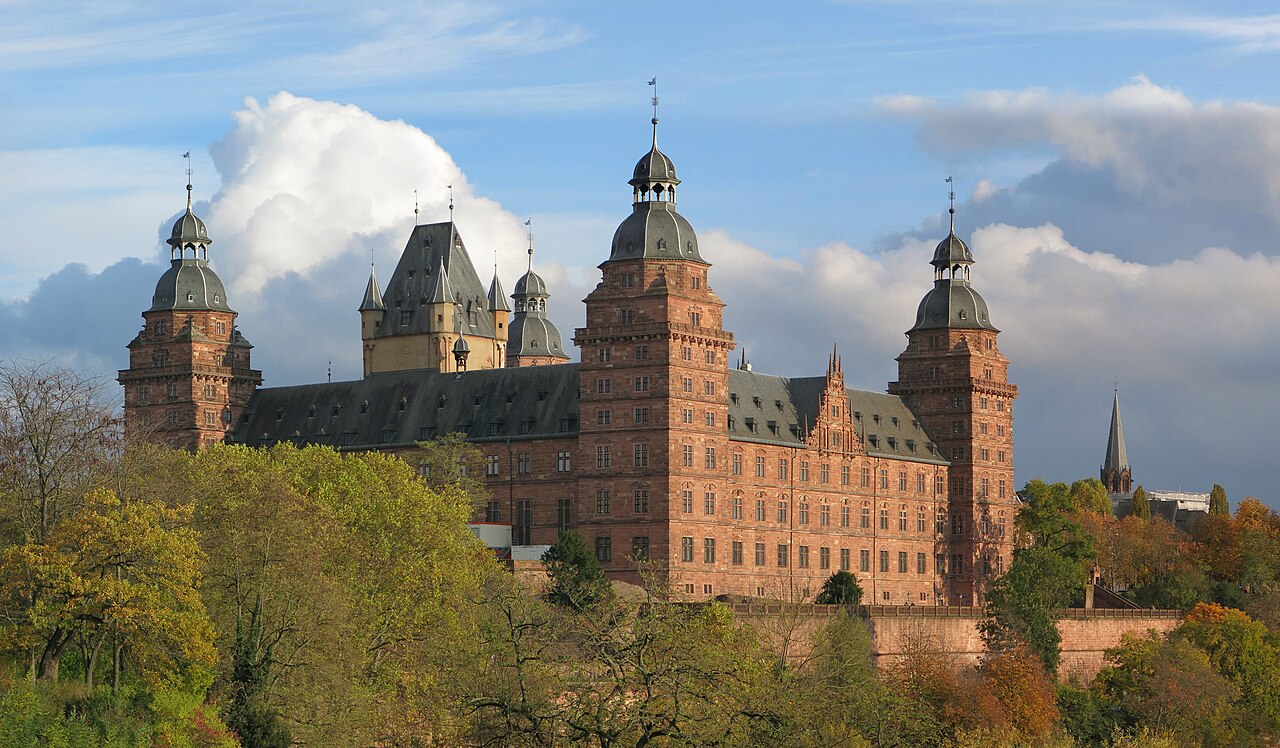
Schloss Johannisburg (German pronunciation: [ˈʃlɔs joˈhanɪsbʊʁk]) is a schloss in the town of Aschaffenburg, in Franconia, in the state of Bavaria, Germany. It was erected between 1605 and 1614 by the architect Georg Ridinger for Johann Schweikhard von Kronberg, Prince Bishop of Mainz. Until 1803, it was the second residence of the Archbishop and Prince Elector of Mainz. It is constructed of red sandstone, the typical building material of the Spessart, the hills near Aschaffenburg.
Text adapted from “Schloss Johannisburg” on Wikipedia, CC BY-SA 4.0.
Schloss Johannisburg ranks #1,008 of 9,079 worldwide in the atlas's castle fame ranking, and #78 of the 711 mapped in Germany. Founded 1605, it is older than 30% of the atlas's dated landmarks — one of 721 atlas entries founded in the 17th century. Its Wikipedia articles were opened 6,044 times in the last 60 days, more than 89% of the atlas. 3 more atlas landmarks stand within 25 km. The nearest day-trip guide is Frankfurt, 36 km away. See how Germany compares in the castle statistics.
View on the interactive castle map →