 Germany · 13th century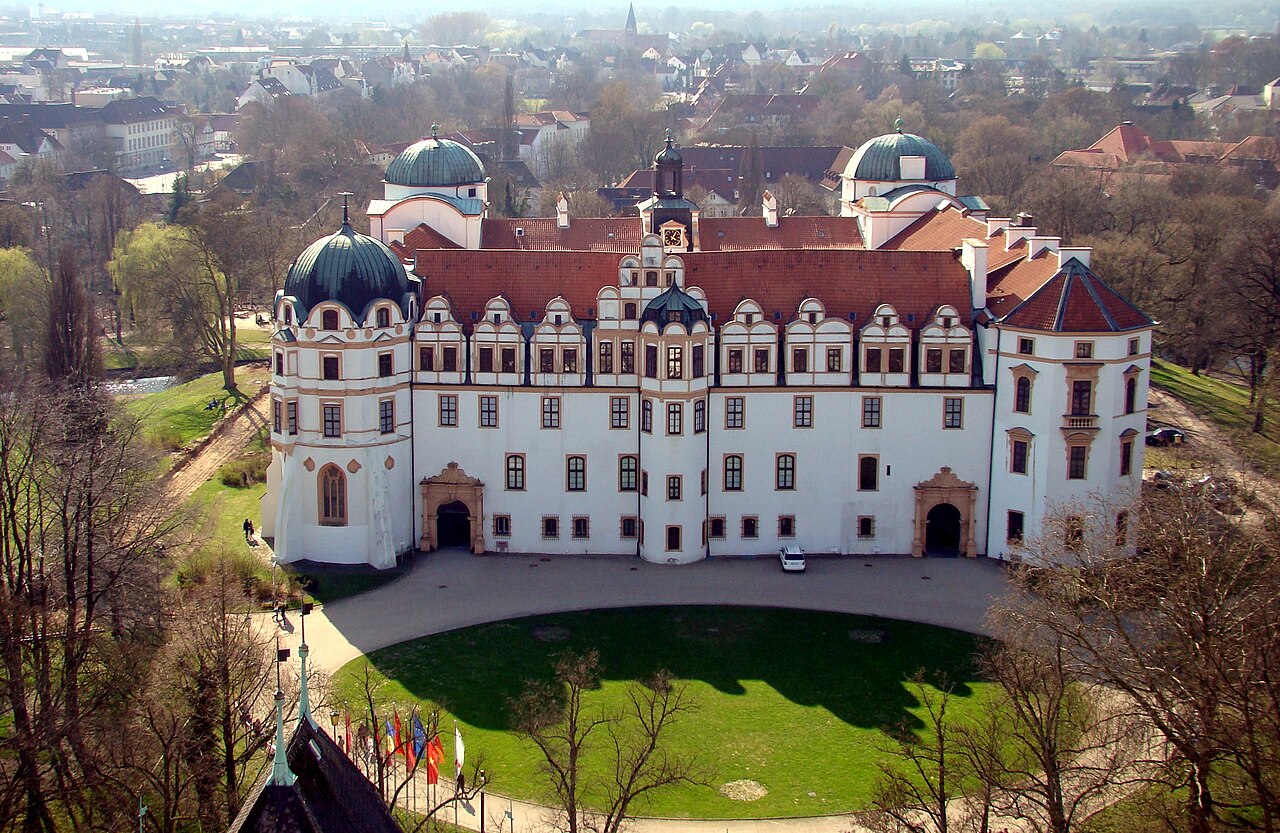
Celle Castle (German: Schloss Celle) or, less commonly, Celle Palace, in the German town of Celle in Lower Saxony, was one of the residences of the House of Brunswick-Lüneburg. This quadrangular building is the largest castle in the southern Lüneburg Heath region.
Celle Castle is based on a fortified wall tower (Wehrturm) with the character of a water castle, which guarded a ford over the River Aller. This first fortification, called Kellu, was built by a Brunonen count around 980 AD. Another forerunner of the castle, which may have been an extension of the wall tower, was founded in 1292 by Otto the Strict. The cellar vault and the lower stories of the watch tower have survived to the present day. Its ruins lie underneath the castle theatre. Around 1315 the actual Castrum Celle was first recorded. As a consequence of the War of the Lüneburg Succession, in 1378 the Dukes of Brunswick-Lüneburg moved their Residenz from Lüneburg to Celle and began transforming the Burg, now encircled by ditches and embankments, into a Schloss.
About a century later the castle was further expanded by Frederick the Pious from 1471 to 1478, and the castle chapel was consecrated in 1485. Ernest I the Confessor had the castle decorated from 1530 in the Renaissance style. At the same time, between 1520 and 1560, the defences, in the form of ramparts and bastions, were pushed further out. At this time the castle was typical of its era, a quadrangular building with a rectangular courtyard, massive corner towers, a large main tower and characteristic features of Weser Renaissance.
From 1670 onwards alterations to the castle were carried out by Duke George William, which were intended to transform the old renaissance seat into a contemporary Residenz. George William was keen on building, typical of the princes of his time, and made further changes that were intended to recall his time in Italy. The façades, which were copied from Venetian buildings, were then given their present-day appearance. Notable features include the corona of gables that encircles the roofs, and the unusual shape of the domed towers. The addition of the castle theatre and the Baroque state rooms stem from this period.
On the death of George William in 1705 the absolute rule of the dukes ended. The Principality of Lüneburg subsequently passed, along with the Principality of Calenberg, to the Kingdom of Hanover.
Text adapted from “Celle Castle” on Wikipedia, CC BY-SA 4.0.
Celle Castle ranks #1,149 of 9,079 worldwide in the atlas's castle fame ranking, and #92 of the 711 mapped in Germany. Founded 1292, it is older than 64% of the atlas's dated landmarks — one of 1080 atlas entries founded in the 13th century. Its Wikipedia articles were opened 4,563 times in the last 60 days, more than 85% of the atlas. See how Germany compares in the castle statistics.
View on the interactive castle map →