 Austria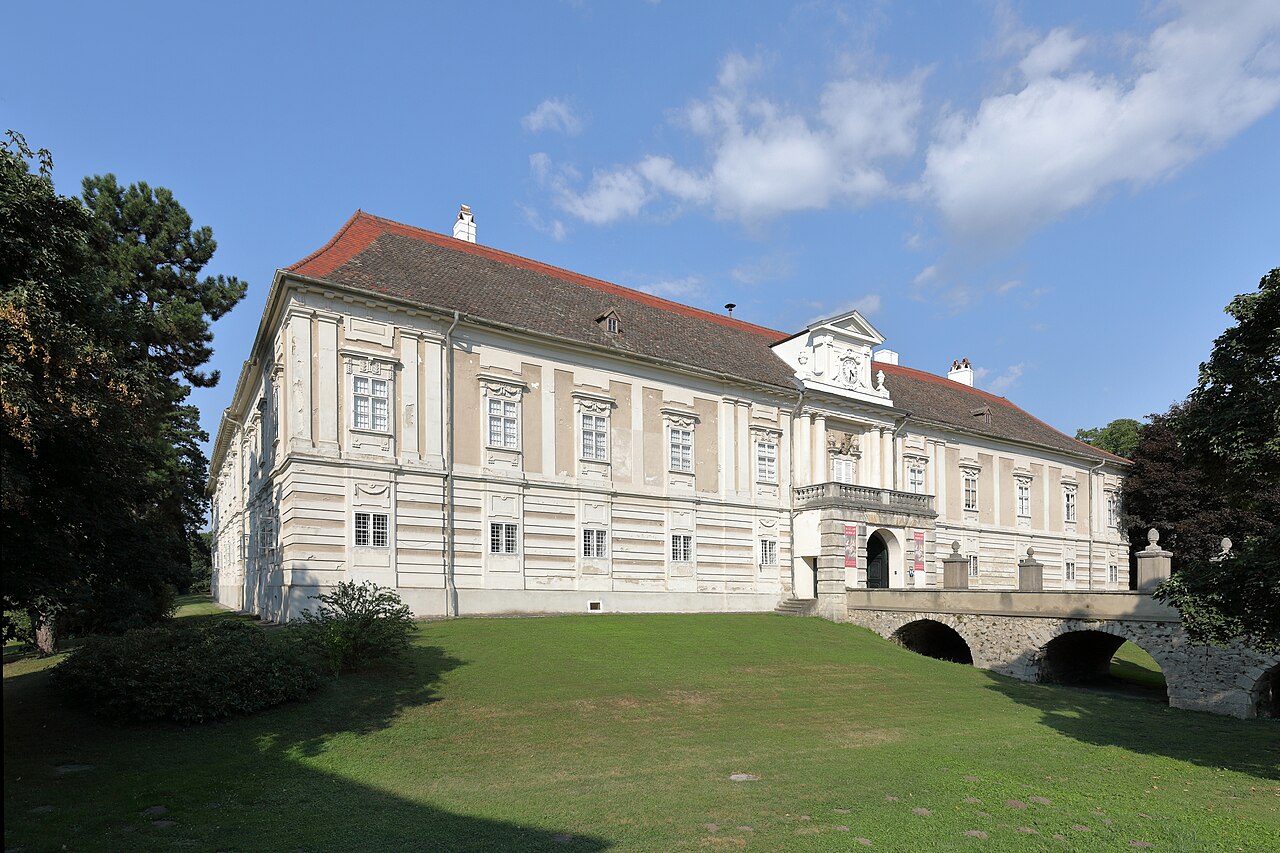
Schloss Rohrau is a castle in the town of Rohrau in Lower Austria, bordering on Burgenland. The building houses the art collection of the counts of Harrach.
Agnes of Poitou (d. 1077), the widow of Emperor Henry III, gave some lands, which extended from Petronell-Carnuntum on the Danube to Rohrau, to Count Palatine Rapoto V of Bavaria from the Counts of Vohburg, who died in 1099. At the beginning of the 12th century his descendent Diepold III, Margrave of Vohburg, gave the lands to Hugo von Liechtenstein (d. 1156) who had come to Austria in his knightly entourage. Hugo built Liechtenstein Castle about 45 km to the west on a fief that he received from the Babenberg margraves of Austria and named himself after it. He was the progenitor of the House of Liechtenstein, the ruling family of the Principality of Liechtenstein. Petronell and Rohrau, which became his own property in 1142 from feudal property, remained important Liechtenstein seats in the High Middle Ages.
Dietrich de Rorow, a member of the Liechtenstein family, was the first to be mentioned under this name in 1240. His line died out in 1278 with Dietrich III. His daughter Diemut married Leutold I von Stadeck († 1292/95). After the death of the last Johann Stadeck in 1399, Duke Wilhelm wanted to give it to his brother Ernst dem Eisernen, but heiress Guta married Hermann II, Count of Celje and received it from King Wenceslaus IV of Bohemia as a gift. In 1402, Rohrau came into the hands of Ulrich, son of Hugo von Montfort-Pfannberg, who inherited from Guta. In 1404, King Ruprecht gave the castle and dominion of Rohrau to the Counts of Montfort who owned it for 120 years.
The Harrach family first appeared in southern Bohemia in the 13th century, later in neighbouring Mühlviertel, including the wealthy town of Freistadt. The Harrachs owned estates in Styria and Carinthia at one time, but their main interests shifted to Vienna (see Palais Harrach) and Lower Austria.
Leonhard III von Harrach inherited the castle and in 1524, during the Counter-Reformation, his son Leonhard IV took the side of the Catholics. He was granted nobility in 1552 and, in 1584, the Order of the Golden Fleece. In 1586, he retired after 55 years of service to the court of Vienna and devoted himself to the Rohrau castle. He died in 1590 and was buried in the Augustinian Church, Vienna. In 1593, the Turks stormed the castle.
Text adapted from “Schloss Rohrau” on Wikipedia, CC BY-SA 4.0.
Schloss Rohrau ranks #3,221 of 9,079 worldwide in the atlas's castle fame ranking, and #80 of the 240 mapped in Austria. 22 more atlas landmarks stand within 25 km. The nearest day-trip guide is Bratislava, 22 km away. See how Austria compares in the castle statistics.
View on the interactive castle map →