Ruin
Beijing city fortifications
🇨🇳 China · 15th century
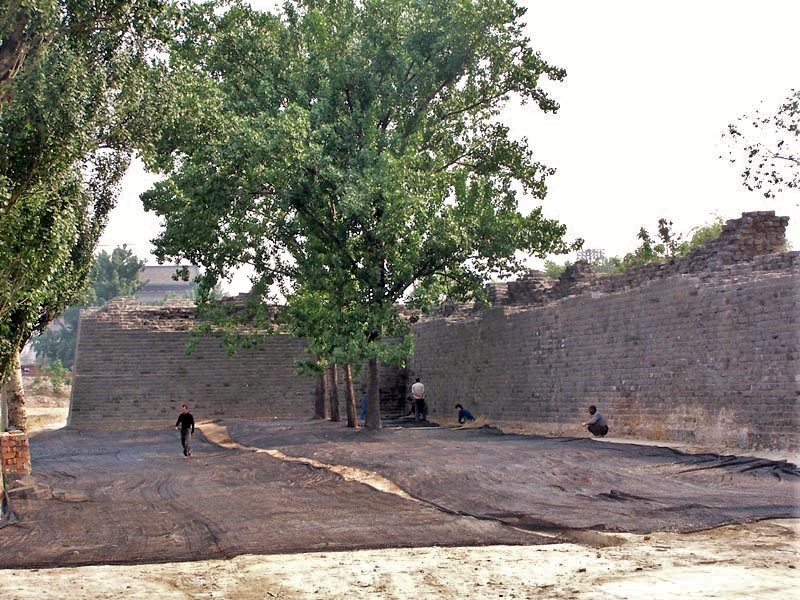
The Beijing city fortifications were a system of walls with towers and gates constructed in the city of Beijing, China in the early 1400s and mostly demolished in the 1950s and 1960s. The entire perimeter of the Inner and Outer city walls stretched for approximately 60 kilometres (37 mi).
Beijing was the capital of China for the majority of the Yuan, Ming, and Qing dynasties, as well as a secondary capital of the Liao and Jin dynasties. As such, the city required an extensive fortification system around the Forbidden City, the Imperial City, the Inner City, and the Outer City. Fortifications included gate towers, gates, archways, watchtowers, barbicans, barbican towers, barbican gates, barbican archways, sluice gates, sluice gate towers, enemy sighting towers, corner guard towers, and a moat system. It had the most extensive defense system in Imperial China.
After the collapse of the Qing dynasty in 1911, Beijing's fortifications were gradually dismantled. The Forbidden City has remained largely intact and has become the Palace Museum. Most of the Inner City fortifications were demolished 1965 for the construction of the 2nd Ring Road and Line 2 of the Beijing Subway. Some fortifications remain intact, including Tiananmen, the gate tower and watchtower at Zhengyangmen, the watchtower at Deshengmen, the southeastern corner guard tower, and a 1.5-kilometre (0.93 mi)-long section of the Inner city wall near Chongwenmen, just south of the Beijing railway station. The latter two components now form the Beijing Ming City Wall Ruins Park. Almost all of the walls of the Outer City and all of its gates were demolished during the 1950s. Yongdingmen was completely reconstructed in 2004.
Text adapted from “Beijing city fortifications” on Wikipedia, CC BY-SA 4.0.
Beijing city fortifications ranks #1,042 of 8,134 worldwide in the atlas's castle fame ranking, and #26 of the 119 mapped in China. Founded c. 1425, it is older than 51% of the atlas's dated landmarks — one of 455 atlas entries founded in the 15th century. Its Wikipedia articles were opened 5,916 times in the last 60 days, more than 87% of the atlas. 15 more atlas landmarks stand within 25 km. The nearest day-trip guide is Beijing, 5 km away. See how China compares in the castle statistics.
View on the interactive castle map →Frequently asked questions
Where is Beijing city fortifications?
Beijing city fortifications stands in China, at 39.89873°, 116.35103°.
When was Beijing city fortifications built?
The atlas dates its founding to c. 1425. Earlier structures may have stood on the site; this is the earliest documented founding year.
How famous is Beijing city fortifications?
In this atlas's fame ranking: #1,042 of 8,134 worldwide, and #26 in China. Fame here combines how many Wikipedia language editions cover a landmark with how many people read them.
What is the nearest castle to Beijing city fortifications?
Zhengyangmen, about 3 km away.
More castles in China
- Yanmen Pass China
- Yangguan China · 2nd century BC
- City Wall of Nanjing China · 14th century
- Guia Fortress China · 19th century
More ruins
- Castro de Elviña Spain
- Arbeia England
- Isca Augusta Wales · 1st century
- Housesteads Roman Fort England