 England · 14th century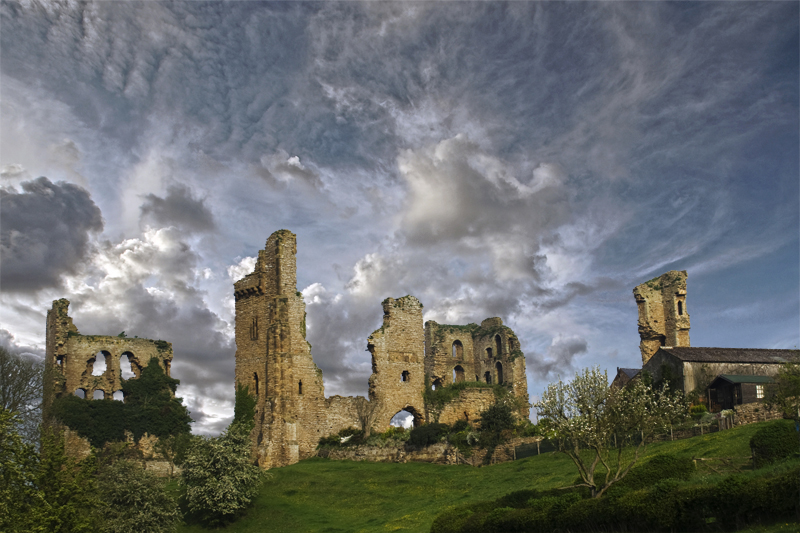
Sheriff Hutton Castle is a ruined quadrangular castle in the village of Sheriff Hutton, North Yorkshire, England. The site of the castle is 10 miles (16 km) north of York, and 8 miles (13 km) south-east of Easingwold.
The original motte and bailey castle, the remains of which can be seen to the south of the churchyard, was built here in the Forest of Galtres by Bertram de Bulmer, Sheriff of York during the reign of King Stephen (c. 1135–1154).
The stone castle was built at the western end of the village by John, Lord Neville in the late fourteenth century. In 1377, John Neville obtained a charter for a market on Monday and an annual fair on the eve of the exaltation of the Holy Cross (14 September). A licence to crenellate was granted by Richard II in 1382, although it is unknown whether building work had commenced before this date. The building has been credited to John Lewyn, who also built nearby Bolton Castle in 1378, on stylistic and documentary grounds. Stylistic details in common with Bolton include the tower parapets stepping up to form turrets, as well as the general arrangement of a quadrangle with massive rectangular corner towers.
This arrangement was popular for castles in the north of England in the late 14th century, also being used at Wressle (Yorkshire) and Lumley (Durham), as well as the rather earlier Chillingham (Northumberland).
The castle passed to John's son, Ralph Neville, the first Earl of Westmorland. Upon Ralph's death in 1425, the Neville estates were partitioned. Ralph's grandson, Ralph Neville, 2nd Earl of Westmorland, retained the title and the Durham estates and his younger son by his second marriage, Richard Neville, 5th Earl of Salisbury, retained the Yorkshire estates, including Sheriff Hutton.
Upon the death of Salisbury's son, Richard Neville, 16th Earl of Warwick, in 1471 at the Battle of Barnet, his lands were given to Richard, Duke of Gloucester, brother of Edward IV by right of his wife, Anne Neville. Richard often stayed at the castle during his tenure as Lord of the North. Its proximity to York made it convenient to Richard.
By the middle of October 1480, Richard was at Sheriff Hutton where he received news from the Earl of Northumberland that the Scots might attempt retaliation for the raiding party that Richard had led across the borders.
Text adapted from “Sheriff Hutton Castle” on Wikipedia, CC BY-SA 4.0.
Sheriff Hutton Castle ranks #3,688 of 9,079 worldwide in the atlas's castle fame ranking, and #251 of the 360 mapped in England. Founded 1382, it is older than 53% of the atlas's dated landmarks — one of 755 atlas entries founded in the 14th century. Its Wikipedia articles were opened 1,461 times in the last 60 days, more than 61% of the atlas. 7 more atlas landmarks stand within 25 km. The nearest day-trip guide is Sheffield, 84 km away. See how England compares in the castle statistics.
View on the interactive castle map →