 Poland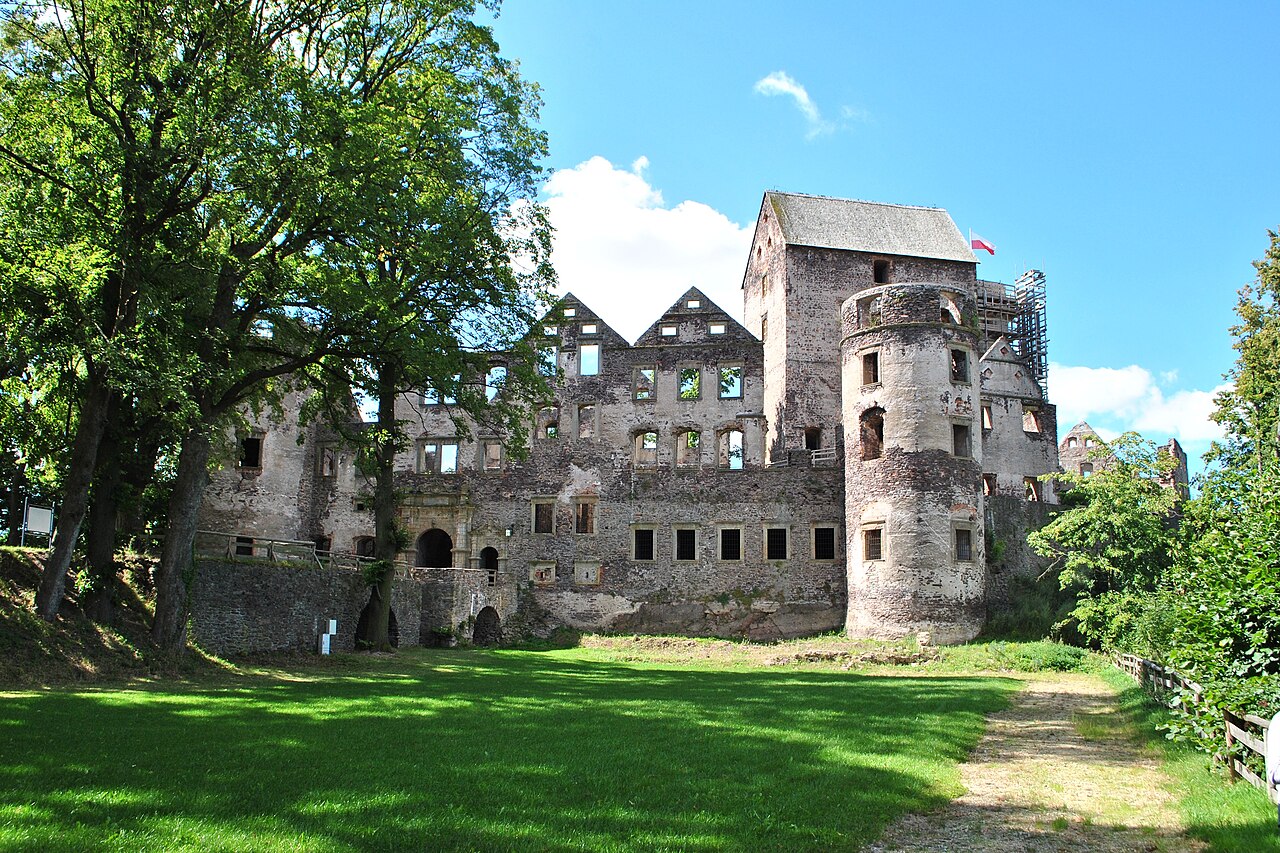
Świny Castle (Polish: Zamek Świny; formerly Schweinhausburg in German) - formerly a gord, as a stronghold existed in its location already in the fifth century - securing the Lubawecki mountain pass, the site was recorded in Cosmas' documents from 1108, where the gord is recorded as Suini in Poloniae. Possibly, soon after, the gord had been expanded into a military stronghold, at which time it was the seat of the castellans. The castle was mentioned in Pope Adrian IV's Papal bull.
By the 13th century, it had prominent owners including Tader in 1230, Jaksa in 1242, and Piotr of Świn in 1248. In the 1270s, Bolko I the Strict's decision led to the loss of its status as a castellany to the newer Bolków Castle. By 1272, the castle had transitioned to knightly ownership, with "dominus Jan de Swin" mentioned in a document from Bolesław the Tall, Duke of Wrocław. In 1313, Piotr de Svyne was noted in the entourage of Bernard of Świdnica. The Śwink family (von Schweinichen) took ownership in the early 14th century, with Henricus de Swyn documented as the owner in 1323. After the Bolków Castle was constructed, the castle began to lose its significance.
In the mid-14th century, the Śwink family replaced the wooden fortifications with a four-story residential-defense tower made from stone, featuring 2.5-meter thick walls. The tower, measuring 12 by 18 meters, had a cellar and was topped with a gabled roof. Its Gothic entrance portal still survives.
In the mid-15th century, Günzel von Schweinichen added a two-gabled residential building and new perimeter fortifications. Between 1614 and 1660, Johann Sigismund von Schweinichen transformed the castle into a Renaissance residence. He also established a theosophical circle and a mystical-theosophical library in Świny. The mystic Jakob Böhme stayed at the castle in 1624 and wrote "Epistle to the Longing and Hungry Soul."
Text adapted from “Świny Castle” on Wikipedia, CC BY-SA 4.0.
Świny Castle ranks #3,562 of 9,035 worldwide in the atlas's castle fame ranking, and #129 of the 397 mapped in Poland. Its Wikipedia articles were opened 1,574 times in the last 60 days, more than 63% of the atlas. 16 more atlas landmarks stand within 25 km. The nearest day-trip guide is Wałbrzych, 23 km away. It is one of the 80 landmarks on the atlas's regional map of Lower Silesia. See how Poland compares in the castle statistics.
View on the interactive castle map →