 Lebanon · 12th century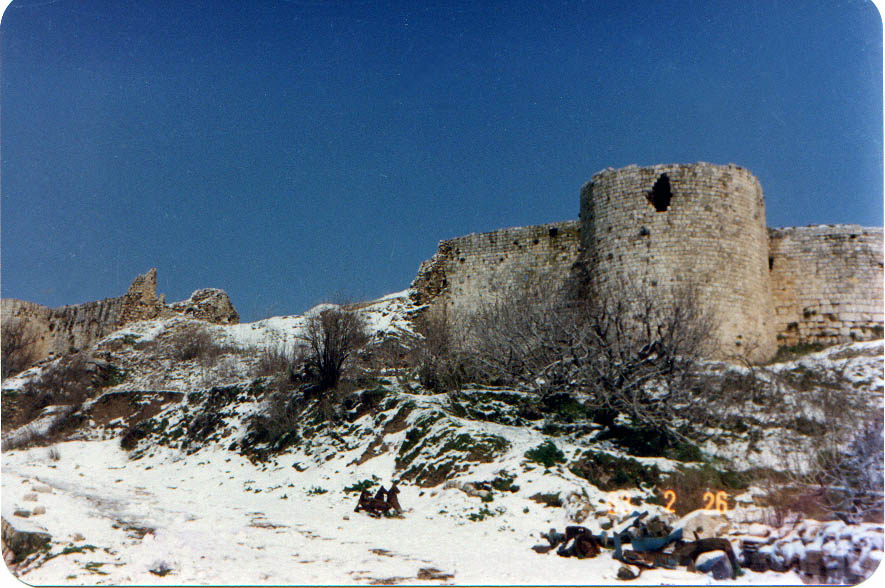
Toron, now Tibnin or Tebnine in southern Lebanon, was a major Crusader castle, built in the Lebanon mountains on the road from Tyre to Damascus. The castle was the centre of the Lordship of Toron, a seigneury within the Kingdom of Jerusalem, actually a rear-vassalage of the Principality of Galilee.
The castle was built by Hugh of Fauquembergues, prince of Galilee, in 1106 AD to assist in capturing Tyre. After Hugh's death, the surroundings of Tibnin were raided by 'Izz al-Mulk, who killed the populace and made off with booty. Tibnin was made an independent seigneury, given to Humphrey I before 1109.
After Humphrey I of Toron, the castle and lordship of Toron successively passed to his descendants Humphrey II and Humphrey IV. Banias, which had been given to Baldwin II by the Assassins in 1128, was inherited by Toron in approximately 1148 when Humphrey II married the daughter of Renier Brus, lord of Banias and Assebebe. Humphrey II sold parts of Banias and Chastel Neuf to the Knights Hospitaller in 1157. Banias was merged with Toron until it fell to Nur ad-Din Zangi on 18 November 1164, and when it was recovered it became part of the Seigneury of Joscelin III of Edessa (see below).
Humphrey IV was also the prince of Oultrejourdain. Toron remained in Crusader possession until 1187, when it fell to the forces of Saladin after the Battle of Hattin in which Saladin all but destroyed the Crusader states. Ten years later, in November, 1197, Toron was besieged by the German contingent of the Crusade of 1197 and would have fallen. However, the Muslim garrison by the tribesmen of El-Seid and Fawaz held out until relief arrived from Egypt.
In 1219 Sultan al-Mu'azzam secretly had the defences of Toron, and of other castles, dismantled. This was done because the forces of the Fifth Crusade had captured the more crucial defences at Damietta on the Nile Delta and were now threatening Cairo. Sultan al-Mu'azzam was prepared to exchange the strongholds in Palestine for the ones in Egypt, but wished not to give strong defendable cities to the Crusaders if he could avoid it. Although the exchange proved unnecessary, the geographical position of the sites remained important for the Crusaders who were interested in recovering Jerusalem from Muslim control.
Text adapted from “Toron” on Wikipedia, CC BY-SA 4.0.
Toron ranks #1,414 of 9,079 worldwide in the atlas's castle fame ranking, and #2 of the 17 mapped in Lebanon. Founded 1105, it is older than 85% of the atlas's dated landmarks — one of 756 atlas entries founded in the 12th century. Its Wikipedia articles were opened 2,713 times in the last 60 days, more than 76% of the atlas. 6 more atlas landmarks stand within 25 km. The nearest day-trip guide is Nabatieh, 21 km away. It is one of the 106 landmarks on the atlas's regional map of the Levant. See how Lebanon compares in the castle statistics.
View on the interactive castle map →