 Poland · 13th century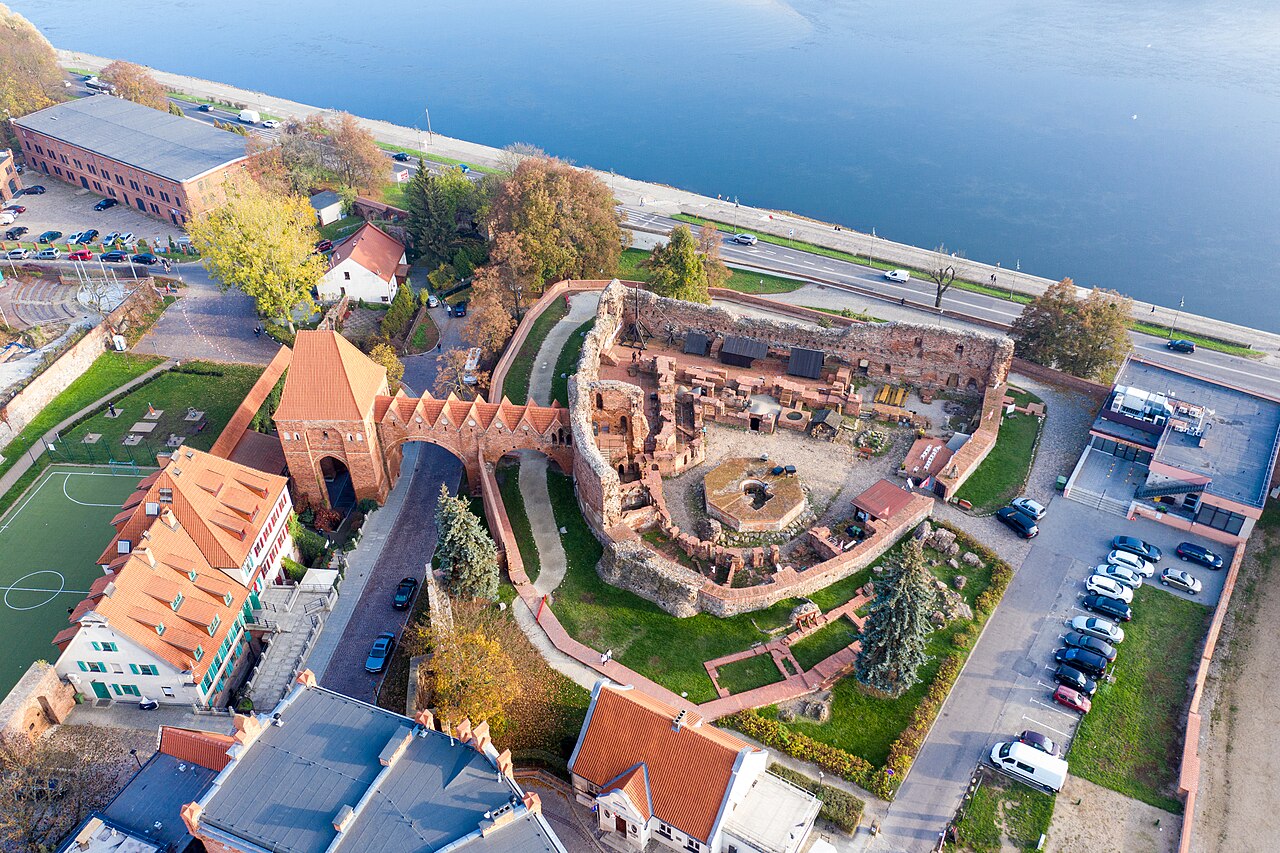
Toruń Castle is a 13th- or 14th-century castle of the Teutonic Order located in Toruń, Poland. The castle is part of the Medieval Town of Toruń, one of the World Heritage Sites in Poland and Historic Monuments of Poland.
The Toruń Castle was one of the first castles built by the order in the territory enfeoffed to them by Duke Konrad I of Masovia. The construction started in the mid 13th century, and continued for about a hundred years. It was the first Teutonic castle in the Chełmno Land. The new town of Toruń grew together with the Teutonic fortifications protecting it. The palace's historic value comes from the fact that it was the base for the Teutonic Knights when they began their first mission to colonize pagan Old Prussians, and subsequently the formation of the Teutonic state. The castle's first known function was as the residence of a Teutonic commander.
Little of the castle survives to the present day, as it has been demolished in centuries since, with much destruction occurring during a town rebellion in 1454. The city rebelled on 4 February, and a few days later the small Teutonic garrison negotiated a surrender; they were allowed to leave the castle and the city. Shortly afterward, on 8 February, the castle was plundered, and then the Toruń city council decided that it would be demolished to prevent the Teutonic Knights from reoccupying it. This event marked the beginning of the Thirteen Years' War (1454–66).
The castle was partially excavated, rebuilt and turned into an historical monument in 1966 during the time of the People's Republic of Poland for the 500th anniversary of the Second Peace of Thorn.
Unlike most later Teutonic castles, it was not a four-winged, rectangular conventional castle; instead it had only two wings, laid out in a pattern similar to that of a horseshoe.
The largest section of the castle to survive to present day is the garderobe tower (dansker). The tower is located over a stream that joins the nearby Vistula river.
The other section of the former castle remaining today are the cellars. Other sections of the former castle now function as permanent exhibits. The permanent exhibits, which are mostly in the palace's vaults, are displayed in settings such as the armoury, kitchen, dormitory, scriptorium, and the mint.
Text adapted from “Toruń Castle” on Wikipedia, CC BY-SA 4.0.
Toruń Castle ranks #1,712 of 9,079 worldwide in the atlas's castle fame ranking, and #56 of the 398 mapped in Poland. Founded c. 1236, it is older than 72% of the atlas's dated landmarks — one of 1080 atlas entries founded in the 13th century. Its Wikipedia articles were opened 3,067 times in the last 60 days, more than 78% of the atlas. 10 more atlas landmarks stand within 25 km. The nearest day-trip guide is Toruń, 1 km away. It is stop 1 of 9 on the Teutonic castle road, Toruń to Malbork. See how Poland compares in the castle statistics.
View on the interactive castle map →