 Georgia · 4th century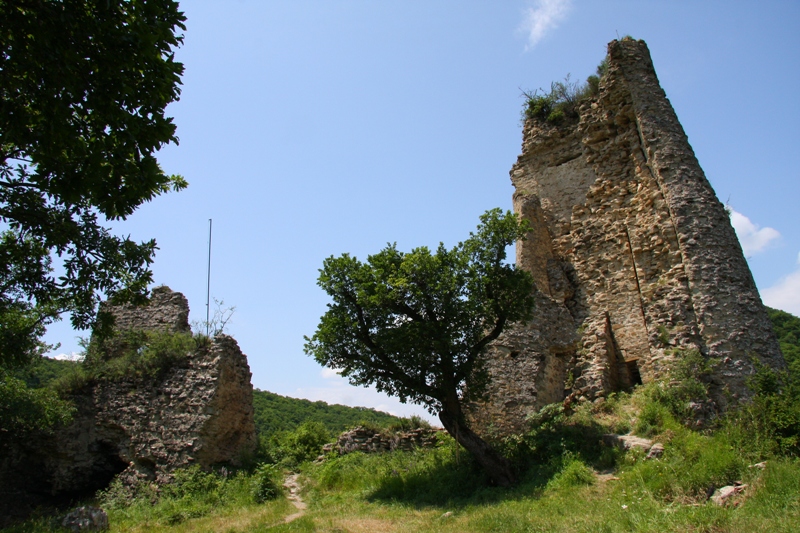
Ujarma (Georgian: უჯარმის ციხე) is a medieval fortress-town at the Outer Kakheti region, in the municipality of Sagarejo Municipality, Georgia. It is located on the right bank of the river Iori, on the Tbilisi — Telavi road, 4 km (2.48 mi) north of Ujarma village, near Gombori Pass through Tsiv-Gombori Range in the historical-geographical province Gare Kakheti.
According to Georgian chronicler Leonti Mroweli, the cornerstone of the Ujarma fortress was built by the King of Iberia, Aspacures I, in the 3rd to 4th centuries. In the reign of King Vakhtang Gorgasali and King Dachi, the fortress was extended and used as a residence. During their time, the citadel was built with strong towers and strong walls, palaces and churches. After Vakhtang V made Ujar one of his residences in the second half of the century, the fortress-town experienced a special rise. 4th to 8th century Ujar played an important role in the history of the country.
Ujamara was conquered in 914 when the Arabs invaded the Caucasus mountains, formerly dominated by the Persians. The fight left severe destruction in the building. The upper fortress was destroyed in the 10th century by the Arab conqueror Abul Kassim, but was restored in the 12th century by King George III.
After that the importance of Ujarma falls and continues to exist as a small settlement. In the 12th century Ujar restored King George III - (1156 - 1184) and made it his treasure.
The Mongol domination in the 13th century, the disintegration of the Kingdom of Georgia into kingdoms at the end of the 15th century, gradually reduced the importance of Ujarma and made the once prosperous city a small place.
The fortress consisted of two parts: the Upper Fortress (the Citadel) and the Lower City. A royal palace, consisting of a two-storey building, was located in the eastern part of the Citadel. The Upper Fortress was destroyed in the 10th century by the Arabian conqueror Abul Kassim but was restored in the 12th century by King George III who used it as a treasury.
The fortress-city was built on a high hill on the right bank of the river Iori and was the closing gate of the narrow exit of Ivory. The city had several doors. The main door was to the west of the castle. There are watchtowers in the main citadel of the castle-town. The ruins of a two-storey residential building were found in the northeast corner of the castle.
Text adapted from “Ujarma fortress” on Wikipedia, CC BY-SA 4.0.
Ujarma Fortress ranks #2,296 of 9,079 worldwide in the atlas's castle fame ranking, and #12 of the 48 mapped in Georgia. Founded c. 350, it is older than 97% of the atlas's dated landmarks — one of 14 atlas entries founded in the 4th century. Its Wikipedia articles were opened 1,395 times in the last 60 days, more than 60% of the atlas. 1 more atlas landmarks stand within 25 km. The nearest day-trip guide is Tbilisi, 32 km away. See how Georgia compares in the castle statistics.
View on the interactive castle map →