Ruin
Vilsegg Castle
🇦🇹 Austria · 13th century
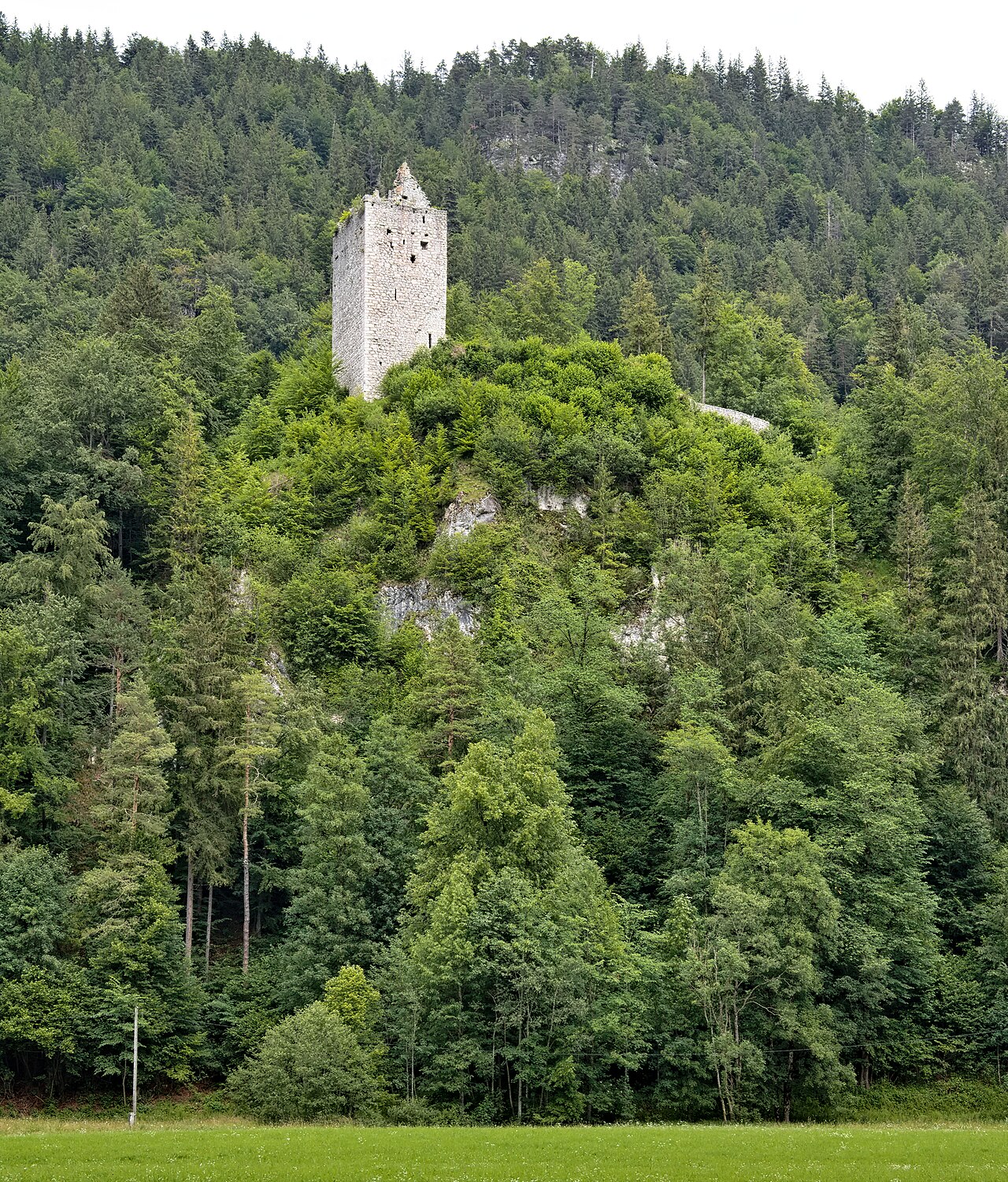
Vilsegg Castle (German: Burg Vilsegg) is a former fortification in the Austrian state of Tyrol that stands about a kilometre northwest of the little town of Vils, between Pfronten and Füssen, a few hundred metres away from the Austro-German border.
The ruins of the hill castle stand about 60 metres (200 ft) above the Vils valley on an 887-metre-high rocky mountain on the edge of the Salober Mountains, which run along the border between Germany and Austria.
The castle hill drops steeply away on all sides; thus the fortress was very difficult to attack despite its relatively low situation above the valley. Vilsegg lies about 350 metres (1,150 ft) lower than its neighbouring castle on the German side of the border – the Falkenstein.
In 1263, Henry of Vilsegg, a Dienstmann of the lords of Hohenegg, was mentioned as being at the castle. The Hoheneggs were, in turn, vassals (Lehnsmänner) of the Bishopric of Kempten. The castle had probably been built by around 1220/30 and is one of the most important examples of Hohenstaufen architecture in Tyrol.
The ministeriales of Vilsegg were last mentioned in 1314; after that the Hoheneggs themselves occupied the castle.
At the start of the 14th century Count Meinhard II of Tyrol sought to enlarge his territory at the expense of his neighbours. He also seized several castles belonging to the Hoheneggs, such as the nearby cave castle of Loch near Pinswang; however, Vilsegg held this at least until 1408 as a fief of the Bishopric of Kempten. Finally the bishopric enfeoffed the Duke of Austria with the castle and lordship, both of which were granted as an afterlehen to the Hoheneggs.
In 1671, John Francis, the last of the Hoheneggs, died and the subfief was returned to Austria; the Roman-German emperor was therefore legally a direct vassal of the bishopric in respect of the Barony of Vilsegg. The castle was occupied until at least 1709 by Austrian governors (Pfleger), but is shown on a 1774 map as a ruin.
1806 saw its transfer to the Kingdom of Bavaria, but in 1816 the town, castle and barony was finally returned to Austria as a result of the Congress of Vienna.
In 1939, large sections of the walls collapsed during an earthquake (for example the east wall of the bergfried with its elevated entrance). In 1953 the bergfried was made safe by the Austrian Federal Monuments Department.
Text adapted from “Vilsegg Castle” on Wikipedia, CC BY-SA 4.0.
Vilsegg Castle ranks #6,065 of 8,134 worldwide in the atlas's castle fame ranking, and #166 of the 201 mapped in Austria. Founded c. 1220, it is older than 75% of the atlas's dated landmarks — one of 861 atlas entries founded in the 13th century. 4 more atlas landmarks stand within 25 km. The nearest day-trip guide is Innsbruck, 66 km away. See how Austria compares in the castle statistics.
View on the interactive castle map →Frequently asked questions
Where is Vilsegg Castle?
Vilsegg Castle stands in Austria, at 47.5567°, 10.6261°.
When was Vilsegg Castle built?
The atlas dates its founding to c. 1220. Earlier structures may have stood on the site; this is the earliest documented founding year.
How famous is Vilsegg Castle?
In this atlas's fame ranking: #6,065 of 8,134 worldwide, and #166 in Austria. Fame here combines how many Wikipedia language editions cover a landmark with how many people read them.
What is the nearest castle to Vilsegg Castle?
Falkenstein Castle (Pfronten), about 3 km away.
More castles in Austria
- Burgruine Steinschloß Austria
- Burgruine Eppenstein Austria · 12th century
- Burgruine Hardegg Austria · 12th century
- Burgruine Gradenegg Austria · 12th century
More ruins
- Gösting Castle Austria · 11th century
- Burgruine Gurnitz Austria
- Burgruine Waisenberg Austria
- Burgruine Weidenburg Austria · 15th century