 Germany · 13th century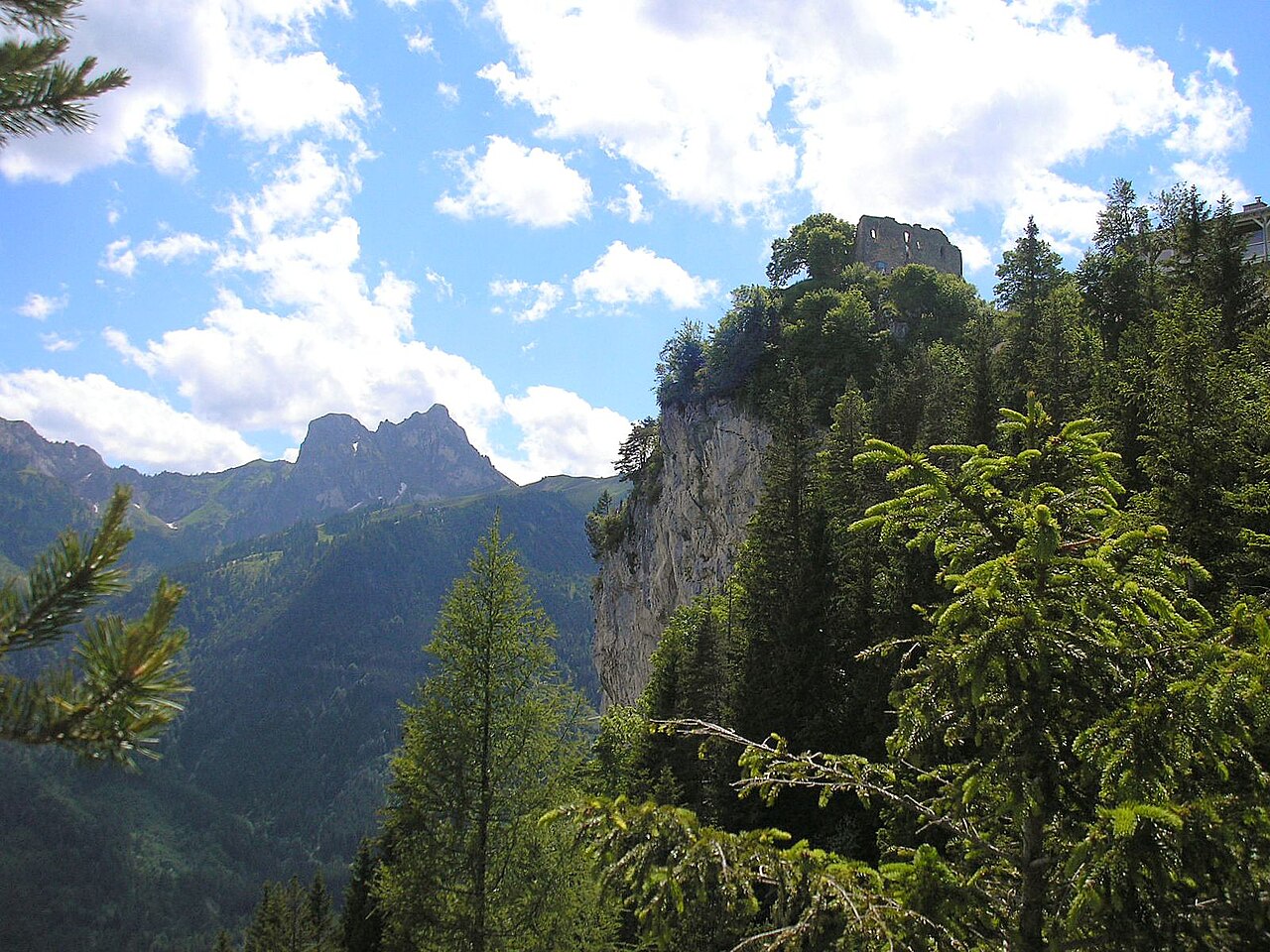
Falkenstein Castle or Castrum Pfronten is the ruin of a castle in the Bavarian Alps, near Pfronten, Germany. At 1,277 metres (4,190 ft) above sea level, it is Germany's highest castle. King Ludwig II of Bavaria purchased the ruin in 1883 and planned to construct a fairy tale castle, but the plans were abandoned upon his death in 1886.
The ruins of Falkenstein Castle are located on the eponymous Falkenstein 1,277 metres (4,190 ft) above sea level, making it Germany's highest elevated castle.
Originally known as Castrum Pfronten, the stone castle was built approximately 1270–1280 by Count Meinhard II of Tyrol on the borders of his land. Because of the unusual situation of the castle it has been interpreted in historical context as a symbol of opposition to the Duchy of Bavaria. (During the winter the castle was dangerous to inhabit because of the high altitude at which it is located.) The name Castle Falkenstein only came into use in the 15th century.
The castle was largely destroyed in the 17th century. In 1646, towards the end of the Thirty Years' War, the Austrian outposts of Falkenstein, Eisenberg, and Hohenfreyberg were set on fire on the orders of the Tyrolean state government to prevent them from being used by the approaching Protestants. The attackers changed their line of advance, so the destruction was unnecessary. All three castles have remained uninhabited ruins since.
King Ludwig II of Bavaria purchased the ruin in 1883 and commissioned several architects, the first being Christian Jank (the designer of Neuschwanstein), to replace the existing structure with a romantic castle.
Jank first created a restrained design, but later envisioned the castle in a dramatic, High Gothic style. Georg von Dollmann was employed to produce plans and elevations in the same year based on Jank's design. However, his modest and economical designs displeased Ludwig.
The task of redesigning Falkenstein was then given to Max Schultze, the Prince Thurn und Taxis' architect, who was flattered by the royal commission. He not only planned the architecture of the castle in a robber baron's style (a highly simplified version of Jank's sketch), but also began creating the castle's interior design and frescos (in a secular Byzantine style) with the help of August Spieß. Of particular note was Ludwig's bedroom, which was reminiscent of a vast chapel.
Text adapted from “Falkenstein Castle (Pfronten)” on Wikipedia, CC BY-SA 4.0.
Falkenstein Castle (Pfronten) ranks #1,823 of 9,035 worldwide in the atlas's castle fame ranking, and #141 of the 709 mapped in Germany. Founded 1280, it is older than 64% of the atlas's dated landmarks, one of 1090 atlas entries founded in the 13th century. Its Wikipedia articles were opened 6,081 times in the last 60 days, more than 89% of the atlas. 4 more atlas landmarks stand within 25 km. The nearest day-trip guide is Innsbruck, 69 km away. It is stop 3 of 6 on Ludwig II’s castles, Hohenschwangau to Herrenchiemsee. See how Germany compares in the castle statistics.
View on the interactive castle map →