 Czech Republic · 15th century
Vranov Castle ranks #5,605 of 9,040 worldwide in the atlas's castle fame ranking, and #175 of the 243 mapped in Czech Republic. Founded 1425, it is older than 49% of the atlas's dated landmarks, one of 556 atlas entries founded in the 15th century. Its Wikipedia articles were opened 968 times in the last 60 days, more than 50% of the atlas. 14 more atlas landmarks stand within 25 km. The nearest day-trip guide is Liberec, 17 km away. It is one of the 189 landmarks on the atlas's regional map of Bohemia. See how Czech Republic compares in the castle statistics.
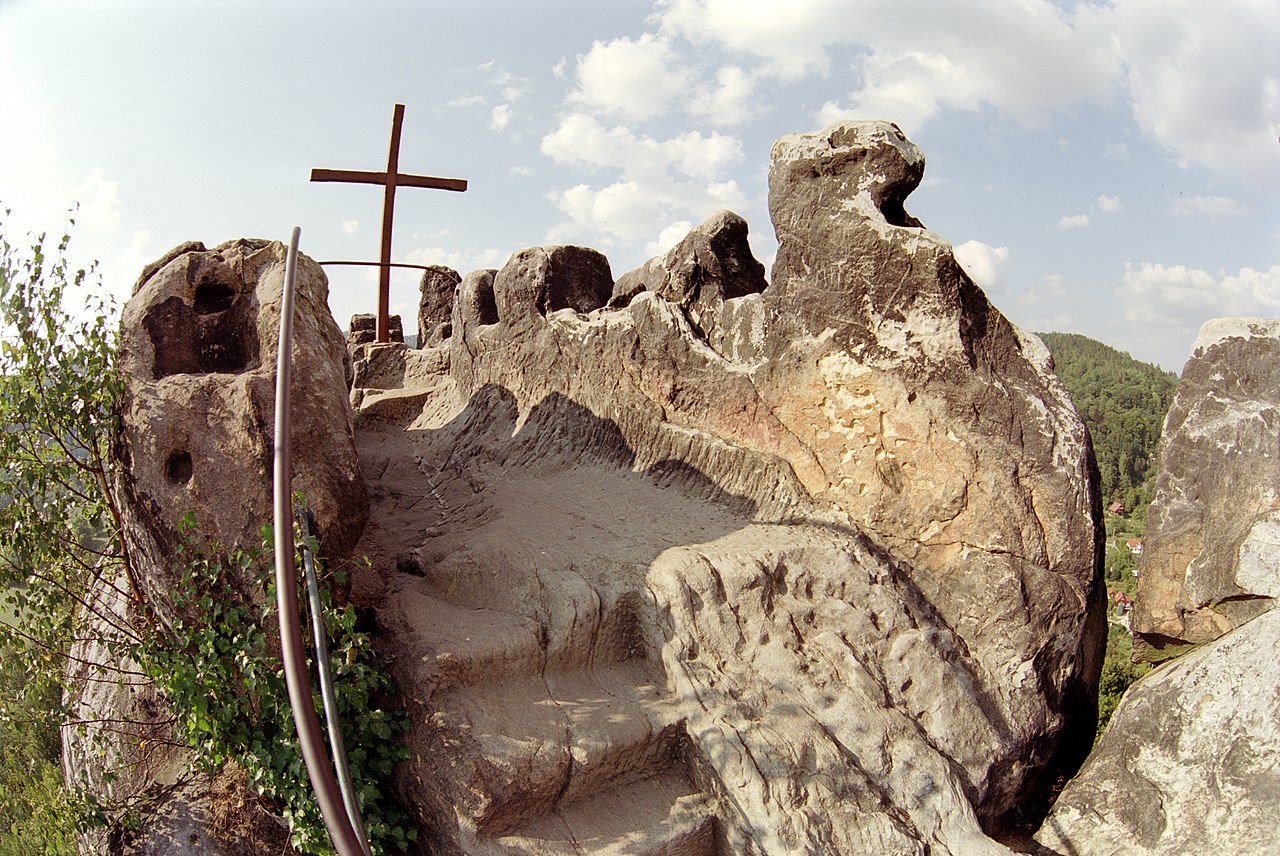
The rock castle Vranov (German: Wranow), today in Czech often called Skály or Skála, but also – pars pro toto – Pantheon, is located near Malá Skála (Kleinskal) in the Český ráj (Bohemian Paradise) above the valley of the Jizera. Of the medieval rock castle a whole series of rooms hewn out of the rock, passages, stairs, beam rebates and also the castle well survive today. The complex, several hundred metres long, is regarded as the most extensive and largest rock castle in Bohemia.
The castle still has supra-regional renown today through the so-called Pantheon, a spacious complex which the then owner Zacharias Baron von Römisch had built by the sculptor Franz Pettrich shortly after the end of the Wars of Liberation, which amounted to an extensive remodelling of the castle in the spirit of Romanticism. The Pantheon commemorates above all numerous military heroes from German and Habsburg history, though Czech personalities were also taken into account. The concept has been interpreted as an anticipation of that of the Walhalla. Central is a space enclosed by rocks dedicated to the leading personalities of the era of the Wars of Liberation; in the individual niches stood busts of the allied rulers (Tsar Alexander I, Emperor Francis I and King Frederick William III).
Furthermore two commanders each of the powers Russia, Austria and Prussia are honoured, namely Schwarzenberg and Colloredo-Mansfeld (Austria), Platov and Ostermann (Russia) as well as Blücher and Kleist (Prussia). The complex has by now largely fallen into decay, but is still clearly recognisable in its conception. The central original inscription read:
Another striking feature of the castle are the numerous maxims, aphorisms and poems in German engraved in the rock, most of which are still clearly legible today.
Machine-translated from “Felsenburg Vranov” on the German Wikipedia, CC BY-SA 4.0.
View on the interactive castle map →