 Croatia · 13th century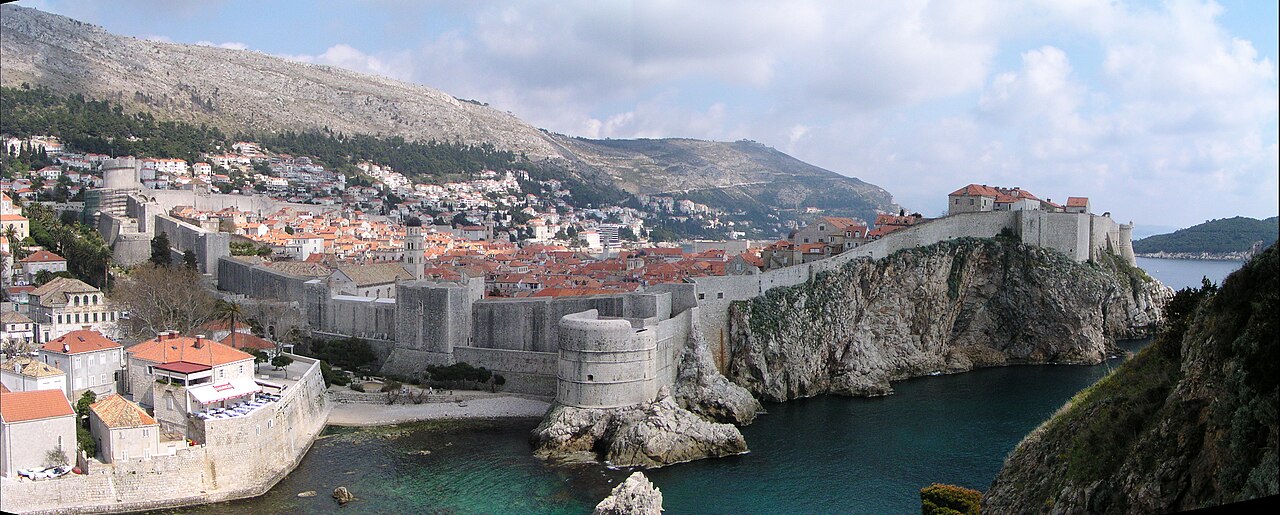
The Walls of Dubrovnik (Croatian: Dubrovačke gradske zidine) are a series of defensive stone walls surrounding the city of Dubrovnik in southern Croatia. Ramparts were built in the outlying areas of the city, including the mountain slopes as part of a set of statutes from 1272. The existing city walls were constructed mainly during the 13th–17th centuries. The walls run an uninterrupted course of approximately 1,940 metres (6,360 ft) in length, encircling most of the old city, and reach a maximum height of about 25 metres (82 ft).
Refugees from destroyed towns such as Epidaurus fled to what would become the defensive settlement of Dubrovnik (also known later as Ragusa) which would become a haven of refuge with the construction of its town walls. The walls were reinforced by three circular and 14 quadrangular towers, five bastions (bulwarks), two angular fortifications and the large St. John's Fortress. Land walls were additionally reinforced by one larger bastion and nine smaller semicircular ones, like the casemate Fort Bokar, the oldest preserved fort of that kind in Europe. The moat that ran around the outside section of the city walls, which were armed by more than 120 cannons, provided superb city defense capabilities.
In 1979, the old city of Dubrovnik, which includes a substantial portion of the old walls of Dubrovnik, joined the UNESCO list of World Heritage Sites. Today, the Walls of Dubrovnik are one of the most popular tourist attractions in Croatia, with more than 1.2 million visitors in 2019.
Text adapted from “Walls of Dubrovnik” on Wikipedia, CC BY-SA 4.0.
Walls of Dubrovnik ranks #337 of 9,079 worldwide in the atlas's castle fame ranking, and #2 of the 79 mapped in Croatia. Founded c. 1250, it is older than 67% of the atlas's dated landmarks — one of 1080 atlas entries founded in the 13th century. Its Wikipedia articles were opened 11,943 times in the last 60 days, more than 95% of the atlas. 4 more atlas landmarks stand within 25 km. The nearest day-trip guide is Nikšić, 70 km away. It is one of the 32 landmarks on the atlas's regional map of Dalmatia. It is stop 21 of 21 on the Dalmatian fortress coast, Zadar to Dubrovnik. See how Croatia compares in the castle statistics.
View on the interactive castle map →