 Germany · 19th century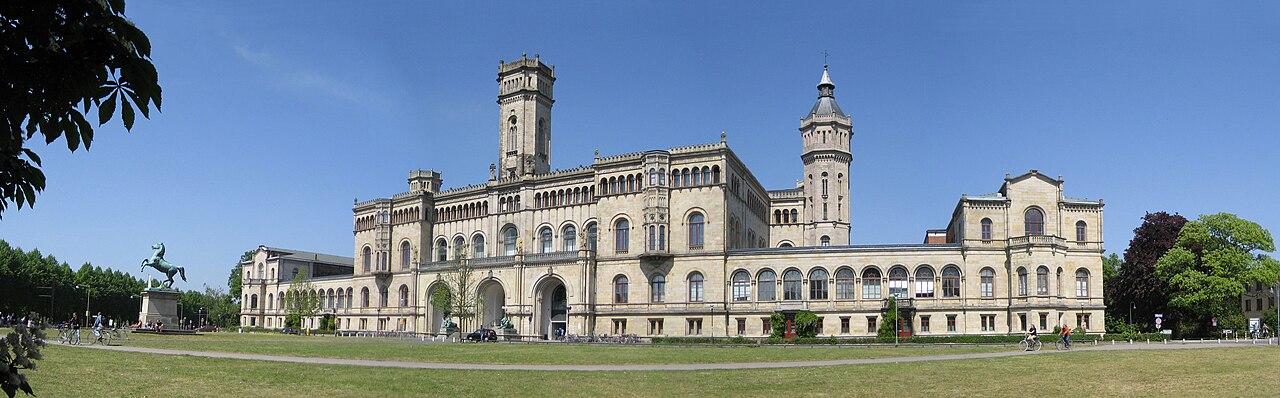
The Welfenschloss (lit. 'Guelph palace') is a former royal palace in Hanover, Germany, which serves as the main building of the Leibniz University Hannover. The university is housed in the palace since 1879. The palace is surrounded by a large English landscape garden, named the Welfengarten (lit. 'Guelph garden').
In 1856, king George V of Hanover (1819–1878) decided to build a new royal residence. Initially, only as a summer residence, but later intended as the main seat replacing the Leineschloss in the city centre. The king engaged the architect Christian Heinrich Tramm (1819–1861) to make the designs in neo-Gothic style. When Tramm died, he was replaced by the construction manager of the project, Eduard Heidelberg.
The site of the palace of previously occupied by another palace, Schloss Monbrilliant. This palace dated from the first half of the 18th century, and served as a summer residence of kings Ernest Augustus (1771–1851) and George V. Before construction of the new palace commenced, the old palace was demolished, and rebuilt in Georgsmarienhütte before finally being torn down in 1923.
Construction of the new palace started in 1857. Workers used yellowish-white sandstone from the Danndorf and Velpke areas near Helmstedt, one of the hardest sandstones in Germany, and sandstone from Nesselberg near Nesselberg.
The palace was initially named Schloss Königsitz, but in 1861 this was changed into Welfenschloss after the reigning dynasty, the House of Welf, of which the House of Hanover was the surviving branch. This also determined the iconography of the palace. On the side of the garden, the Welfengarten, the exterior is decorated with sculptures of eight significant Welf rulers. Around 1862 the sculptor Wilhelm Engelhard created the most important one, that of Henry the Lion (1129/1131-1195). On the entrance side, Adolf Rosenthal created the bronze Lions.
George V's reign ended as a result of the Austro-Prussian War in 1866 after the battle of Langensalza and Prussia annexing Hanover. Construction works ended, leaving the palace empty for over a decade. While the Welfenschloss was built, George V also constructed another neo-gothic castle, Marienburg castle, between 1858 and 1867, which he presented to his wife Marie of Saxe-Altenburg as a birthday present.
Text adapted from “Welfenschloss” on Wikipedia, CC BY-SA 4.0.
Welfenschloss ranks #2,903 of 9,079 worldwide in the atlas's castle fame ranking, and #225 of the 711 mapped in Germany. Founded 1857, it is older than 7% of the atlas's dated landmarks — one of 717 atlas entries founded in the 19th century. Its Wikipedia articles were opened 2,053 times in the last 60 days, more than 70% of the atlas. 4 more atlas landmarks stand within 25 km. See how Germany compares in the castle statistics.
View on the interactive castle map →