 Germany · 14th century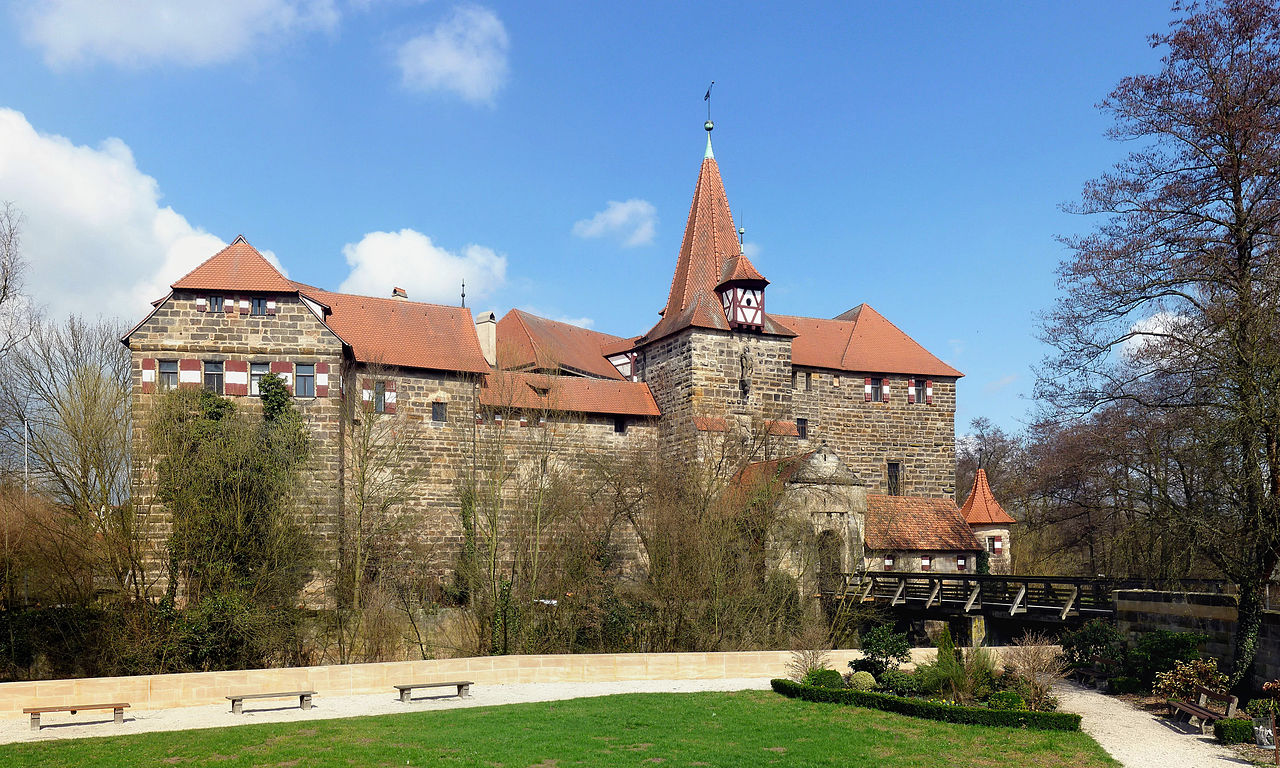
Lauf Castle (German: Wenzelschloss or Burg Lauf; Czech: hrad Lauf) was originally a medieval fortress in the town of Lauf an der Pegnitz near Nuremberg, Germany. The German name Wenzelschloss ("Saint Wenceslas' Castle") is derived from to the present day surviving statue of Saint Wenceslas, patron saint of Czechs, on the facade of the entrance gate. The castle was built by the Charles IV, Holy Roman Emperor in 1356, on the way between Prague and Nuremberg on the ruins of an older castle. The dominant feature of the castle is the hall of arms; in 1934, under a layer of old paint were discovered 112 coats of arms of noblemen of the Crown of Bohemia. It is the most precious collection of Bohemian, Moravian and Silesian secular and ecclesiastical heraldry.
Lauf laid in an area called the Bohemian Palatinate, which was once part of the Bohemian crown lands. In 1373 Emperor Charles IV ceded the castle along with parts of the Bohemian Palatinate to Otto V, Duke of Bavaria in exchange for the Margraviate of Brandenburg. Charles' son Wenceslaus IV lost the rest of the Palatinate in 1401.
Text adapted from “Lauf Castle” on Wikipedia, CC BY-SA 4.0.
Wenzelschloss ranks #5,782 of 9,079 worldwide in the atlas's castle fame ranking, and #502 of the 711 mapped in Germany. Founded 1356, it is older than 54% of the atlas's dated landmarks — one of 755 atlas entries founded in the 14th century. Its Wikipedia articles were opened 1,303 times in the last 60 days, more than 58% of the atlas. 11 more atlas landmarks stand within 25 km. See how Germany compares in the castle statistics.
View on the interactive castle map →