Castle
Zeze Castle
🇯🇵 Japan · 17th century
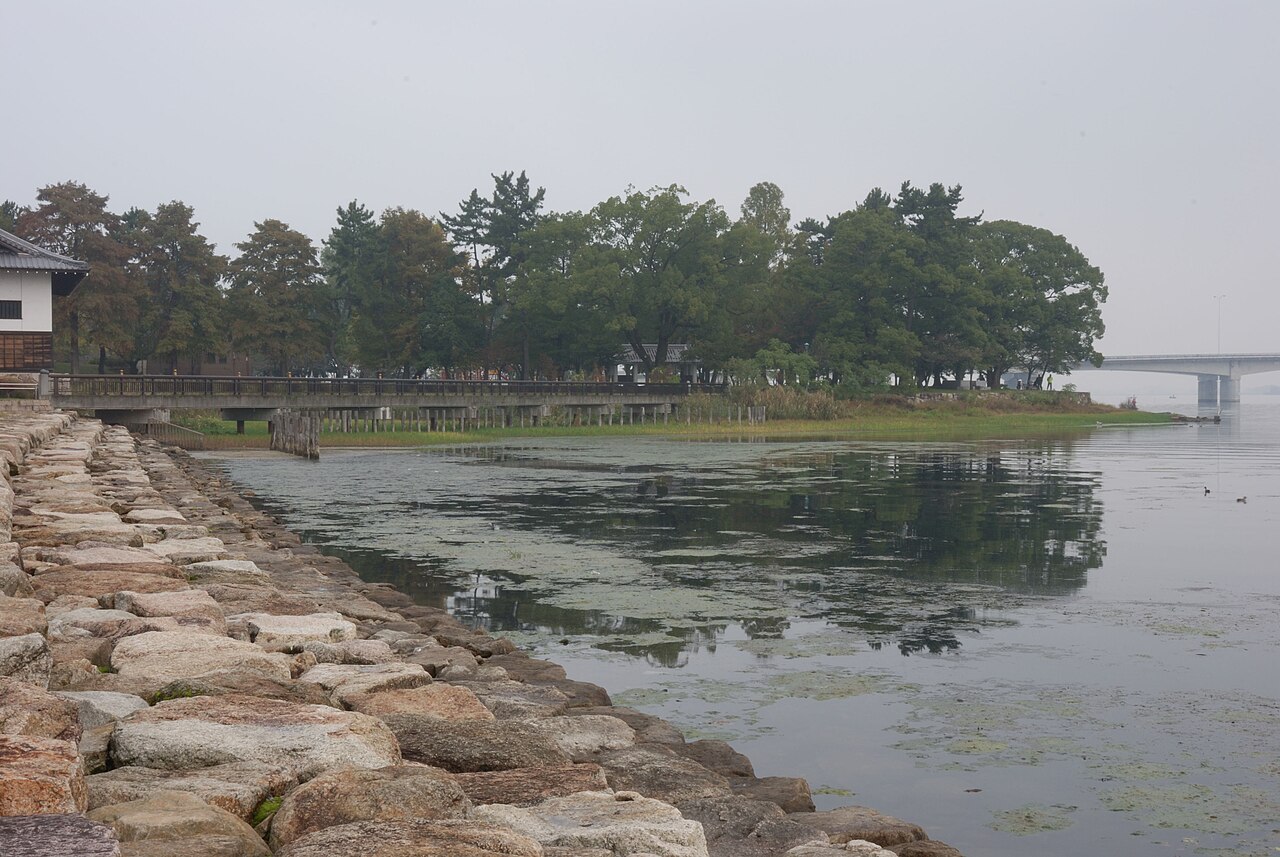
Zeze Castle (膳所城, Zeze-jō), is a hirashiro-style Japanese castle located in eastern part of the city of Ōtsu, Shiga Prefecture, Japan.
Zeze Castle is located on a peninsula jutting into Lake Biwa. Almost immediately after the Battle of Sekigahara, Tokugawa Ieyasu order the destruction of Ōtsu Castle and the construction of a new castle at this location in order to control the Tōkaidō highway connecting Kyoto with Edo and the provinces of eastern Japan. This was the most important highway in Edo Period Japan, and the location of Zeze Castle was even more strategically important as it was close to the Seta-no-Karahashi, an ancient bridge which marked the entrance to the capital. The layout of the castle was planned by Todo Takatora, who already had a reputation for castle design.
The construction work was assigned to the major western daimyō, with many materials from the demolished Ōtsu Castle used to speed construction. The tenshu, located in the western corner of the inner bailey was unusual in that it had a four-story design. The San-no-maru (Third Bailey) was on the shore, with the Ni-no-maru (Second Bailey) and Honmaru (Inner Baily) separated by stone walls and moats, each forming an island.
On its completion, the castle was assigned to Toda Kazuaki, who was appointed daimyō of the newly created Zeze Domain with a kokudaka of 30,000 koku. His son, Toda Ujizane, was reassigned to Amagasaki Domain in Settsu Province in 1617, and the castle came under the control of a number of fudai daimyō clans, most notably the Honda clan, who ruled over 13 generations from 1651 to the Meiji restoration.
The castle was severely damaged by an earthquake in 1662, and due to its lakeside location suffered from land erosion which required constant upkeep. In 1870, after the Meiji restoration, the structures of the castle were either destroyed or sold off. The site of the inner bailey has become the "Zeze Castle Ruins Park", with a few stone walls remaining a reconstructed gate. A number of the original castle gates have survived in various locations, including at the Zeze Shrine (Ōtemon Gate from the Honmaru), Shinozu Shrine (North Ōtemon Gate), and Muchisaki Hachiman-gu (South Ōtemon Gate). Each of these three gates has been designated as a National Important Cultural Property.
Text adapted from “Zeze Castle” on Wikipedia, CC BY-SA 4.0.
Zeze Castle ranks #3,427 of 8,134 worldwide in the atlas's castle fame ranking, and #176 of the 297 mapped in Japan. Founded 1601, it is older than 32% of the atlas's dated landmarks — one of 626 atlas entries founded in the 17th century. Its Wikipedia articles were opened 3,136 times in the last 60 days, more than 76% of the atlas. 15 more atlas landmarks stand within 25 km. The nearest day-trip guide is Kyoto, 12 km away. It is one of the 71 landmarks on the atlas's regional map of Kansai. See how Japan compares in the castle statistics.
View on the interactive castle map →Frequently asked questions
Where is Zeze Castle?
Zeze Castle stands in Japan, at 34.99527°, 135.89536°.
When was Zeze Castle built?
The atlas dates its founding to 1601. Earlier structures may have stood on the site; this is the earliest documented founding year.
How famous is Zeze Castle?
In this atlas's fame ranking: #3,427 of 8,134 worldwide, and #176 in Japan. Fame here combines how many Wikipedia language editions cover a landmark with how many people read them.
What is the nearest castle to Zeze Castle?
Sakamoto Castle, about 7 km away.
More castles in Japan
- Nagaoka Castle Japan · 16th century
- Toba Castle Japan · 16th century
- Tatsuno Castle Japan · 15th century
- Shinjō Castle Japan · 17th century
More castles
- Camponeschi Castle Italy · 16th century
- Gerdauen Castle Russia · 14th century
- Preußisch Eylau Castle Russia · 14th century
- Castle of Castrojeriz Spain · 8th century