 Japan · 14th century
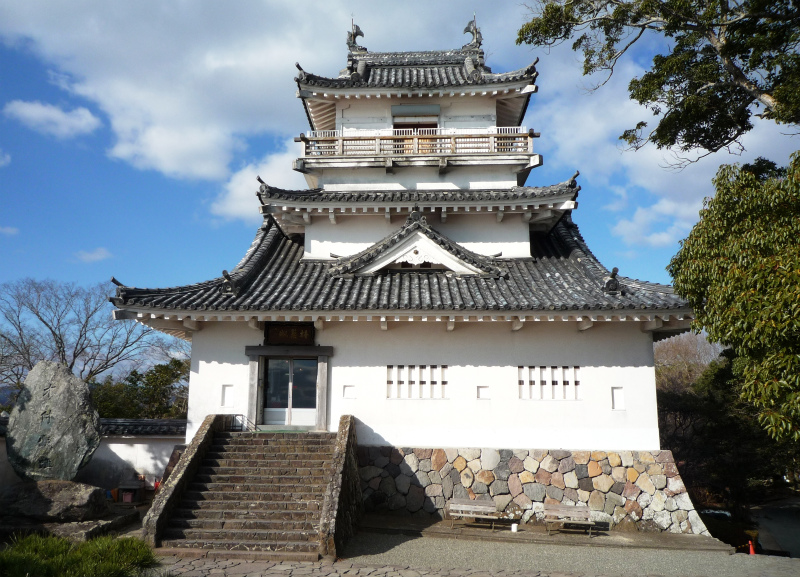
Kitsuki Castle ranks #3,609 of 9,040 worldwide in the atlas's castle fame ranking, and #182 of the 295 mapped in Japan. Founded 1394, it is older than 52% of the atlas's dated landmarks, one of 758 atlas entries founded in the 14th century. Its Wikipedia articles were opened 2,365 times in the last 60 days, more than 73% of the atlas. 2 more atlas landmarks stand within 25 km. It is one of the 37 landmarks on the atlas's regional map of Kyushu. See how Japan compares in the castle statistics.
Kitsuki Castle (杵築城, Kitsuki-jō) is an Edo period yamajiro-style Japanese castle located in the city of Kitsuki, Ōita Prefecture, Japan. Its ruins have been protected as a National Historic Site since 2020. The current castle, a replica tenshu built in 1970, is considered to be the smallest castle in Japan.
Kitsuki Castle is located on Shiroyama hill on the southern seashore of the Kunisaki Peninsula in Kyushu in what was once northern Bungo Province. The castle is situated on a long and narrow hill about 200 meters in length. Its elevation is only between 20 and 30 meters, but as the slopes of the hill are steep cliffs and the site was seen to be protected on either side by the Yasaka-gawa and Takayama-gawa rivers, the location was considered a natural fortress.
The original castle was constructed at this location in 1394 by the Kitsuki clan, a cadet branch of the Ōtomo clan, who had been dispatched as shugo of the province by the Kamakura shogunate. Initially, the Kitsuki clan established their stronghold at Takeno Castle 10 kilometers upstream, but Kitsuki Yorinao relocated it to the coast and constructed a new jōkamachi to better control the port.
In the Sengoku period, Kitsuki Shigenao was an important retainer of Ōtomo Sōrin, who directly or indirectly controlled northern half of Kyushu. However, the Ōtomo were defeated by the aggressive Shimazu clan in a series of battles in Hyūga Province, losing most of the territory and many of their retainers, including their capital of Funai (modern-day Ōita city) in 1587. However, the Kitsuki clan withstood a two-month siege by Shimazu forces and remained in the hands of the Kitsuki clan until after Toyotomi Hideyoshi's conquest of Kyushu. The Ōtomo were restored to control of Bungo Province; however, Ōtomo Yoshimune was subsequently accused of cowardice during the Japanese invasions of Korea (1592–1598) and was dispossessed.
At that time, the Kitsuki clan was dispossessed and its leaders killed themselves. Toyotomi Hideyoshi subsequent awarded the castle to Sugihara Nagafusa, a marriage relative of Hideyoshi, built hillside residence at the north of the hill. At the beginning of the Edo Period, the castle was maintained as a secondary fortification by Hosokawa Tadaoki, who was at the time the daimyō of Kokura Domain.
Text adapted from “Kitsuki Castle” on Wikipedia, CC BY-SA 4.0.
View on the interactive castle map →