 Iran · 17th century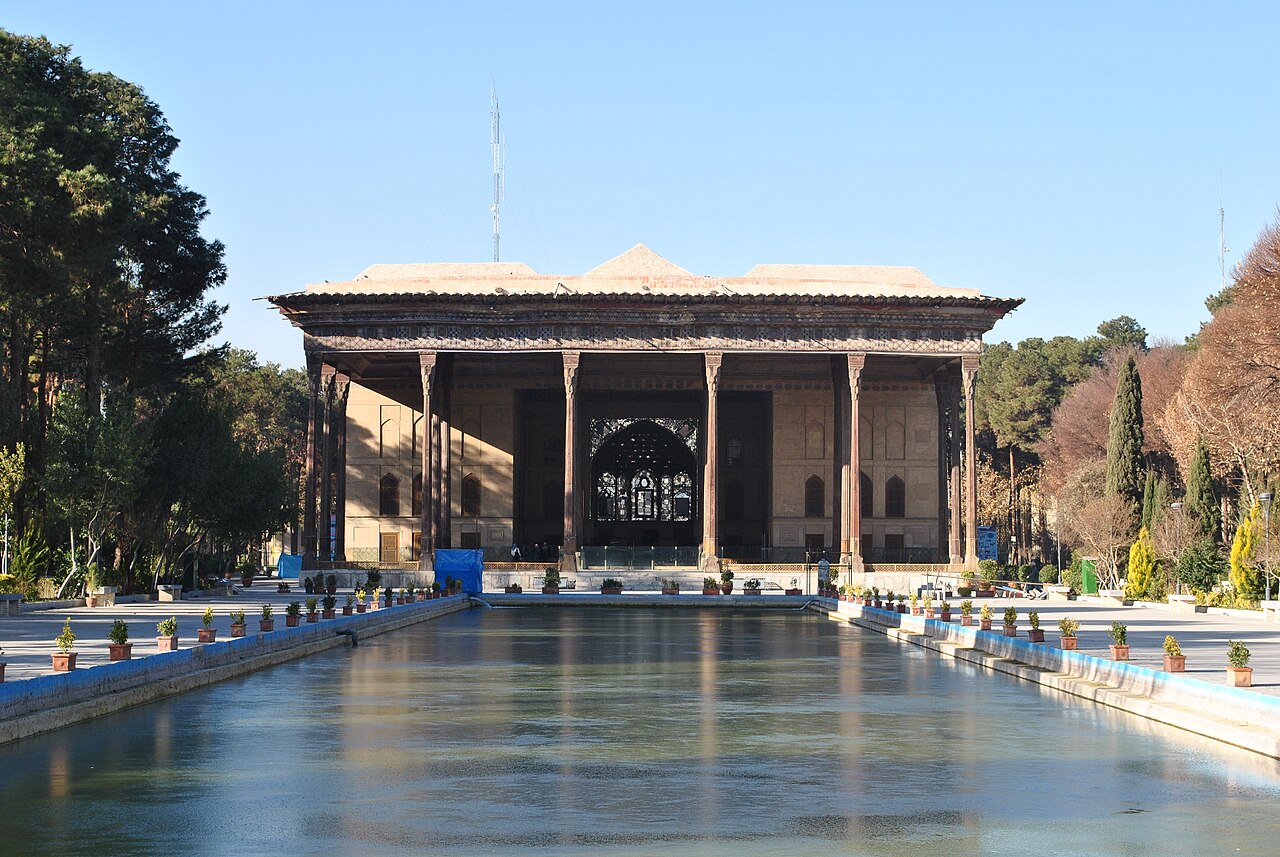
Chehel Sotoun (Persian: چهلستون, lit. 'Forty Columns') is a 17th century pavilion and garden, in Isfahan, Iran. It was commissioned by Abbas the Great and completed by Shah Abbas II, both Safavid Shahs, mostly for royal entertainment and receptions. Chehel Sotoun Garden, along with eight other gardens all located in Iran, have been inscribed as Persian Gardens World Heritage Sites since 2011.
As with the Ali Qapu, the palace contains many frescoes and paintings on ceramic. Many of the ceramic panels have been dispersed and are now in the possession of major museums in the West. Four of the major frescoes are thought to have been painted circa 1650, and in any case between 1647 (date of the construction of the Chehel Sotoun) and 1666, based on stylistic grounds, and on the fact that Jean Chardin described the specific paintings as "three royal entertainments and one battle scene" during his visit in 1666. They were commissioned by the Safavid ruler Abbas II. They are:
There are also more recent paintings, generally dating to Qajar era, such as the infamous Battle of Chaldiran against the Ottoman Sultan Selim I, and Nader Shah's victory against the Indian Army at Karnal in 1739. There are also less historical, but more aesthetic compositions in the traditional miniature style, themed around life, love, and joy.
In the pavilion, the combined designs of the walls and ceiling of the hall, which are placed in Lachak Toranj (corner and medallion), and the main lines of the building divisions, which are a combination of painting, tiling, ayeneh-kari, and various other decorations, make the building one of the best examples of Persian architecture during the Safavid era. At present, the mansion operates as a museum; and its central hall displays some works of art from different periods of Iran.
Text adapted from “Chehel Sotoun” on Wikipedia, CC BY-SA 4.0.
Chehel Sotun ranks #352 of 9,079 worldwide in the atlas's castle fame ranking, and #5 of the 173 mapped in Iran. Founded c. 1650, it is older than 25% of the atlas's dated landmarks — one of 721 atlas entries founded in the 17th century. Its Wikipedia articles were opened 9,809 times in the last 60 days, more than 93% of the atlas. 5 more atlas landmarks stand within 25 km. The nearest day-trip guide is Isfahan, 1 km away. See how Iran compares in the castle statistics.
View on the interactive castle map →