Ruin
Anhalt Castle
🇩🇪 Germany · 12th century
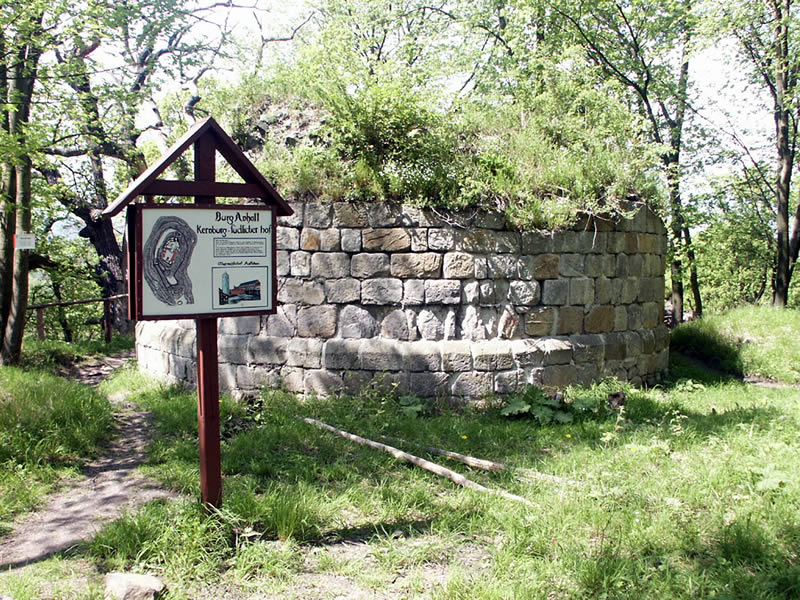
Anhalt Castle (German: Burg Anhalt) is a ruined medieval fortification near the town of Harzgerode in Saxony-Anhalt, Germany.
The castle is located in the eastern, lower part of the Harz mountain range (Unterharz). The ruins stand on the Großer Hausberg, a hill situated between the villages of Meisdorf and Mägdesprung, above the Selke valley. The area is part of the Harz/Saxony-Anhalt Nature Park; at a short distance up the Selke river is the preserved Falkenstein Castle.
The fortress was probably built by Count Otto of Ballenstedt (d. 1123), a member of the Saxon noble House of Ascania. Otto's grandfather Count Esico, mentioned in a 1036 deed issued by Emperor Conrad II, had ruled in the Saxon Schwabengau and the adjacent territories of the Saxon Eastern March. Otto assumed comital rights in Saxony after the assassination of his father Count Adalbert II in 1080; he married Eilika, the daughter of Duke Magnus of Saxony, and launched several campaigns against the Polabian Slavs. Shortly before his death, he turned the collegiate church in Ballenstedt into a Benedictine abbey and had Anhalt Castle erected as the dynasty's ancestral seat, from which the Ascanian Principality of Anhalt got its name.
The castle was first mentioned in 1140: while Otto's son Albert the Bear fought for the Saxon ducal title against the rivalling Welf dynasty, the fortress was devastated by the forces of the Archbishop of Magdeburg and Margrave Conrad of Meissen. Shortly afterwards, however, Albert had it rebuilt. The new castle complex was one of the mightiest fortifications in the Harz region. The scale of the castle was comparable to that of the Wartburg in Thuringia. The dry moat with its outer rampart (the Vorwall) that surrounded the castle, had a length of 543 metres (1,781 ft). This castle was built of brick, a material uncharacteristic of its time and the area. According to legend, the name is derived from Middle Low German: An-Holt, "(built) without wood".
The castle remained occupied until the early 14th century and afterwards decayed. Early excavations were initiated by Duke Alexius of Anhalt-Bernburg in 1822. From 1901 to 1907 excavations were carried out on the site of the ruins under the direction of the Brunswick surveyor, Brinckmann.
Text adapted from “Anhalt Castle” on Wikipedia, CC BY-SA 4.0.
Anhalt Castle ranks #3,975 of 8,134 worldwide in the atlas's castle fame ranking, and #309 of the 505 mapped in Germany. Founded c. 1123, it is older than 85% of the atlas's dated landmarks — one of 564 atlas entries founded in the 12th century. Its Wikipedia articles were opened 1,804 times in the last 60 days, more than 64% of the atlas. 5 more atlas landmarks stand within 25 km. See how Germany compares in the castle statistics.
View on the interactive castle map →Frequently asked questions
Where is Anhalt Castle?
Anhalt Castle stands in Germany, at 51.6692°, 11.1927°.
When was Anhalt Castle built?
The atlas dates its founding to c. 1123. Earlier structures may have stood on the site; this is the earliest documented founding year.
How famous is Anhalt Castle?
In this atlas's fame ranking: #3,975 of 8,134 worldwide, and #309 in Germany. Fame here combines how many Wikipedia language editions cover a landmark with how many people read them.
What is the nearest castle to Anhalt Castle?
Falkenstein Castle (Harz), about 5 km away.
More castles in Germany
- Hohengeroldseck Germany · 13th century
- Zwingenberg Castle Germany · 14th century
- Heldburg Fortress Germany · 16th century
- Windeck Castle Germany · 12th century
More ruins
- Riberhus Denmark
- Château du Hohlandsbourg France · 13th century
- Château de l'Ortenbourg France · 13th century
- Château de Vendôme France · 10th century