 Russia · 18th century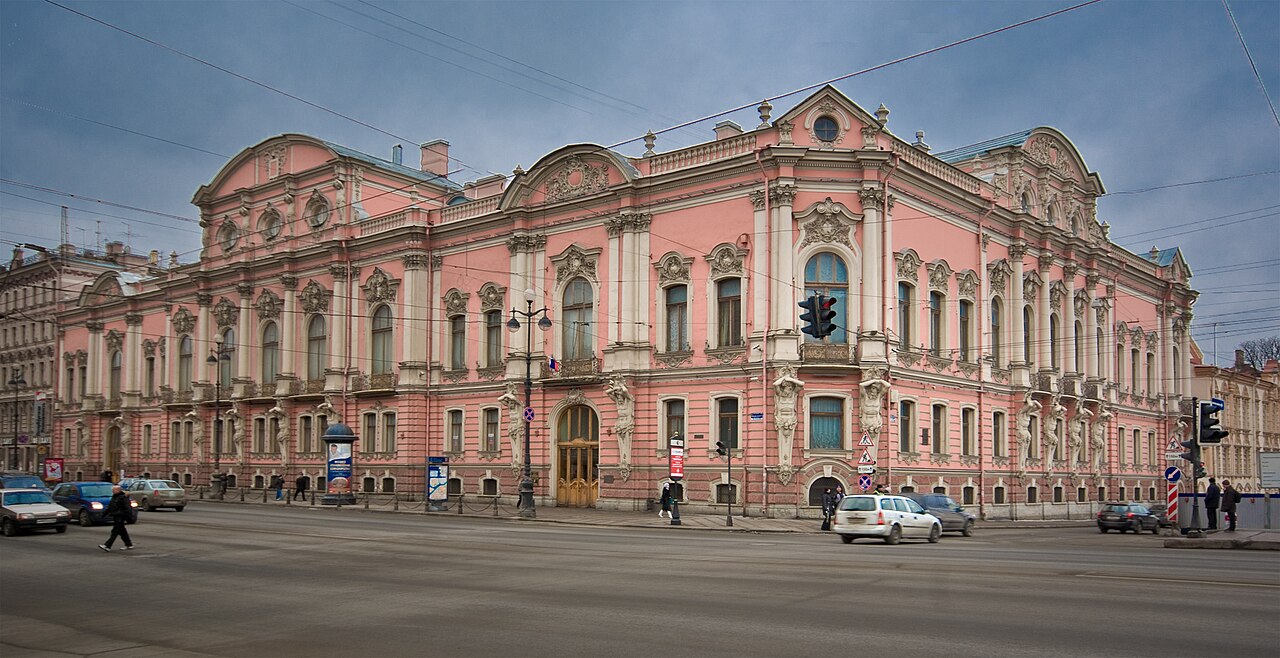
Beloselsky Belozersky Palace (Russian: Дворе́ц Белосе́льских-Белозе́рских; also known before the Revolution as the Palace of the Grand Duchess Elizabeth Fyodorovna, the Sergei Palace, and the Dmitry Palace) is a rococo revival palace at the intersection of the Fontanka River and Nevsky Prospekt in St. Petersburg, Russia.
The first Beloselsky-Belozersky Palace was built on Nevsky Prospekt in 1747 for Prince Mikhail Andreevich Beloselsky (1702–1755) during the reign of Elizabeth of Russia; the building, far smaller than it is today, was designed in the French style with a large private garden and a launch onto the canal, stuccoed and painted in imitation of Parisian limestone.
Inherited by his son - Prince Alexander Mikhailovich Beloselsky (1752–1809) - it was he that bought a plot of land in 1800 which allowed the building to be greatly extended. Prince Alexander Mikhailovich was a close friend, supporter and devoted servant of Paul I of Russia. Through his Ukaze (Decree) in year 1800, Paul I assured the revival of the ancient title of Princes of Belozersk by authorizing Alexander Mikhailovich Beloselsky to use and add the Belozersky title and name to him and his descendants (other branches of Belozersk Princes had died out). It is from this point on in time the family is known as the Beloselsky-Belozersky Белосельский-Белозерский. The Rurikid princely double name Beloselsky-Belozersky is also given to their palace.
Alexander Mikhailovich' second wife, Anna Grigorievna (born Kozitskaya; her father was Secretary of State to Catherine II, Gregory Vasilievich Kozitsky; he was also rector of Moscow University. Anna Grigorievna's portrait by the well-known French and Russian court portrait painter Élisabeth Louise Vigée Le Brun is in Washington DC's National Museum of Women in the Arts) was an heiress of a great fortune through her mother, Ekaterina Ivanovna Myasnikova (major south Urals area metals and mining heiress from the Myasnikov-Tverdychev families, e.g. Yuryuzan, Ust-Katav, Katav-Ivanovsk, Nizhnyi Tagil, Beloretsk). This allowed further purchases of land in St. Petersburg, including the Krestovsky island as well as further additions to the Beloselsky-Belozersky palace.
The palace passed down the family line to Esper Alexandrovich Beloselsky-Belozersky (son of Alexander Mikhailovitch) who died at a young age.
Text adapted from “Beloselsky-Belozersky Palace” on Wikipedia, CC BY-SA 4.0.
Beloselsky-Belozersky Palace ranks #1,074 of 9,079 worldwide in the atlas's castle fame ranking, and #42 of the 146 mapped in Russia. Founded 1747, it is older than 18% of the atlas's dated landmarks — one of 696 atlas entries founded in the 18th century. Its Wikipedia articles were opened 4,672 times in the last 60 days, more than 85% of the atlas. 32 more atlas landmarks stand within 25 km. The nearest day-trip guide is Saint Petersburg, 2 km away. See how Russia compares in the castle statistics.
View on the interactive castle map →