Palace & château
Jal Mahal (Narnaul)
🇮🇳 India · 16th century
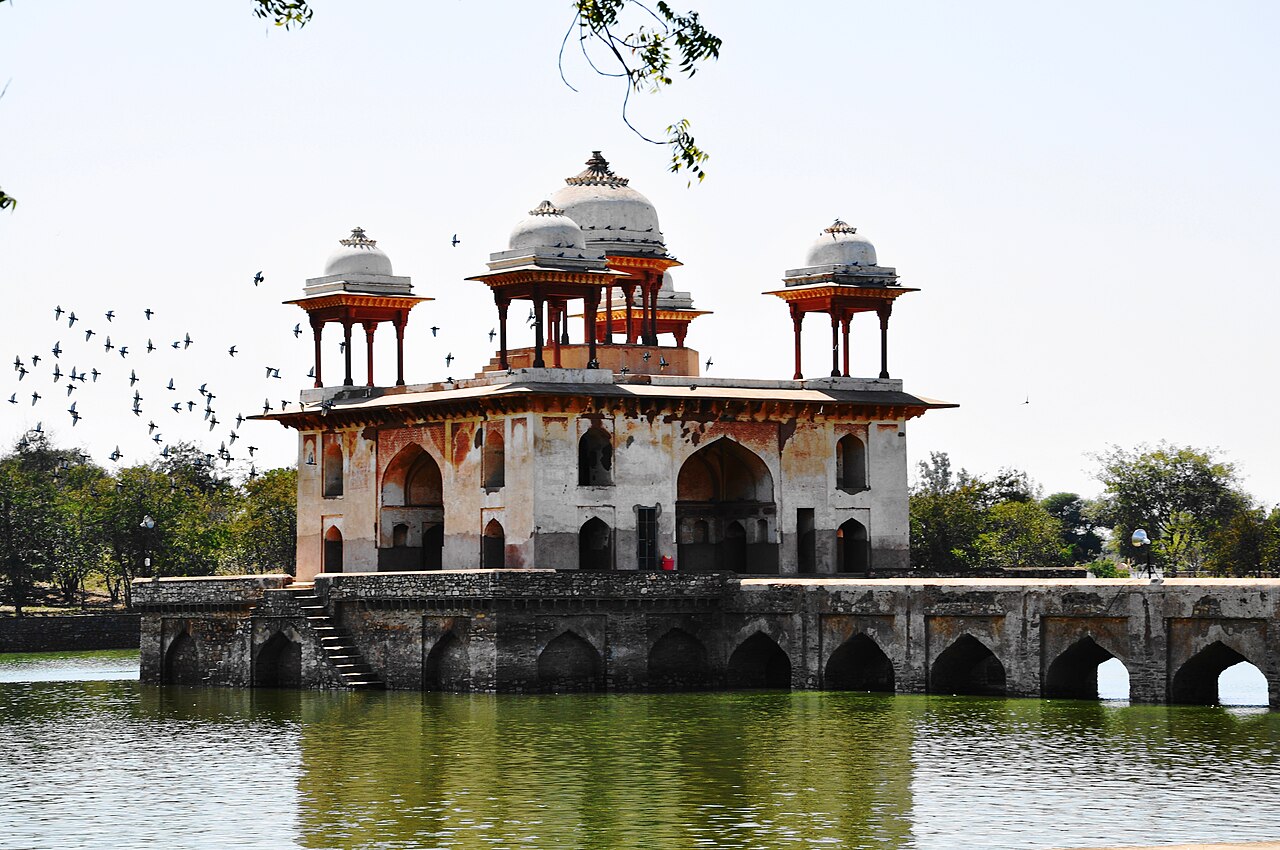
The Jal Mahal, also known as the Jal Mahal of Narnaul or the Water Palace, is a late 16th century palace, fortification, and artificial lake located in Narnaul, Haryana, India. Built by a Mughal governor of Narnaul, the structure currently serves as a tourist attraction.
The Jal Mahal was built in 1591 AD by Shah Quli Khan, a member of the nobility of the Mughal empire and the governor of Narnaul. Khan was a protegee of Bairam Khan, an important official in the Mughal court and one-time regent of the empire. He was also a successful military commander who served in the Mughal army under Akbar the Great. The campaigns of Akbar to conquer northern India made Khan wealthy, and the commander distinguished himself by wounding the Suri general Hemu at the Second Battle of Panipat. In gratitude for Khan's service, Akbar granted him titles, wealth, and appointed him as the governor of Narnaul.
In addition to being a competent military leader, Khan was a noted architectural patron. Upon being appointed governor, he began a series of construction projects in Narnaul; these projects, the first of which was a tomb (built 1574-75) for himself, are described as being of a "personal sort" and as being different from some of his projects elsewhere in India; furthermore, Khan's projects were noteworthy enough to be recorded in contemporary Mughal texts.
15 years after completing his tomb, Khan began to construct a new palace in Narnaul; this structure became what is now the Jal Mahal. Khan began by creating a square artificial lake (often described as a tank or reservoir) with an island in the center; this lake was intended to form a "second Kausar" (the Pond of Abundance in Muslim paradise) for the palace's occupants. Khan then ordered the construction of a fortified gateway on the northern edge of the lake. Following this, a causeway was built out into the center of the reservoir, where a foundation was laid and a palace built. The construction of the Jal Mahal, its gate, and the lake took 2–3 years.
The palace itself was decorated in the style of other Mughal palaces and pavilions; the structure was adorned with art and carvings, including inscriptions that celebrated Khan's famous victory over Hemu. In terms of area, the compound encompasses 11 acres.
In the centuries after its completion, the palace's pool gradually filled with earth.
Text adapted from “Jal Mahal (Narnaul)” on Wikipedia, CC BY-SA 4.0.
Jal Mahal (Narnaul) ranks #5,014 of 8,764 worldwide in the atlas's castle fame ranking, and #177 of the 220 mapped in India. Founded 1591, it is older than 35% of the atlas's dated landmarks — one of 827 atlas entries founded in the 16th century. It is one of the 31 landmarks on the atlas's regional map of Rajasthan. See how India compares in the castle statistics.
View on the interactive castle map →Frequently asked questions
Where is Jal Mahal (Narnaul)?
Jal Mahal (Narnaul) stands in India, at 28.02835°, 76.10192°.
When was Jal Mahal (Narnaul) built?
The atlas dates its founding to 1591. Earlier structures may have stood on the site; this is the earliest documented founding year.
How famous is Jal Mahal (Narnaul)?
In this atlas's fame ranking: #5,014 of 8,764 worldwide, and #177 in India. Fame here combines how many Wikipedia language editions cover a landmark with how many people read them.
What is the nearest castle to Jal Mahal (Narnaul)?
Bhangarh Fort, about 105 km away.
More castles in India
- Kavaledurga Fort India · 9th century
- Lotus Mahal Pavilion India
- Mirjan Fort India
- Narnala Fort India · 10th century
More palaces & châteaux
- Rajwada palace India · 18th century
- Corvaja Palace Italy · 14th century
- Ducal Palace of Guastalla Italy · 16th century
- Ducal Palace, Lucca Italy