Ruin
Baynard's Castle
ENG England · 11th century
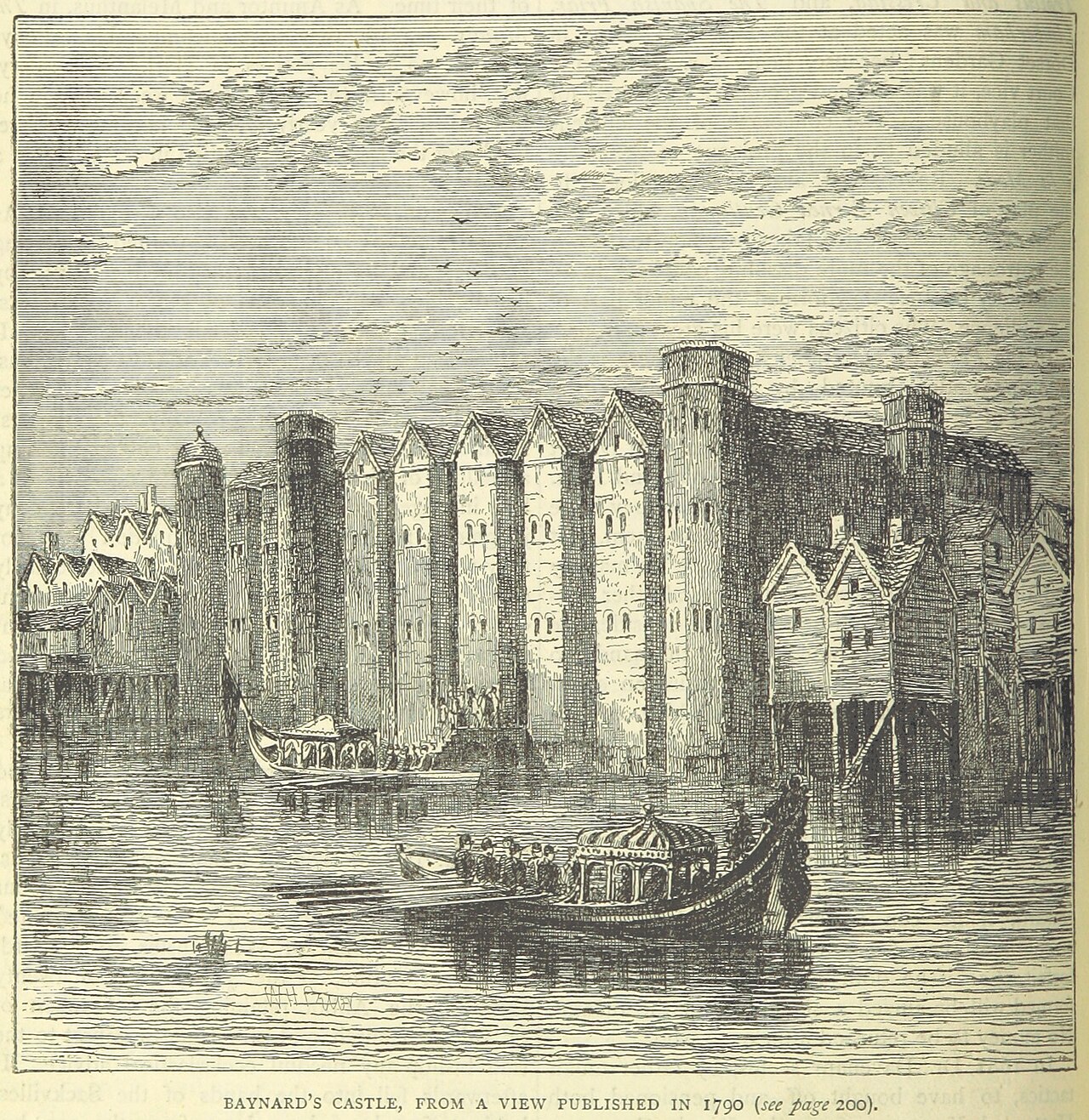
Baynard's Castle refers to buildings on two neighbouring sites in the City of London, between where Blackfriars station and St. Paul's Cathedral now stand. The first was a Norman fortification constructed by Ralph Baynard (fl. 1086), 1st feudal baron of Little Dunmow in Essex, and was demolished by King John in 1213. The second was a medieval palace built a short distance to the south-east and later extended, but mostly destroyed in the Great Fire of London in 1666. According to Sir Walter Besant, "There was no house in [London] more interesting than this".
The original castle was built at the point where the old Roman walls and River Fleet met the River Thames, just east of what is now Blackfriars Station. The north wall of the castle used as its foundation the Roman-era river wall from the 3rd century, distinguished by a tile-course of Roman brick. The Norman castle stood for over a century before being demolished by King John in 1213. It appears to have been rebuilt after the Barons' Revolt, but the site was sold in 1276 to form the precinct of the great Blackfriars' Monastery.
About a century later, a new mansion was constructed on land that had been reclaimed from the Thames, south-east of the first castle. The house was rebuilt after 1428, and became the London headquarters of the House of York during the Wars of the Roses. The accession of King Edward IV was agreed and proclaimed in the castle on 3 March 1461.
The house was reconstructed as a royal palace by King Henry VII (1485–1509) at the end of the 15th century, and his son Henry VIII gave it to Katherine of Aragon on the eve of their wedding. In 1551, after Henry's death in 1547 and during the reign of King Edward VI, the house was granted to William Herbert, 1st Earl of Pembroke (1501–1570), brother-in-law of Henry's widow, Queen Katherine Parr.
Text adapted from “Baynard's Castle” on Wikipedia, CC BY-SA 4.0.
Baynard's Castle ranks #1,945 of 8,134 worldwide in the atlas's castle fame ranking, and #128 of the 333 mapped in England. Founded 1017, it is older than 92% of the atlas's dated landmarks — one of 325 atlas entries founded in the 11th century. Its Wikipedia articles were opened 5,439 times in the last 60 days, more than 86% of the atlas. 25 more atlas landmarks stand within 25 km. The nearest day-trip guide is London, 2 km away. See how England compares in the castle statistics.
View on the interactive castle map →Frequently asked questions
Where is Baynard's Castle?
Baynard's Castle stands in England, at 51.51139°, -0.1°.
When was Baynard's Castle built?
The atlas dates its founding to 1017. Earlier structures may have stood on the site; this is the earliest documented founding year.
How famous is Baynard's Castle?
In this atlas's fame ranking: #1,945 of 8,134 worldwide, and #128 in England. Fame here combines how many Wikipedia language editions cover a landmark with how many people read them.
What is the nearest castle to Baynard's Castle?
Ludgate, about 1 km away.
More castles in England
- Saltwood Castle England · 11th century
- Broughton Castle England
- Edlingham Castle England · 16th century
- Greys Court England · 14th century
More ruins
- Dryslwyn Castle Wales · 13th century
- Loughor Castle Wales · 12th century
- Midhope Castle Scotland · 16th century
- Newcastle Emlyn Castle Wales · 13th century